Most arbitration exists because two parties agreed to it. Statutory arbitration exists because a legislature decided that a category of disputes should be resolved by arbitration, and wrote the rules, the procedure or the obligation to arbitrate into law. That single difference in the source of authority changes almost everything a party needs to know: whether it can refuse to arbitrate, who appoints the tribunal, how much procedural freedom it has, how far the courts can review the outcome and whether the award will be recognised abroad. Within Handle’s Law & Arbitration practice, statutory arbitration is understood as a hybrid: private adjudication operating inside a framework that the state has designed for its own policy reasons, such as protecting a regulated sector, keeping essential services running or relieving congested courts. Understanding which kind of arbitration applies is the first strategic question in any such dispute. Consent creates commercial arbitration. Statute creates statutory arbitration.
What Is Statutory Arbitration?
Statutory arbitration is arbitration that is created, required, authorised or substantially governed by legislation, rather than arising solely from a private arbitration agreement. The tribunal’s authority comes, in whole or in part, from the statute itself.
Legislation can play several roles. It may require that particular disputes be arbitrated, so that court proceedings are unavailable or available only after arbitration. It may establish a specialised arbitral body or panel for a sector. It may prescribe how arbitrators are appointed, what qualifications they must hold, which procedural steps apply and how quickly the award must be issued. It may also define the scope of appeal or review, sometimes more broadly than ordinary arbitration law allows.
It is important to distinguish statutory arbitration from the general arbitration law that every jurisdiction maintains. A general arbitration statute, such as an enactment based on the UNCITRAL Model Law, supports and regulates arbitration that the parties have chosen. It does not compel anyone to arbitrate. Statutory arbitration, in the sense used here, goes further: the legislation supplies the reason the dispute is in arbitration at all, or dictates the shape of the process in ways the parties cannot change.
How Does Statutory Arbitration Differ From Commercial Arbitration?
The two forms share the core features of arbitration: a neutral tribunal, a private process and a binding decision. They differ in where authority comes from and how much control the parties retain.
| Feature | Commercial Arbitration | Statutory Arbitration |
|---|---|---|
| Source of authority | The parties’ written arbitration agreement | Legislation, sometimes alongside an agreement |
| Can a party refuse to arbitrate? | Yes, unless it has agreed to arbitrate | Often no, where the statute makes arbitration mandatory |
| Tribunal appointment | Chosen by the parties or under agreed rules | Often prescribed by statute or a designated body |
| Procedural flexibility | High; parties tailor the procedure | Lower; timelines and steps may be fixed by law |
| Court review | Narrow, usually limited to set-aside grounds | Defined by the statute; can be broader |
| Cross-border enforcement | Strong under the New York Convention | Can be uncertain where no arbitration agreement exists |
Why Do Legislatures Use Statutory Arbitration?
Governments and regulators turn to statutory arbitration when they want disputes in a particular field resolved by specialists, quickly and consistently, without leaving the design of the process to private bargaining. Common policy motivations include the need for technical expertise in complex sectors, the protection of continuity in essential services, the reduction of court backlogs, consistency of outcomes across an industry and, in some fields, the protection of weaker parties who might otherwise lack an effective forum.
The trade-off is party autonomy. The more the legislature prescribes, the less room the parties have to choose their arbitrators, set their timetable or agree the procedure. For businesses, statutory arbitration is therefore not a forum they select. It is a feature of the regulatory environment they operate in, and it should be understood before a dispute arises.
Where Is Statutory Arbitration Commonly Used?
The fields in which statutory arbitration appears vary between jurisdictions, but several recur internationally.
Labour and public-sector employment. Some jurisdictions require interest arbitration or compulsory arbitration for collective disputes, particularly in essential public services where strikes are restricted. The aim is to resolve disputes over pay and conditions without interrupting services.
Construction and infrastructure. Several jurisdictions impose statutory mechanisms to keep cash flowing on construction projects. Many of these are adjudication schemes rather than arbitration, such as the regime introduced in England and Wales by the Housing Grants, Construction and Regeneration Act 1996, which produces decisions binding on an interim basis until finally determined by arbitration or litigation. The distinction matters, because an adjudicator’s decision does not carry the finality of an arbitral award.
Utilities and regulated industries. In telecommunications, energy and transport, legislation may refer access, pricing or interconnection disputes to arbitration or to a specialist regulatory panel, so that technical questions are decided by people with sector expertise.
Insurance, consumer and financial disputes. Some legal systems route certain insurance or consumer claims to statutory arbitration or to ombudsman-style bodies to improve access and speed. Here too, the label matters: many of these bodies are not arbitral tribunals and their decisions have a different legal status.
Mandatory and Voluntary Statutory Arbitration
Statutory arbitration takes two broad forms. Mandatory statutory arbitration removes the choice: the statute requires the dispute to be arbitrated, and court proceedings are either unavailable or deferred until arbitration has been completed. Voluntary statutory arbitration provides a legislated framework that parties may elect to use. The statute supplies the infrastructure, such as a panel of arbitrators, procedural rules and enforcement provisions, but the parties still decide whether to enter it.
Mandatory schemes attract the sharpest scrutiny. Questions of access to courts, procedural fairness and imbalance of bargaining power are most acute where a weaker party, such as an employee or a consumer, is compelled into a process it did not choose. Legislatures often respond by widening rights of appeal or judicial review, which in turn reduces the finality that makes arbitration attractive.
The Role of the Courts
Statutory arbitration does not exclude the courts. They remain involved in enforcement, in policing jurisdiction and procedural fairness, and in hearing any appeals that the statute permits. The extent of that involvement is set by the legislation rather than by the parties. Some statutory schemes allow appeals on points of law or even on the merits, going further than general arbitration statutes, which typically confine court intervention to narrow grounds for setting aside an award.
Enforcement across borders raises a distinct issue. The New York Convention is built on recognition of written arbitration agreements. Where an award results from compulsory arbitration imposed by statute, with no agreement between the parties, a foreign court may question whether the Convention applies at all. Statutory arbitration is therefore often most effective within the jurisdiction that created it, and parties with assets abroad should consider how an award would be enforced there.
A Worked Example: Comparing the Two Routes
Consider an illustrative payment dispute of AED 6 million between a contractor and a regulated utility over additional works on a network upgrade. Assume, for illustration, that a sector statute provides a mandatory arbitration panel with a 120-day timetable and an appeal on points of law, while the parties’ contract also contains a conventional arbitration clause.
| Question | Statutory Panel Route | Contractual Arbitration Route |
|---|---|---|
| Which route governs? | The statute, if its scope covers the dispute | The clause, only if the statute does not displace it |
| Tribunal | Panel members with sector expertise | Arbitrators chosen by the parties |
| Illustrative timetable | About 120 days to award | Commonly 12 to 18 months |
| Review | Appeal on points of law | Set-aside on limited grounds only |
| Enforcement abroad | Potentially uncertain | Under the New York Convention |
The contractor’s first task is not to argue the merits. It is to determine whether the statute applies to this dispute and, if so, whether it overrides the contractual clause. A party that starts in the wrong forum can lose months and face a jurisdictional challenge before the substantive claim is heard.
Statutory Arbitration in the UAE
In the UAE, arbitration is primarily consensual. The general regime onshore is the Federal Arbitration Law (Federal Law No. 6 of 2018, as amended by Federal Law No. 15 of 2023), which requires a written arbitration agreement and supplies default procedural rules where the parties have not agreed otherwise. An onshore award may be challenged by an application to set it aside within 30 days of notification under Article 54, before the competent Court of Appeal, and is recognised and enforced under Article 55 together with the Civil Procedure Law (Federal Decree-Law No. 42 of 2022). The financial free zones have their own regimes: the DIFC Arbitration Law No. 1 of 2008, under which a set-aside application must be made within three months to the DIFC Courts, and the ADGM Arbitration Regulations 2015, administered by the ADGM Courts. The UAE has been party to the New York Convention since 2006.
Several specialised dispute mechanisms in the UAE are created by legislation, but many of them are not arbitration. Tenancy disputes in Dubai, for example, are heard by the Rental Disputes Settlement Centre, and employment claims onshore pass through the Ministry of Human Resources and Emiratisation before reaching the courts. These bodies operate under their own statutes and their decisions are subject to their own review routes. Parties should not assume that an arbitration clause will displace them, and should check whether a specialised forum has exclusive jurisdiction before commencing arbitration. Government counterparties may also be subject to emirate-level rules requiring approval before they agree to arbitrate, which affects the validity of the arbitration agreement itself.
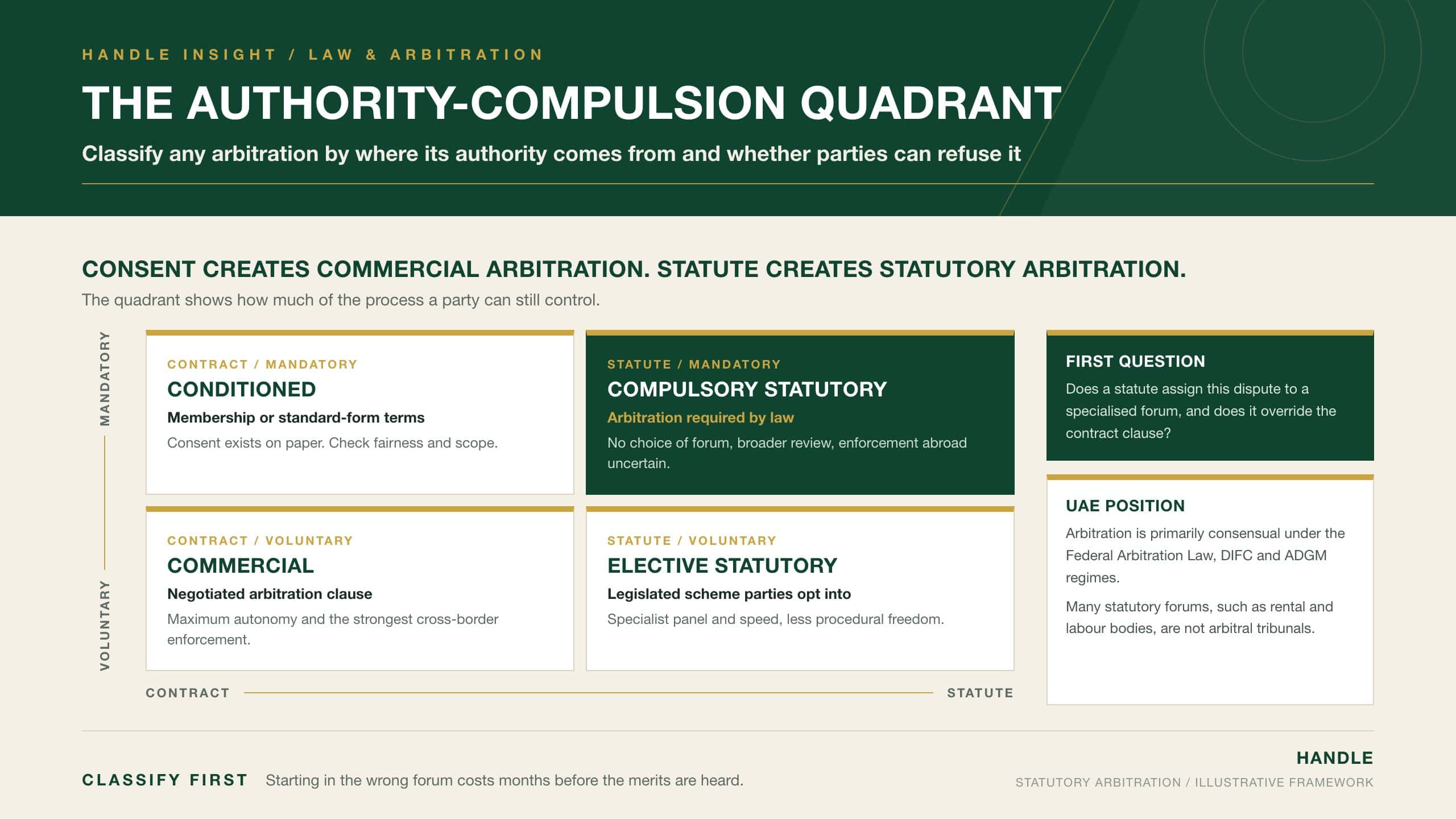
Original Analysis: The Authority-Compulsion Quadrant
A practical way to classify any arbitration is to ask two questions. Where does the tribunal’s authority come from: a contract or a statute? And is participation voluntary or mandatory? The answers place the process in one of four quadrants, each with different implications for strategy.
| Quadrant | Authority and Participation | Typical Form | Strategic Implication |
|---|---|---|---|
| Commercial | Contract, voluntary | Negotiated arbitration clause | Maximum autonomy and strongest cross-border enforcement |
| Conditioned | Contract, effectively mandatory | Arbitration required by membership or standard-form terms | Consent exists on paper; check fairness and scope |
| Elective statutory | Statute, voluntary | Legislated scheme the parties may opt into | Specialist panel and speed, with less procedural freedom |
| Compulsory statutory | Statute, mandatory | Arbitration required by law | No choice of forum; broader review; enforcement abroad uncertain |
The quadrant tells a party what it can control. In the commercial quadrant, almost everything is negotiable. In the compulsory statutory quadrant, almost nothing is, and the strategy shifts toward understanding the statute’s scope, its review rights and the practical value of the award where the counterparty’s assets sit.
Common Mistakes in Statutory Arbitration
- Assuming that a contractual arbitration clause prevails over a statute that assigns the dispute to a specialised forum.
- Confusing statutory adjudication, ombudsman schemes or administrative committees with arbitration, and expecting the same finality.
- Overlooking statutory time limits for commencing the process, which can be shorter than ordinary limitation periods.
- Planning cross-border enforcement as if the New York Convention will apply automatically to an award produced by compulsory arbitration.
- Ignoring the broader rights of appeal that some statutes grant, which can extend the life of the dispute.
- Contracting with a government entity without confirming that it was authorised to agree to arbitration.
Each mistake begins with the same error: treating the forum as a matter of contract when the law has already decided it.
Conclusion
Statutory arbitration is arbitration whose authority comes, in whole or in part, from legislation rather than from the parties’ agreement alone. Legislatures use it to bring specialist decision-makers, speed and consistency to sectors such as labour relations, construction, utilities, insurance and other regulated industries. The cost is autonomy: procedure, appointment and timetables may be fixed by law, review may be broader, and enforcement abroad may be less certain than for a conventional award under the New York Convention. In the UAE, arbitration remains primarily consensual under the Federal Arbitration Law, the DIFC Arbitration Law and the ADGM Arbitration Regulations, while many specialised statutory forums are committees or centres rather than arbitral tribunals. The first strategic step is classification: contract or statute, voluntary or mandatory. Everything else follows from that answer. Know the source of the tribunal’s authority. Then plan the case.