Every arbitration is governed by more than one body of law. One law governs the arbitration agreement, another governs the procedure at the seat, and a third, the substantive law, decides who is right. Substantive law in arbitration is the law the tribunal applies to the merits: whether a contract was breached, how its terms are read, which remedies are available and how much can be recovered. Within Handle’s Law & Arbitration practice, the choice of substantive law is treated as a commercial decision taken when the contract is negotiated, because it fixes the rules that will decide any dispute before a dispute exists. Parties often spend weeks on the price and minutes on the governing law clause. That allocation is usually wrong. The procedure decides how you argue. The substantive law decides whether you win.
What Is Substantive Law in Arbitration?
Substantive law in arbitration is the body of legal rules that a tribunal uses to determine the rights, obligations, liabilities and remedies of the parties. It governs the substance of the dispute rather than the way the arbitration is run.
In practice, the substantive law answers the questions on which the award turns. Did a breach occur? Is a clause valid and enforceable? Are damages recoverable, and on what measure? Is a limitation of liability effective? Has a defence such as force majeure or set-off been made out? Without a substantive law, the tribunal has no legal standard against which to measure the parties’ conduct.
In most commercial contracts, the substantive law is the law named in the governing law clause. The clause may select the law of a country, such as UAE law or English law, or the law of a common law jurisdiction within a country, such as the law of the Dubai International Financial Centre.
Substantive Law Versus Procedural Law
The most important distinction in arbitration is between the law that decides the dispute and the law that governs the process. Procedural law, often called the lex arbitri, is the arbitration law of the seat. It sets the framework for appointing and challenging arbitrators, the powers of the tribunal, the supervisory role of local courts and the grounds on which an award can be set aside. Institutional rules chosen by the parties then fill in the procedural detail within that framework.
| Question | Substantive Law | Procedural Law (Lex Arbitri) |
|---|---|---|
| What does it govern? | Rights, obligations, liability and remedies under the contract | Conduct of the arbitration and court supervision at the seat |
| How is it chosen? | Governing law clause in the main contract | Choice of seat in the arbitration clause |
| Typical issues | Breach, interpretation, damages, validity of clauses | Tribunal appointment, interim measures, evidence, set-aside |
| Who applies it? | The tribunal, on the merits | The tribunal and the courts of the seat |
| Effect on the award | Determines the outcome | Determines whether the award survives challenge at the seat |
The two are frequently different. A contract may be governed by English law, provide for arbitration seated in the DIFC, and adopt institutional rules. Each layer does a different job, and a dispute can be won or lost at any of them.
How Is Substantive Law Chosen?
Party autonomy is the starting point. The parties select the substantive law in the governing law clause, and the tribunal is bound to apply it. Under the UAE Federal Arbitration Law (Federal Law No. 6 of 2018, as amended by Federal Law No. 15 of 2023), the tribunal applies the rules of law agreed by the parties to the substance of the dispute. The arbitration regimes of the DIFC and ADGM, which are based on international model law principles, follow the same approach.
The choice should be express and complete. A clause that refers to the law of a country should make clear whether it means the law applied by that country’s onshore courts or the law of a financial free zone within it. In the UAE, “the laws of Dubai” is ambiguous in a way that “the laws of the Dubai International Financial Centre” or “the federal laws of the UAE as applied in the Emirate of Dubai” is not.
The parties may also authorise the tribunal to decide as an amiable compositeur or according to fairness, but tribunals will generally do so only where the parties have expressly agreed. Without that express authority, a tribunal that substitutes its own sense of fairness for the chosen law risks an award that can be challenged.
What Happens When No Substantive Law Is Chosen?
Where the contract is silent, the tribunal must determine the applicable law itself. Under the UAE Federal Arbitration Law, the tribunal applies the substantive rules of the law it considers most closely connected to the subject matter of the dispute. Other arbitration laws refer the tribunal to the conflict of laws rules it considers applicable.
The factors usually include the place where the contract was concluded, the place of performance, the location of the parties, the currency and language of the contract and, in some cases, the seat. None of these is decisive on its own. The result is a preliminary dispute about the applicable law that adds cost, delay and uncertainty to the main dispute. For that reason, sophisticated agreements always specify the governing law.
Why Substantive Law Changes Outcomes
Legal systems differ on points that decide large claims. Four areas matter most in commercial arbitration.
Contract interpretation. Some legal systems read a contract primarily by its words in their commercial context. Others give more weight to the common intention of the parties and to obligations of good faith in performance. UAE civil law, for example, requires contracts to be performed in good faith and allows a tribunal to look to the parties’ common intention where the words are unclear.
Damages and agreed compensation. Legal systems treat liquidated damages differently. Under UAE civil law, a court or tribunal may, on application, adjust agreed compensation so that it corresponds to the actual loss. Under English law, an agreed damages clause is generally enforced unless it is out of all proportion to the legitimate interest it protects.
Limitation and exclusion clauses. The validity of caps on liability, exclusions of consequential loss and time bars depends on the governing law. Some systems will not allow a party to exclude liability for fraud or gross fault, whatever the contract says.
Corporate and shareholder rights. In shareholder disputes, the law of the company’s place of incorporation usually governs internal matters such as directors’ duties and the validity of share transfers, even where the shareholders’ agreement chooses a different law. A tribunal may therefore apply two substantive laws to one dispute.
How Do Substantive Law and the Seat Interact?
The seat and the substantive law are independent choices. A contract can be governed by English law with an onshore Dubai seat, by UAE law with a DIFC seat, or by DIFC law with an ADGM seat. The seat determines which courts supervise the arbitration and hear any set-aside application. For an onshore UAE seat, an application to set aside must be brought before the competent Court of Appeal within 30 days of notification of the award. For a DIFC seat, the DIFC Courts have supervisory jurisdiction and the DIFC Arbitration Law (DIFC Law No. 1 of 2008) allows three months. For an ADGM seat, the ADGM Courts supervise under the ADGM Arbitration Regulations 2015.
The substantive law does not change the set-aside grounds, but it affects the risk of a challenge. If the chosen law conflicts with mandatory rules or public policy at the seat, the award becomes vulnerable there, whichever law the parties selected.
Mandatory Rules and Public Policy
Party choice has limits. Certain rules apply regardless of the law the parties select, because the state where the contract is performed or the award is enforced treats them as mandatory. Competition rules, sanctions, anti-corruption laws, employment protections and some real estate and commercial agency rules fall into this category.
Public policy also operates at enforcement. The UAE acceded to the New York Convention in 2006, and UAE courts recognise and enforce foreign awards under Article 55 of the Federal Arbitration Law and the civil procedure rules now contained in Federal Decree-Law No. 42 of 2022. Under the Convention and UAE law, recognition may be refused where the award is contrary to the public order of the enforcing state. A tribunal that applies the chosen law correctly can still produce an award that a court refuses to enforce if the result offends mandatory rules where the assets are located.
A Worked Example: The Same Clause Under Two Laws
Consider an illustrative construction subcontract worth AED 60 million with a liquidated damages clause of AED 100,000 per day of delay, capped at AED 6 million. The subcontractor finishes 50 days late, so the clause produces AED 5 million. The main contractor’s actual, provable loss is AED 1.2 million.
| Issue | Contract Governed by UAE Law | Contract Governed by English Law |
|---|---|---|
| Starting point | Agreed compensation applies | Agreed compensation applies |
| Subcontractor’s main argument | Ask the tribunal to reduce the amount to the actual loss | Argue the clause is an unenforceable penalty |
| Test applied | Whether the agreed sum corresponds to the loss suffered | Whether the sum is out of all proportion to a legitimate interest |
| Illustrative range of outcome | Closer to AED 1.2 million if the reduction is granted | Closer to AED 5 million if the clause is upheld |
The facts, the seat and the procedure are identical. The difference of up to AED 3.8 million comes entirely from the substantive law. That is why the governing law clause deserves the same attention as the price.
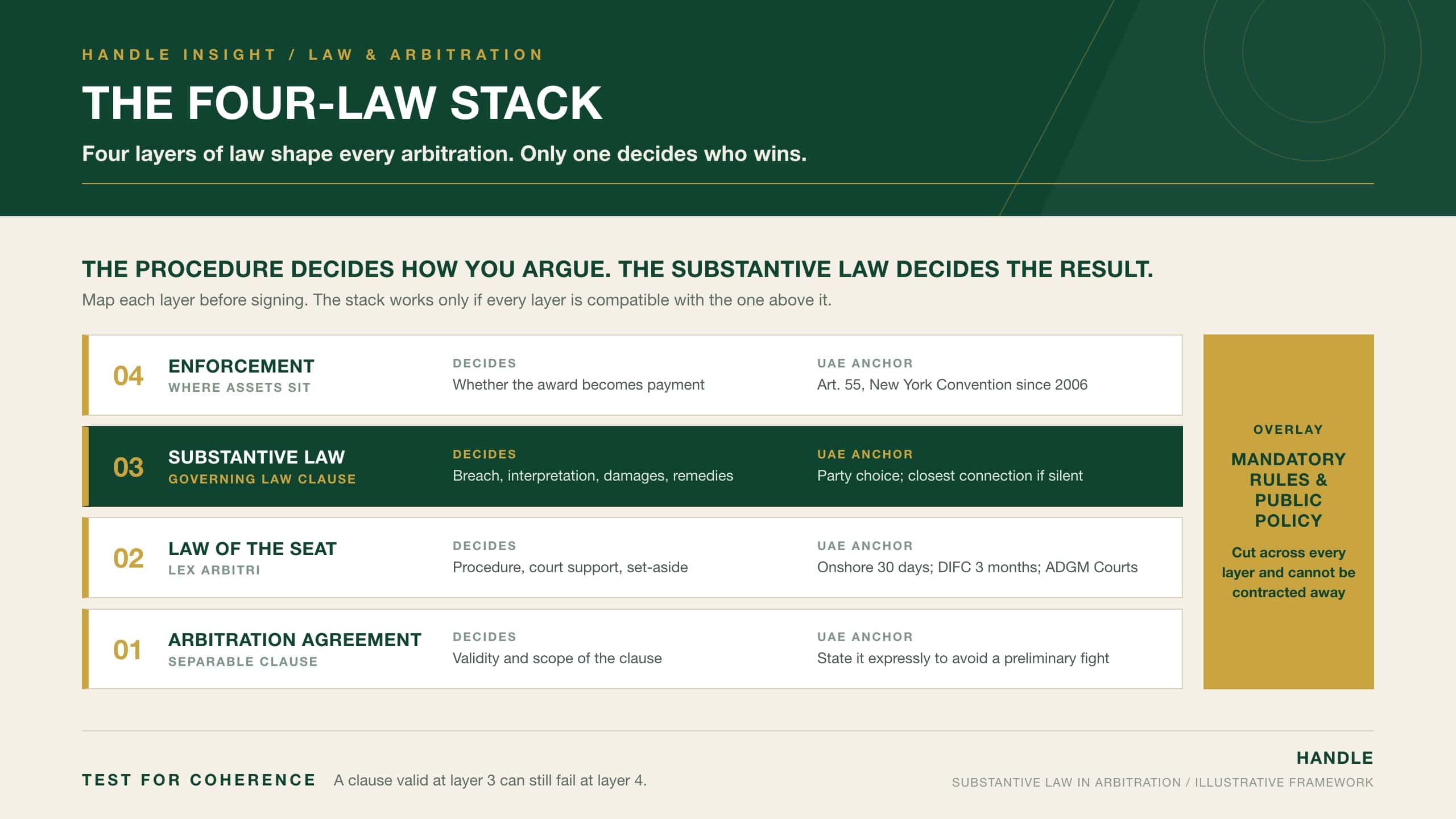
Original Analysis: The Four-Law Stack
The Four-Law Stack is a model for mapping every legal system that can affect an arbitration before the contract is signed. It treats the dispute as four layers, each with its own governing law, all sitting under an overlay of mandatory rules.
Layer 1: the law of the arbitration agreement. Because the arbitration clause is separable from the main contract, its validity and scope may be governed by a different law. If the parties do not state it, the question becomes another preliminary dispute.
Layer 2: the law of the seat. This governs procedure, court support and set-aside.
Layer 3: the substantive law. This decides the merits and is the layer that determines the economic outcome.
Layer 4: the law of the place of enforcement. This decides whether the award can be converted into payment against the counterparty’s assets.
Overlay: mandatory rules and public policy. These cut across every layer and cannot be contracted away.
The test is coherence. If the substantive law validates a clause that the law of the enforcement jurisdiction treats as contrary to public policy, the stack fails at the top. If the seat’s courts and the place of enforcement are the same, as is often the case when the counterparty’s assets are in the UAE, the seat and the enforcement layers should be chosen together. A coherent stack gives a predictable path from claim to cash.
Common Mistakes in Choosing Substantive Law
- Selecting a governing law by habit or familiarity without checking how it treats the clauses that matter most, such as liquidated damages, caps on liability and termination rights.
- Using ambiguous wording such as “the laws of Dubai”, which leaves the tribunal to decide whether onshore UAE law or DIFC law was intended.
- Confusing the seat with the governing law and assuming that a DIFC or London seat imports DIFC or English substantive law.
- Leaving the law of the arbitration agreement unstated, which invites a preliminary fight over whether the clause is valid at all.
- Ignoring mandatory rules in the place of performance, such as UAE rules on decennial liability in construction, which apply whatever the contract chooses.
- Choosing a substantive law without considering where the award will have to be enforced and whether the expected result is compatible with public policy there.
Each of these mistakes is made at drafting. Each is expensive to correct once a dispute has begun.
Conclusion
Substantive law in arbitration is the law that decides the merits. It determines how the contract is read, whether its clauses are valid, which remedies are available and how much can be recovered. It is distinct from the procedural law of the seat, from the law of the arbitration agreement and from the law of the place where the award must be enforced, and all four sit beneath mandatory rules and public policy. In the UAE, the Federal Arbitration Law respects the parties’ choice and supplies a closest-connection rule where they are silent, while the onshore courts, the DIFC Courts and the ADGM Courts supervise awards according to the seat. The Four-Law Stack helps parties test whether those choices fit together before a dispute arises. A governing law clause is not boilerplate. It is a pricing decision. Make it deliberately.