An arbitration clause can be perfectly drafted and still fail. The reason is arbitrability: some disputes are reserved by law to courts, regulators or other public authorities, whatever the parties have agreed. Within Law & Arbitration, identifying non arbitrable disputes is a threshold question that decides whether a tribunal has authority at all, whether its award will survive a challenge at the seat and whether it can be enforced where the assets are. The categories are broadly consistent across legal systems: criminal liability, personal status, collective insolvency, the exercise of regulatory and tax powers, and the validity of public registrations. The boundaries are not identical everywhere, and the UAE draws some of them in its own way. An arbitration agreement allocates disputes between the parties. It cannot allocate powers the parties never had.
What Makes a Dispute Non-Arbitrable?
Two separate questions are often confused. The first is consent: did the parties agree to arbitrate this dispute? The second is arbitrability: does the law allow this type of dispute to be decided by a private tribunal at all? A dispute can fail the second test even when the first is answered clearly.
The underlying principle is that arbitration rests on consent between private parties. A tribunal can bind those parties, and it can decide rights they are free to dispose of. It cannot exercise powers that belong to the state, determine legal status that binds the whole world, or decide matters where the law protects interests beyond the parties to the contract.
In the UAE, this principle is expressed through the link between arbitration and conciliation. The UAE Federal Arbitration Law (Federal Law No. 6 of 2018, as amended by Federal Law No. 15 of 2023) does not permit arbitration in matters on which conciliation is not permitted. Matters of public order, and personal status questions other than their financial consequences, fall outside what parties can settle between themselves, and therefore outside what they can submit to arbitration.
Which Matters Are Generally Not Referred to Arbitration?
Criminal liability. A tribunal cannot convict, sentence or exercise prosecutorial powers. Fraud, bribery, money laundering and criminal breach of trust are matters for the public prosecution and the criminal courts. A commercial claim arising from the same facts, such as a claim for damages for misrepresentation, can still be arbitrated.
Personal status. Marriage, divorce, custody, guardianship, legitimacy and the determination of heirs affect legal status and protected persons. These are reserved to the courts. Financial arrangements connected to family matters may in some systems be arbitrable, but the status questions themselves are not.
Insolvency proceedings. Bankruptcy is a collective process for the benefit of all creditors, supervised by the court. A tribunal cannot declare insolvency, rank creditors or distribute the estate. A contractual claim against a company can often be arbitrated before insolvency, and in some systems even after it, but the insolvency process itself remains with the court.
Regulatory and administrative enforcement. Licence revocations, regulatory fines and supervisory measures are exercises of public power. In the financial free zones, the DFSA in the DIFC and the FSRA in ADGM exercise these powers. Parties cannot agree to take them to arbitration.
Tax assessment. The determination of tax due to the state is a sovereign function. In the UAE, Corporate Tax and VAT disputes follow the statutory reconsideration and objection route administered by the Federal Tax Authority and the courts. A private tribunal can, however, decide how two contracting parties allocate a tax cost between themselves.
Validity of public registrations. Whether a patent or registered trademark is valid affects everyone, not just the parties. In many jurisdictions it is reserved to the registry or the courts. Disputes about licences, royalties and ownership as between the parties are normally arbitrable.
Competition enforcement. Merger control and the prohibition of anti-competitive conduct are enforced by public authorities. In the UAE, the Competition Law (Federal Decree-Law No. 36 of 2023) gives these powers to the competent authority. Contractual claims touching on competition issues may still be arbitrated, but the tribunal cannot grant clearance or impose sanctions.
| Dispute Category | Reserved to Courts or Authorities | Usually Arbitrable |
|---|---|---|
| Criminal conduct | Conviction, penalties, prosecution | Civil damages claims arising from the same facts |
| Family and personal status | Divorce, custody, guardianship, heirship | Some financial arrangements, depending on jurisdiction |
| Insolvency | Opening of proceedings, ranking, distribution | Underlying contractual claims, subject to the insolvency regime |
| Regulation and licensing | Fines, licence decisions, supervisory measures | Contractual disputes between regulated firms and clients |
| Tax | Assessment and collection by the state | Tax indemnities and cost allocation between parties |
| Intellectual property | Validity of registered rights | Licensing, royalties, ownership between parties |
| Competition | Merger clearance, sanctions, public enforcement | Contractual claims with a competition dimension |
Employment and Consumer Disputes: Protected Parties
Employment and consumer disputes sit in a different category. They are not reserved because they involve public power, but because the law protects one party against unequal bargaining strength.
In the UAE onshore, employment claims must first go through the Ministry of Human Resources and Emiratisation complaint process before reaching the labour courts, and the statutory rights of employees cannot be waived by contract. An arbitration clause in an onshore employment contract should therefore be treated with real caution. In the DIFC and ADGM, employment matters are governed by the free zone employment regimes and are ordinarily heard by the DIFC Courts or ADGM Courts. Consumer claims raise similar concerns where statutory protections apply. Practice varies between jurisdictions, and the position should be checked for each contract rather than assumed.
How the UAE Approaches Non Arbitrable Disputes
The UAE has three arbitration regimes with a shared policy of supporting commercial arbitration and a shared respect for public order. Each sets its own rules on who decides arbitrability and when.
UAE onshore. Under the Federal Arbitration Law, the court considering an application to set aside an award may raise, on its own motion, that the subject matter is not capable of settlement by arbitration or that the award conflicts with public order. The same concerns can arise when a party seeks ratification and enforcement. Capacity and authority also matter: an arbitration agreement must be concluded by a person with capacity to dispose of the right in question, or by a representative of a legal person who is authorised to agree to arbitration. Authority defects have historically been a common basis for challenges to UAE-seated awards.
DIFC. The DIFC Arbitration Law (DIFC Law No. 1 of 2008) follows the UNCITRAL Model Law approach. The DIFC Courts may set aside an award, or refuse to recognise it, where the subject matter is not capable of settlement by arbitration or where the award conflicts with public policy.
ADGM. The ADGM Arbitration Regulations 2015 adopt a comparable Model Law approach, with the ADGM Courts exercising the supervisory role.
There are also sector-specific reservations onshore. Registered commercial agency disputes were historically reserved to the UAE courts. The commercial agencies law of 2022 relaxed that position and allows the parties to agree to arbitration, although the Commercial Agencies Committee retains a role for registered agencies and the registration itself remains an administrative matter. Certain real estate registration matters have also been treated by courts as linked to public order. Each of these points should be confirmed against current legislation and court practice before a clause is relied on.
| Issue | UAE Onshore | DIFC | ADGM |
|---|---|---|---|
| Governing arbitration law | Federal Law No. 6 of 2018, as amended | DIFC Law No. 1 of 2008 | ADGM Arbitration Regulations 2015 |
| Core test | No arbitration where conciliation is not permitted; public order | Subject matter capable of settlement by arbitration; public policy | Subject matter capable of settlement by arbitration; public policy |
| Supervising court | Competent Court of Appeal | DIFC Courts | ADGM Courts |
| Points needing particular care | Signatory authority, commercial agency, real estate registration, employment | Public policy of the UAE where enforcement is sought onshore | Public policy of the UAE where enforcement is sought onshore |
Why Arbitrability Changes Across Borders
Arbitrability can be tested at three points: by the tribunal when its jurisdiction is challenged, by the courts of the seat on an application to set aside, and by the courts of each country where enforcement is sought. Under the New York Convention, to which the UAE acceded in 2006, an enforcing court may refuse recognition where the subject matter is not capable of settlement by arbitration under its own law, or where enforcement would be contrary to its public policy.
A dispute that is arbitrable at the seat can therefore produce an award that is unenforceable where the assets are. The analysis must run against every jurisdiction that matters for recovery, not just the seat.
A Worked Example: Splitting a Mixed Dispute
The following facts are illustrative. A Dubai mainland distributor and a foreign manufacturer have a distribution agreement with an arbitration clause. The manufacturer terminates, alleging that the distributor paid bribes to win a government tender. The distributor claims AED 15 million for wrongful termination and seeks to keep its registration as the manufacturer’s commercial agent.
The dispute contains four strands. The wrongful termination claim and the damages calculation are contractual and arbitrable. The bribery allegation can be considered by the tribunal as a fact relevant to termination, but any criminal liability is for the public prosecution. The status of the commercial agency registration may engage the reserved jurisdiction of the onshore courts and the commercial agencies committee. Any regulatory consequence for the government tender belongs to the procuring authority.
A well-structured strategy arbitrates the AED 15 million contractual claim, takes advice on whether the agency registration point must be pursued separately, and keeps the criminal and regulatory strands outside the tribunal’s mandate. Asking the tribunal to decide everything would invite a partial set-aside or refusal of enforcement.
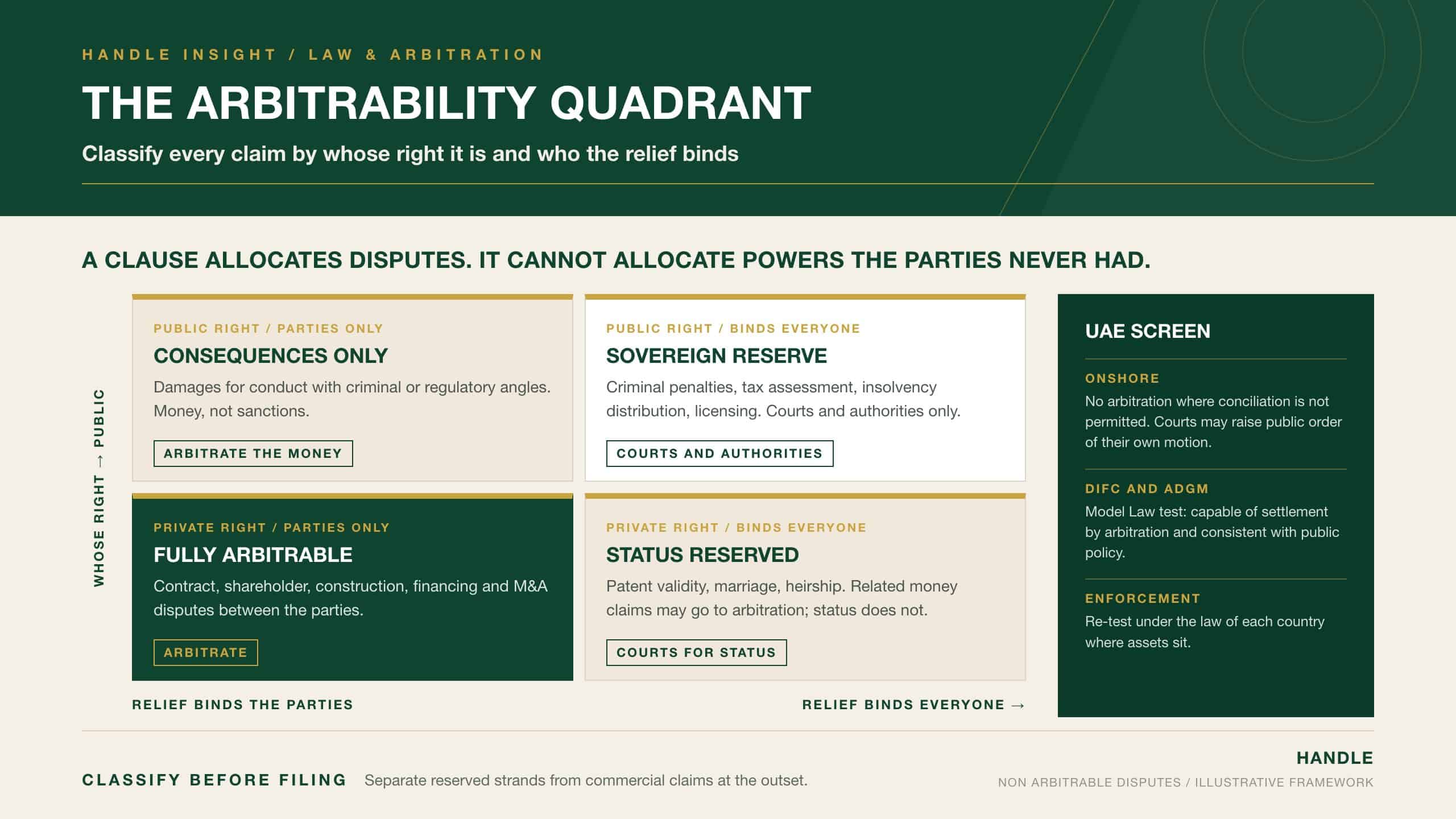
Original Analysis: The Arbitrability Quadrant
A practical way to screen a dispute is to ask two questions. Whose right is it: one the parties can freely dispose of, or one held by or for the state or third parties? And what does the requested relief do: does it bind only the parties, or does it change status or public records for everyone?
- Private right, effect between the parties. Fully arbitrable. Contract, shareholder, construction, financing and M&A disputes sit here.
- Public interest, effect between the parties. Arbitrable as to consequences only. Damages for conduct that also has criminal, competition or regulatory dimensions sit here; the tribunal decides money, not sanctions.
- Private interest, effect on everyone. Reserved for status. Patent validity, marriage and heirship sit here; the tribunal may decide related financial claims between the parties but not the status itself.
- Public interest, effect on everyone. Sovereign reserve. Criminal penalties, tax assessment, insolvency distribution and licensing sit here and stay with courts and authorities.
The quadrant does not replace jurisdiction-specific advice. It forces every claim in a dispute to be classified before the notice of arbitration is filed, which is when reframing is still cheap.
Common Mistakes With Non Arbitrable Disputes
- Assuming that a broad arbitration clause covering all disputes makes every issue arbitrable, when the law sets limits the parties cannot contract around.
- Pleading criminal or regulatory relief in an arbitration, which invites a jurisdictional objection and taints otherwise sound commercial claims.
- Checking arbitrability only under the law of the seat and not under the law of the country where enforcement will be sought.
- Overlooking the authority of the person who signed the arbitration agreement, a recurring ground for challenge to UAE onshore awards.
- Including arbitration clauses in onshore employment or consumer contracts without considering whether the statutory protections will override them.
- Failing to separate mixed disputes into arbitrable and reserved strands, leading to parallel proceedings with inconsistent outcomes.
Each of these mistakes is visible at the drafting stage. Most are expensive only after the award.
Conclusion
Non arbitrable disputes are those the law reserves to courts, regulators or other public authorities regardless of what the parties have agreed. Criminal liability, personal status, collective insolvency, regulatory enforcement, tax assessment and the validity of public registrations are the core examples. Employment and consumer claims raise separate concerns about protected parties. In the UAE, the Federal Arbitration Law excludes matters on which conciliation is not permitted and allows the courts to raise non-arbitrability and public order of their own motion, while the DIFC and ADGM regimes apply a Model Law test supervised by their own courts. Arbitrability must also be checked in every country where enforcement will be sought. Classifying each claim before proceedings begin, and separating reserved strands from commercial ones, protects the award. The clause defines consent. The law defines its limits.