

A syndicated investment is not closed when the term sheet is agreed or when the last investor says yes. It is closed when every investor’s capital has moved, at the same moment, into a vehicle whose governance is already binding. The closing process for syndicated investments is the controlled conversion of negotiated commitments into enforceable agreements, verified funds and issued ownership. With several institutions involved, each with its own approvals, compliance checks and payment channels, the risk is not disagreement. It is asynchrony. Within Capital Raises and Syndication, closing is the stage at which the syndicate either moves as one or exposes the weakest link in its timetable. A single late investor can hold an entire round in escrow. Closing certainty is designed, not hoped for.
Why Syndicated Closings Fail Differently
In a single-investor financing, closing depends on one counterparty’s documents, one approval process and one transfer of funds. In a syndicate, the same steps multiply. Each investor has an investment committee, a compliance team, a legal adviser and a treasury function. Each may be subject to different regulators. The issuing company must satisfy all of them before any of them will fund.
This changes the nature of closing risk. The question is no longer whether the deal is acceptable to the investors. That was settled during negotiation. The question is whether every investor can complete its internal steps within the same window, and what happens if one cannot. A syndicated closing is a coordination problem with legal consequences.
| Closing Feature | Single-Investor Financing | Syndicated Investment |
|---|---|---|
| Documentation | One subscription and one investment agreement | Subscription agreements per investor under one shareholder or investor agreement |
| Approvals | One investment committee | Several committees, each with its own calendar |
| Compliance | One set of onboarding checks | Onboarding and source-of-funds checks for every investor |
| Funding | One transfer | Multiple transfers that must arrive together, usually through escrow |
| Failure mode | Deal fails or is renegotiated | One investor’s delay blocks or reshapes the whole round |
| Coordination | Bilateral | Lead investor or sponsor manages the group |
Finalising the Documentation Set
Closing begins when the legal documentation is complete and agreed in final form. Three documents carry most of the weight.
Subscription agreements confirm each investor’s commitment and the terms on which it acquires its interest in the company or investment vehicle. They fix the economic participation of each investor and usually set out the conditions that must be met before that investor is obliged to fund.
The shareholder or investor agreement sets the governance framework that will bind the syndicate after closing: board composition, voting mechanisms, reserved matters, information rights and transfer restrictions. Where the company’s constitution must be amended to reflect these rights, the amendment should be approved and ready for filing at closing, so the agreement and the constitution say the same thing.
Disclosure schedules record known exceptions to the warranties given by the company. Investors rely on them to confirm that diligence findings are reflected in the documents, and they define what investors can and cannot claim for later.
Before signature, counsel should verify that the documents are consistent with each other. A cap table in the subscription agreements that differs from the one in the shareholder agreement, or a reserved matter that appears in one document and not the constitution, is the kind of discrepancy that delays closing or creates a dispute afterwards.
Conditions Precedent: What Must Be True Before Money Moves
Conditions precedent convert closing from a promise into a checklist. Each condition should name who is responsible for satisfying it and what evidence will prove it has been met. The lead investor or sponsor typically maintains the closing checklist and reports on it to the syndicate.
| Condition | Responsible Party | Evidence at Closing |
|---|---|---|
| Documents agreed in final form | Company counsel and investor counsel | Execution versions circulated and signature pages held in escrow |
| Corporate approvals of the issuer | Company | Board and shareholder resolutions approving the issue and waiving pre-emption rights where required |
| Investor internal approvals | Each investor | Written confirmation of investment committee approval |
| Investor onboarding and compliance | Company and each investor | Completed know-your-customer and source-of-funds checks |
| Regulatory clearances | Company with deal counsel | Clearance letters or confirmation that no filing is required |
| No material adverse change | Company | Bring-down certificate confirming warranties at closing |
Regulatory Approvals in a UAE Syndicate
Regulatory requirements depend on the target, the sector and where the investors and the company sit. Three categories recur in UAE transactions.
Merger control. The UAE Competition Law (Federal Decree-Law No. 36 of 2023) requires notification of economic concentrations that meet the prescribed thresholds, and a notifiable transaction should not be completed before clearance. A minority syndicated investment does not always amount to a concentration, but where investors acquire control or decisive influence the question must be analysed before closing, not after.
Ownership and licensing. Onshore, most commercial activities can now be wholly foreign owned under the Commercial Companies Law (Federal Decree-Law No. 32 of 2021), but certain activities of strategic impact remain subject to specific conditions, and sector regulators may need to approve changes in ownership of licensed businesses. A capital increase in an onshore company typically requires amended constitutional documents registered with the licensing authority. In the DIFC and ADGM, share issues are reflected in filings with the relevant Registrar of Companies.
Securities rules. Offering shares to investors is regulated activity in many contexts. Within the DIFC and ADGM, offers of securities and financial promotions are governed by DFSA and FSRA rules, which provide exemptions for offers made only to professional investors. Onshore offers are subject to the federal securities framework. Counsel should confirm that every investor in the syndicate falls within the exemption relied on.
Coordinating the Syndicate
Closing discipline depends on a single point of coordination. The lead investor or sponsor manages communication with the group, maintains the closing timetable and resolves questions before they spread. Legal teams for the investors and the company coordinate execution so that signatures, approvals and filings are released together. Financial advisers confirm that the funds committed match the final allocation.
The most useful coordination tool is a fixed closing calendar agreed at signing, with dates for final documents, approval confirmations, funding instructions and the closing call. Investors who know when they will be asked to fund can schedule their committees and treasury approvals accordingly. Investors who are told late cannot.
Funding, Escrow and Simultaneous Release
Funding is the central event of closing. In most syndicated deals, investors transfer capital into an escrow account held by a bank or agent rather than directly to the company. Funds are released only when every condition precedent is satisfied and every investor’s funds have arrived. Escrow protects early funders from being the only capital in a vehicle that never closes, and protects the company from issuing shares against money that has not been received.
Funding instructions should be issued in writing, confirmed by a call-back to a known contact, and never changed by email alone. Payment fraud aimed at closing accounts is a known risk, and a syndicate multiplies the number of payment instructions in circulation.
Worked Example: A USD 60 Million Round With One Late Investor
Consider an illustrative growth round of USD 60 million. The lead investor commits USD 25 million. Four co-investors commit USD 15 million, USD 10 million, USD 6 million and USD 4 million. Funds are due into escrow five business days before the closing date.
Three days before the deadline, the USD 6 million investor reports that its compliance team has not completed its review. USD 54 million can arrive on time. USD 6 million cannot. The syndicate has four options, and the documents should already say which is available. The lead or another investor can take up the shortfall, keeping the round at USD 60 million. The company can close at USD 54 million and admit the late investor at a second closing on identical terms within a fixed period. The closing can be deferred, which delays capital for every investor. Or, if the commitment was binding, default provisions can apply. A syndicate that agreed a second-closing mechanism and a backstop in advance resolves this in a day. One that did not must renegotiate under time pressure.
Issuing Ownership and Activating Governance
Once funds are released, the company issues shares or units in the agreed allocation, updates its register of members and cap table, and makes any required registry filings. The updated cap table becomes the official record of each investor’s participation and should be circulated to the syndicate immediately.
Governance rights take effect at the same moment. Investor directors should be appointed at closing, not weeks later, and the first board meeting should be scheduled before the closing call ends. Reporting obligations, information rights and committee structures in the shareholder agreement apply from closing. A syndicate whose rights exist on paper but whose directors are not yet appointed has funded without oversight.
Stress-Testing the Closing Plan
Before the closing calendar is issued, the lead should test it against the risks that most often move a closing date. Each risk has an early warning sign and a control that can be put in place at signing.
| Closing Risk | Early Warning | Control Agreed at Signing |
|---|---|---|
| Investor funding delay | Committee date not confirmed in writing | Backstop commitment and second-closing right |
| Documentation discrepancy | Multiple drafts in circulation close to signing | Single master set held by lead counsel |
| Regulatory timing | Filing analysis still open at term sheet | Long-stop date and clearance condition |
| Payment instruction fraud | Late changes to bank details | Verbal call-back to a pre-agreed contact |
None of these controls is expensive. Each costs far less than a deferred closing.
Original Analysis: The Five-Lock Closing Sequence
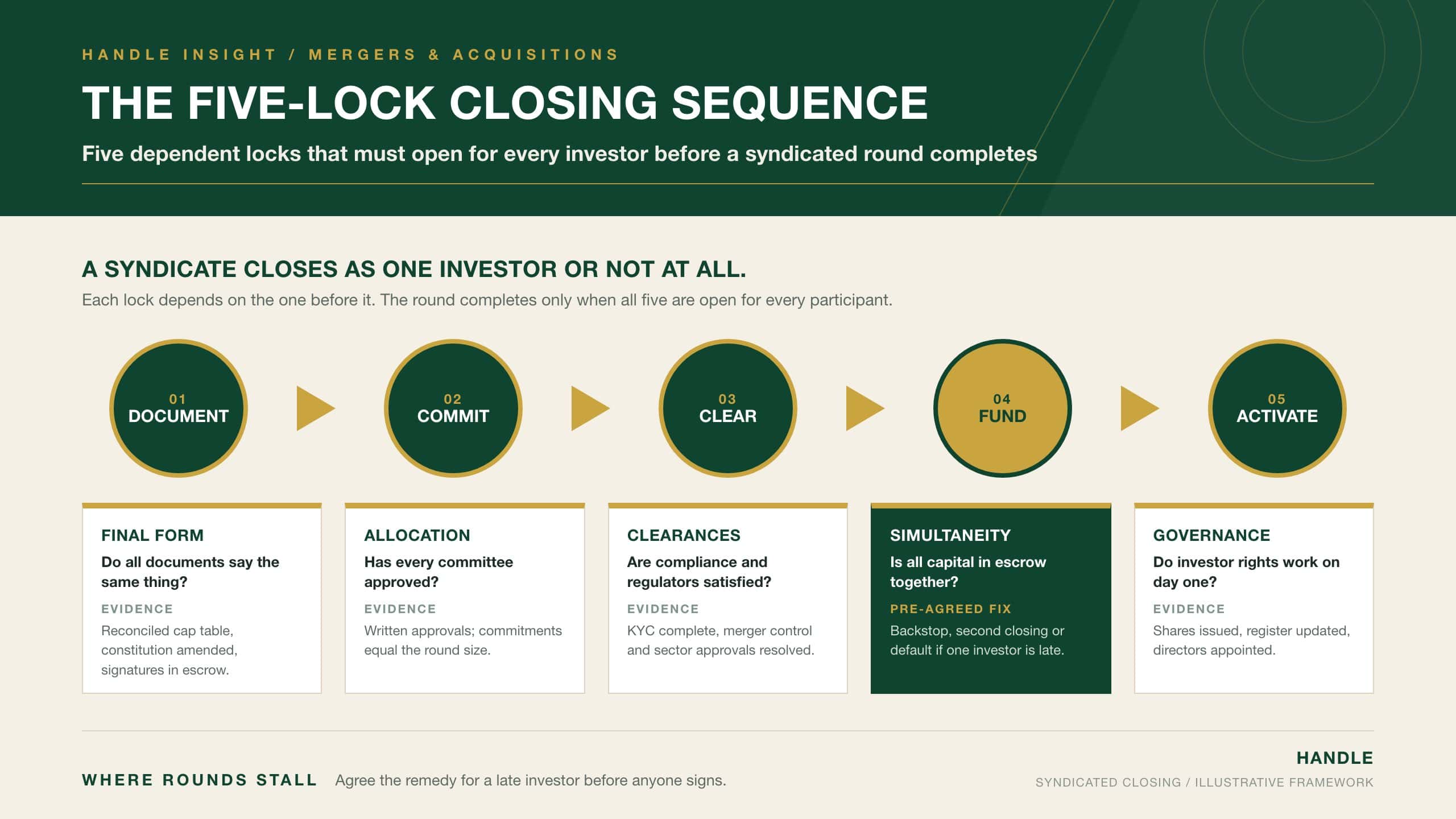
A syndicated closing can be modelled as five locks that must open in order. Each lock depends on the one before it, and the round cannot complete until all five are open for every investor.
- Document. All agreements are in final form, consistent with each other and with the constitution, and held in escrow for release.
- Commit. Every investor has confirmed internal approval and its allocation, and the total equals the financing required.
- Clear. Onboarding checks, regulatory clearances and corporate approvals are evidenced.
- Fund. All capital is in escrow and verified, and is released simultaneously.
- Activate. Shares are issued, the register is updated, directors are appointed and reporting begins.
Fund is the lock where syndicates most often stall, because it is the only one that depends on every investor acting on the same day. The control is to agree in advance what happens when one investor cannot: backstop, second closing or default. The sequence turns closing from an event into a managed process.
Common Closing Failures
- Allowing document versions to diverge, so that the cap table or reserved matters differ between the subscription agreements, the investor agreement and the constitution.
- Assuming every investor’s committee and compliance process will finish on the sponsor’s timetable without confirming it in writing.
- Leaving merger control or sector approval analysis until after signing, when a filing may be mandatory before completion.
- Releasing funds before all capital has arrived, leaving the company partly funded and early investors exposed.
- Accepting changed payment instructions by email, which exposes the syndicate to payment fraud.
- Delaying the appointment of investor directors, so governance rights exist without anyone to exercise them.
Each failure is a gap between agreement and execution. Closing discipline closes that gap.
Conclusion
The closing process for syndicated investments converts negotiated commitments into enforceable ownership. Documents are finalised and reconciled, each investor’s approval and compliance checks are evidenced, regulatory questions such as merger control under the UAE Competition Law are resolved, capital moves into escrow and is released together, and governance takes effect the moment shares are issued. The difficulty is not complexity alone. It is synchronisation across institutions that each run on their own calendar. Syndicates that agree a closing timetable, a single coordinator and a remedy for late funding before they sign rarely lose a closing to one investor’s delay. Those that do not discover the gap on the day money should move. Closing is where the syndicate proves it is one investor. Discipline makes it so. Governance begins at completion.


