

A divestiture is agreed between a seller and a buyer, but it is completed with the permission of people who never sat at the negotiating table. Competition authorities, sector regulators and licensing bodies decide whether ownership may change, when it may change and on what terms. Regulatory approvals in divestitures are therefore not a closing formality to be collected in the final weeks. They are a structural input that shapes the perimeter of the business being sold, the identity of acceptable buyers, the long-stop date and the allocation of risk in the sale agreement. Within Carve Outs and Divestitures, regulatory approval planning is the workstream that maps every authority with a say over the transaction, sequences their reviews and protects the business while they decide. Sellers who treat clearance as paperwork discover its power late. Clearance sets the timetable. The timetable sets the risk.
Why Regulatory Approvals in Divestitures Decide More Than the Closing Date
Most divestitures change who controls a set of assets, contracts and licences. Each of those elements may sit inside a regulatory framework that was designed around the current owner. A banking licence was granted on the basis of a known controller. A telecoms authorisation reflects a reviewed shareholder structure. A market position was assessed when the seller held it, not when a competitor acquires it.
When ownership moves, those frameworks ask the same question again. The answer can be a straightforward approval, an approval with conditions or a refusal. Each outcome affects value. Conditions may require the buyer to sell overlapping assets, ring-fence data or maintain supply to rivals. A refusal can force the seller back into the market with a weaker process and a business that has been in limbo for months.
For that reason, regulatory analysis belongs at the start of a divestiture, alongside the perimeter decision and the buyer universe. It tells the seller which buyers can realistically close, how long each would take and which risks must be priced or contractually allocated. A higher headline price from a buyer who faces a long and uncertain review may be worth less than a lower price from a buyer who can close cleanly.
Which Approvals Does a Divestiture Actually Trigger?
Approvals fall into four broad categories. Not every transaction triggers all four, but every transaction should be tested against each of them before a buyer is selected.
| Approval Category | Typical Trigger | What the Authority Tests | Effect on the Transaction |
|---|---|---|---|
| Merger control | Acquisition of control that meets turnover or market share thresholds | Whether the combination restricts competition in a relevant market | Mandatory filing and standstill until clearance |
| Sector change of control | Transfer of a licensed entity in banking, insurance, telecoms, energy, healthcare or similar sectors | Fitness, financial strength and governance of the incoming controller | Prior approval required before ownership changes |
| Licence transfer or reissue | Activity licences held by the seller rather than the divested entity | Whether the new holder meets licensing conditions | New application or amendment, often on its own timetable |
| Foreign ownership controls | Non-national buyer acquiring an activity subject to ownership limits | Whether the activity permits the proposed ownership structure | Restructuring of the deal or exclusion of certain buyers |
The matrix is a starting point. The detailed analysis must be repeated for each jurisdiction in which the divested business operates, holds assets or generates turnover, because a single carve-out can trigger filings in several countries at once.
How UAE Merger Control Applies to a Carve-Out
In the UAE, merger control is governed by Federal Decree-Law No. 36 of 2023 on the Regulation of Competition, administered by the Ministry of Economy, together with its implementing Cabinet resolution. The regime applies to economic concentrations, which include acquisitions that confer control over all or part of another business. The acquisition of a carved-out division by a new owner can therefore qualify even though the seller is exiting the market.
Notification is required where the transaction meets the thresholds set by the implementing resolution, which are framed by reference to annual turnover in the relevant UAE market and the combined market share of the parties. Where a filing is required, the transaction should not be completed until clearance is obtained. Closing early, often called gun-jumping, exposes the parties to penalties and can undermine the validity of the transaction.
Two practical points follow. First, the threshold analysis must be done on the buyer and the target business as they will exist after separation, not on the seller group as a whole. Second, the review period runs from a complete filing, and the authority can request further information. Parties who file incomplete notifications lose time they cannot recover.
Certain regulated sectors, notably parts of financial services, may be subject to their own sectoral competition oversight, and transactions carried out wholly within the DIFC or ADGM raise separate questions. Each should be checked rather than assumed.
Sector Regulators and Change of Control in the UAE
Sector approval is frequently the longer and less predictable path. Regulators in licensed industries review the incoming controller with the same seriousness they applied at the original licence application.
In financial services, the Central Bank of the UAE supervises banks, finance companies, payment service providers and insurers onshore, and prior approval is generally required before control of a licensed entity changes. In the financial free zones, the Dubai Financial Services Authority in the DIFC and the Financial Services Regulatory Authority in ADGM operate their own change-in-control regimes for authorised firms. Telecoms, energy, healthcare, aviation and education each have their own authorities and approval processes at federal or emirate level.
These regulators typically assess the buyer’s ownership chain up to the ultimate controller, the source of funds, the experience and integrity of proposed directors and senior managers, the business plan and the capital position after completion. A buyer that cannot document its ownership chain clearly, or that relies on complex offshore layers, should expect questions that extend the review.
Foreign Ownership: Licensing Rather Than Screening
The UAE does not operate a single, stand-alone foreign investment screening regime of the kind found in some other jurisdictions. Foreign ownership controls operate mainly through licensing. Under the Commercial Companies Law (Federal Decree-Law No. 32 of 2021), most onshore activities can now be fully foreign owned, but activities designated as having strategic impact remain subject to additional conditions, and sector regulators may impose their own ownership requirements.
For a divestiture, the practical test is simple. The seller must confirm, for each licensed activity of the divested business, whether the intended buyer can hold it directly. Where it cannot, the structure must change, the activity must be carved out of the perimeter, or the buyer pool must be narrowed. Discovering this after signing is expensive.
Structuring the Filing Sequence
Once the approval map is complete, the seller and buyer must agree who prepares each filing, who controls communications with each authority and in what order filings are made. Merger control filings usually fall to the acquirer, but the seller supplies much of the information about the target. Sector filings may be submitted by the licensed entity itself.
Where approvals are independent, they should run in parallel. Where one regulator expects to see another’s decision, the sequence must respect that dependency. Pre-filing engagement, where the authority permits it, allows the parties to test the scope of information required and to surface concerns before the formal clock starts.
What Can a Regulator Impose? Outcomes and Contractual Responses
Regulatory outcomes are not binary. The sale agreement must anticipate each outcome and say what happens next.
| Outcome | What It Means | Contractual Response |
|---|---|---|
| Unconditional clearance | The transaction may close as agreed | Condition satisfied; completion follows within an agreed period |
| Clearance with structural remedies | Assets or businesses must be sold or excluded | Remedy obligations defined in advance, with limits on what the buyer must accept |
| Clearance with behavioural conditions | Commitments on supply, pricing, data or conduct | Allocation of the cost and duration of commitments between the parties |
| Extended review | Further investigation delays the decision | Long-stop date with extension mechanics and interim operating covenants |
| Prohibition | The transaction cannot close as structured | Termination rights and, where negotiated, a reverse break fee payable by the buyer |
The strength of the buyer’s obligation to accept remedies is one of the most heavily negotiated points in any divestiture with regulatory risk. A seller wants certainty. A buyer wants to cap the value it may have to give up. The answer belongs in the agreement before signing, not in a dispute after a regulator has spoken.
Protecting the Business While Approval Is Pending
Between signing and clearance, the seller still owns and runs the business. Interim covenants restrict major decisions without the buyer’s consent, but they must not hand the buyer operational control before approval, which would itself breach standstill rules. Information sharing between competitors must be limited to what integration planning genuinely requires, often through clean teams.
Employees, customers and suppliers also need stability. A long review period with no communication erodes the very value the regulator is being asked to approve.
Worked Example: An Illustrative Payments Carve-Out
Consider an illustrative case. A UAE group sells its payments division, licensed by the Central Bank of the UAE, to a regional financial services buyer. The division is held through a DIFC holding company and an onshore operating company. The buyer already operates a smaller payments business in the UAE.
The approval map identifies three reviews: a merger control filing with the Ministry of Economy, because the combined UAE payments turnover appears to meet the notification thresholds; a Central Bank change-of-control approval for the onshore licensed entity; and confirmation of the holding company share transfer in the DIFC. The parties estimate, for illustration, eight to twelve weeks of preparation, a merger control review measured in months and a sector review of similar length that runs in parallel. They set a long-stop date nine months after signing, with one three-month extension if only the regulatory condition remains outstanding.
The sale agreement obliges the buyer to offer behavioural commitments if required, but caps any structural remedy at assets generating no more than an agreed share of the combined business’s revenue. A reverse break fee, set at an illustrative 3% of the purchase price, is payable if clearance is refused. The seller accepts a lower headline price than a competing bid from a larger competitor whose filing would have raised deeper concerns. The decision is driven by closing certainty, not price.
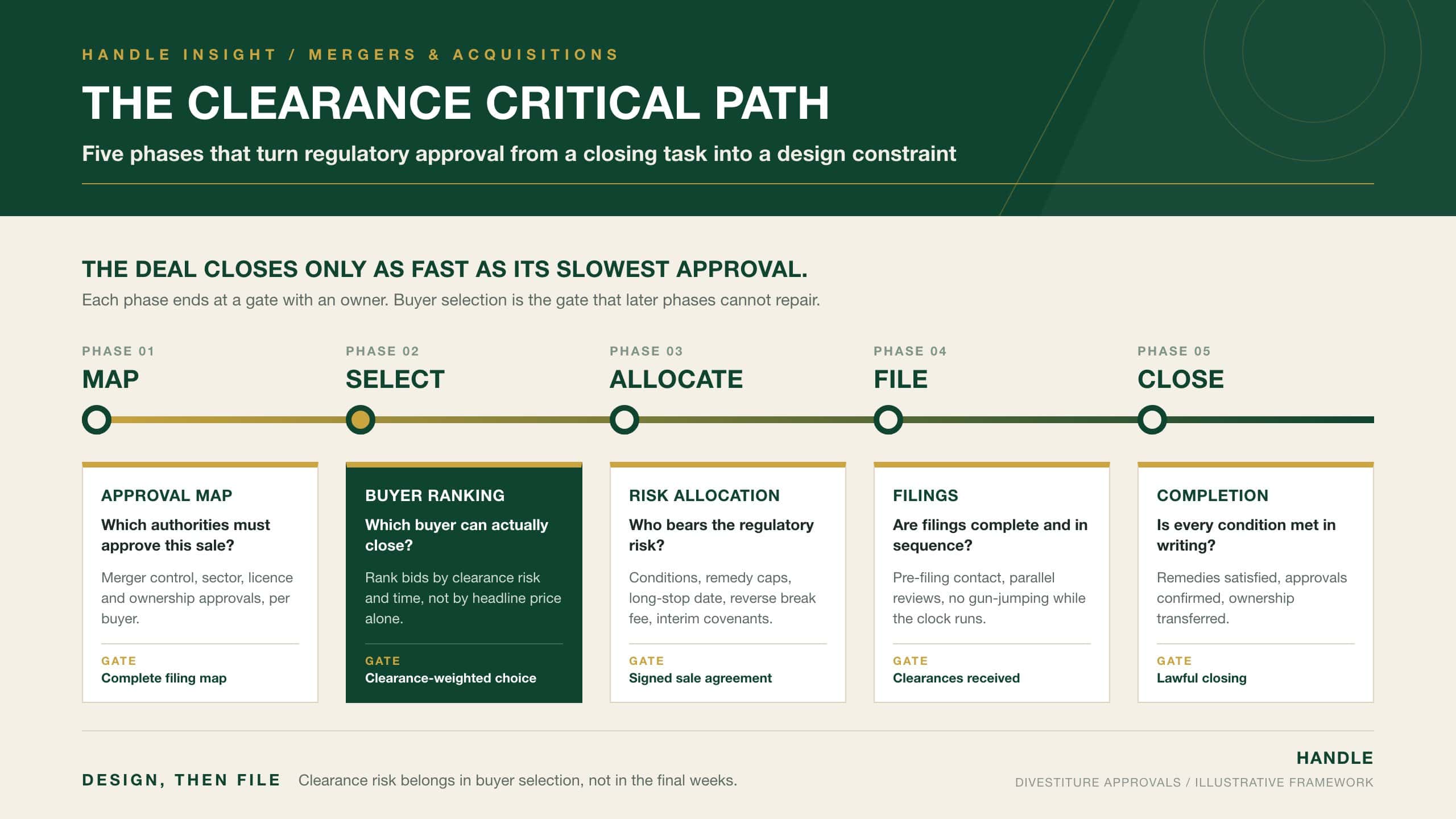
Original Analysis: The Clearance Critical Path
Regulatory approval in a divestiture can be managed as a critical path of five phases. Each phase has a gate that must be passed before the next begins, and each gate has an owner.
1. Map. Identify every merger control, sector, licensing and ownership approval in each relevant jurisdiction, tested against the post-separation perimeter and each candidate buyer.
2. Select. Rank buyers by clearance risk as well as price, and build that ranking into the bid evaluation.
3. Allocate. Fix conditions precedent, remedy obligations, long-stop dates, break fees and interim covenants in the sale agreement before signing.
4. File. Submit complete filings in the correct sequence, with pre-filing engagement where permitted, and run independent reviews in parallel.
5. Close. Satisfy remedies, confirm all conditions in writing and complete only when every approval is in hand.
The highest-risk gate is the second. Once a buyer with a difficult clearance profile has been selected, the later phases can only manage the consequences. They cannot remove them. The path is only as short as its slowest approval.
Common Regulatory Approval Failures in Divestitures
- Running threshold analysis on the seller group rather than on the buyer and the carved-out business, which produces the wrong filing map.
- Selecting the highest bidder without weighting clearance risk, then losing months to a review that a different buyer would have avoided.
- Assuming licences move with the business when they are held by a seller entity outside the perimeter and must be reissued.
- Leaving the buyer’s remedy obligations undefined, so that a conditional clearance becomes a renegotiation.
- Setting a long-stop date that ignores realistic review periods, giving one party a walk-away right at the worst moment.
- Allowing the buyer to influence operations before clearance, which risks a gun-jumping breach.
- Submitting incomplete filings, which delays the start of the formal review period.
Each failure has the same root. Regulatory approval was treated as an end-stage task rather than a design constraint.
Conclusion
Regulatory approvals in divestitures determine whether a sale completes, when it completes and what the buyer actually receives. Merger control tests the effect of the new ownership on competition. Sector regulators test the fitness of the incoming controller. Licensing and ownership rules test whether the buyer can hold the activities at all. In the UAE, these reviews run under the federal Competition Law, the Central Bank and other sector authorities, and the DFSA and FSRA in the financial free zones, each on its own timetable. Sellers who map approvals early, rank buyers by clearance risk, allocate remedies and long-stop dates in the agreement and file completely and in sequence retain control of the process. Sellers who wait hand that control to the regulator. Clearance is designed, not awaited. Certainty is worth paying for.


