

A divestiture transfers ownership. It does not, on its own, create a business that can survive without its former parent. Before a division can be sold, spun off or capitalised by new investors, it must become a legal entity that can contract in its own name, hold its own assets, pay its own people, report its own numbers and satisfy its own regulators. Within Carve Outs and Divestitures, standalone entity creation is the workstream that converts an internal operating unit into a company with independent legal identity, governance and infrastructure. The sequence matters as much as the content. Incorporating a vehicle is quick. Moving contracts, licences, data, employees and cash flows into it without interrupting customers is where separations succeed or stall. Independence is not declared at signing. It is built, tested and evidenced before the parent steps away.
Why a Division Cannot Simply Be Sold as It Stands
Inside a group, a business unit rarely owns what it uses. Customer contracts are signed by the parent or a sister company. Staff are employed by a group employer. Trademarks sit in a holding entity. The ERP system, bank accounts, insurance programme and regulatory licences are shared across divisions.
A buyer cannot acquire a set of activities spread across several legal entities with any certainty. It needs a defined perimeter: one entity, or a small group of entities, holding the assets, liabilities, people and permissions that make up the business being sold.
Standalone entity creation draws that perimeter and then fills it. The work answers three questions that every buyer, lender and regulator will ask: what exactly is being transferred, can it operate on day one without the parent, and what still depends on the seller after closing?
The Five Steps of Standalone Entity Creation
Most separations follow the same sequence, although workstreams overlap in practice and complex carve-outs run several in parallel.
1. Define the Perimeter
The separation team identifies which assets, contracts, employees, systems, intellectual property and liabilities belong to the divested business. Shared items are flagged early because they drive the hardest negotiations: a warehouse used by two divisions, a software licence covering the whole group or a key manager who splits time between businesses.
2. Form the Legal Entity
The parent incorporates the new company, issues shares, appoints directors and adopts constitutional documents. The choice of jurisdiction shapes everything that follows, including licensing, tax treatment, governance rules and the ease with which a future buyer or investor can acquire the shares.
3. Transfer Assets, Contracts and People
Assets move by sale, contribution or licence. Contracts move by assignment or novation, usually requiring counterparty consent. Employees move to new employment contracts with the standalone entity. Each transfer must be documented so that title and obligations are clear.
4. Build Independent Infrastructure
The entity opens bank accounts, establishes treasury and payment authority, sets up accounting and payroll, and either builds or licenses the technology it needs. Policies, internal controls and compliance functions are created or adapted.
5. Exit Transitional Dependence
Where the business cannot operate alone on day one, the parent provides transitional services for an agreed period. The final step is migrating off those services so the entity runs entirely under its own leadership and systems.
Choosing the Jurisdiction and Legal Form
Jurisdiction is a structuring decision, not an administrative one. It determines which company law governs the board and shareholders, which regulators supervise the business and how easily shares can be transferred or pledged.
In the UAE, a standalone entity can be established onshore under the federal Commercial Companies Law (Federal Decree-Law No. 32 of 2021) and the relevant emirate licensing authority, in a free zone, or in one of the two financial free zones with their own common-law based company regimes: the Dubai International Financial Centre (DIFC Companies Law No. 5 of 2018) and Abu Dhabi Global Market (ADGM Companies Regulations 2020). Many groups place a DIFC or ADGM holding company above an operating company that remains onshore or in a free zone, because the holding layer offers familiar governance tools and a cleaner route to transfer ownership at exit.
The operating licence must still match the activity. A holding company in a financial free zone does not authorise trading, manufacturing or regulated services carried on elsewhere in the UAE.
| Consideration | Onshore Operating Company | Free Zone Company | DIFC or ADGM Holding Company |
|---|---|---|---|
| Typical role in a carve-out | Operating entity serving the UAE market | Operating entity for activities licensed within that zone | Holding and governance layer above operating entities |
| Governing company law | Federal Commercial Companies Law | Free zone regulations | DIFC Companies Law or ADGM Companies Regulations |
| Licensing | Emirate economic department and any sector regulator | Free zone authority and any sector regulator | Registrar of Companies; activity licences sit in subsidiaries |
| Advantage at exit | Direct ownership of the operating licence | Streamlined registry processes | Shares transferred at holding level without re-licensing every subsidiary |
Moving Assets, Contracts and Intellectual Property
Transfers are where the legal theory of separation meets commercial reality. Three categories need particular care.
Operating assets. Equipment, inventory and fit-out move under an asset transfer agreement. Real estate leases normally need landlord consent, and in the UAE a new lease is often registered in the name of the new entity rather than assigned.
Customer and supplier contracts. Most commercial contracts cannot be transferred without the counterparty’s agreement. Novation replaces the parent with the new entity as a party; assignment transfers benefits but may leave the parent exposed. Change-of-control and anti-assignment clauses must be mapped early, because a key customer that refuses consent can reduce the value of the business being sold.
Intellectual property. Trademarks, software, domain names and know-how are either assigned to the new entity or licensed by the parent. UAE trademark assignments should be recorded with the Ministry of Economy so that the new owner can enforce them. Where IP must remain shared, a long-term licence with clear field-of-use limits avoids future disputes.
Tax Consequences of the Transfer
The way assets move into the new entity can create or avoid tax cost. Under UAE VAT law, the transfer of a whole business or an independent part of it to a taxable person can fall outside the scope of VAT as a transfer of a going concern, provided the conditions are met. Under the UAE Corporate Tax regime (Federal Decree-Law No. 47 of 2022), qualifying group relief and business restructuring relief can allow assets and liabilities to be transferred without an immediate taxable gain, subject to ownership conditions and clawback rules if the shares or assets are disposed of within the specified period.
These reliefs interact directly with the deal timetable. A transfer structured to obtain relief may restrict how soon the new entity can be sold, so tax structuring belongs in the perimeter decision, not after it.
People: Transferring the Workforce
UAE onshore employment law does not contain an automatic transfer mechanism equivalent to European business-transfer rules. Employees generally move by terminating or amending their existing employment and entering new contracts with the standalone entity, together with new visas and work permits where the sponsor changes.
End-of-service gratuity must be addressed explicitly: either settled by the parent at transfer or carried over by agreement so that service continuity is recognised. Key-person retention, incentive plans and any non-compete arrangements should be agreed before announcement to protect the business from attrition during separation.
Building Financial and Operational Infrastructure
A legal entity without its own financial infrastructure cannot trade independently. The minimum day-one capability normally includes:
- Corporate bank accounts, signatory mandates and payment approval limits in the name of the new entity.
- A chart of accounts, accounting system and month-end close process capable of producing standalone financial statements.
- Payroll, employee benefits and statutory registrations.
- Tax registrations, including VAT and Corporate Tax, where required.
- Insurance cover in the entity’s own name or properly extended under a transitional arrangement.
- A delegation of authority defining who can commit the company and up to what amount.
Working capital is frequently underestimated. Inside a group, the division may have relied on central cash pooling. As a standalone company it needs its own liquidity to fund receivables, inventory and supplier payments from day one.
Governance From Day One
The new entity requires a functioning board, defined executive roles and documented decision rights. Directors owe duties to the new company, not to the parent, and those duties begin at incorporation. Where the parent retains ownership until closing, the board must manage conflicts carefully, particularly on intra-group pricing, transitional services and the allocation of shared costs.
Governance documents should anticipate the buyer. A constitution, reserved matters list and delegation framework that a buyer can adopt with minimal change shortens the post-closing integration period and reduces the risk of a governance gap.
Transitional Service Agreements: Controlled Dependence
Very few carve-outs are fully independent at closing. Transitional service agreements allow the parent to continue providing IT, finance, HR or procurement support for a defined period, usually priced at cost or cost plus a margin.
| TSA Element | What It Should Define | Risk if Left Vague |
|---|---|---|
| Service schedule | Each service, its scope and service levels | Disputes over what was promised |
| Duration | A fixed term per service, with limited extensions | Open-ended reliance on the seller |
| Pricing | Cost basis, mark-up and invoicing method | Margin disputes and unexpected cost |
| Data and access | Data segregation, access rights and return of data | Confidentiality and data protection breaches |
| Exit plan | Migration milestones and responsibilities | Services ending before replacements exist |
A TSA is a bridge, not a destination. Each service should carry an exit milestone, and the separation programme should track progress against those milestones from the first month.
Original Analysis: The Standalone Independence Test
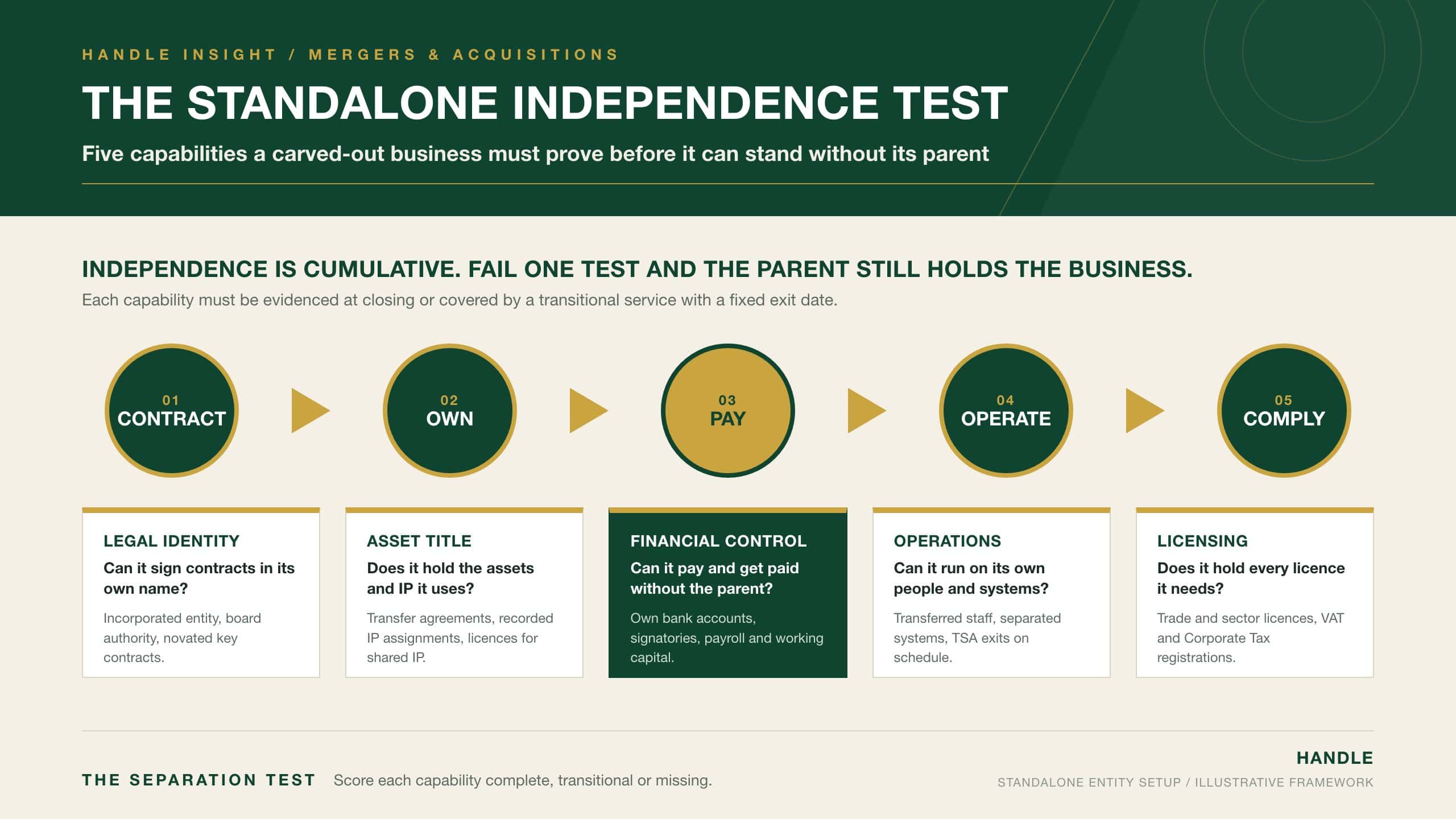
A practical way to judge whether a carve-out is genuinely ready is to ask five questions of the new entity. Each question corresponds to a capability that buyers, lenders and regulators will test, and each must be answered with evidence rather than intent.
| Test | Question | Evidence of Independence |
|---|---|---|
| Contract | Can it sign and perform contracts in its own name? | Incorporated entity, board authority, novated key contracts |
| Own | Does it hold the assets and IP it uses? | Executed transfer agreements, recorded IP assignments, licences for shared IP |
| Pay | Can it receive and make payments without the parent? | Own bank accounts, signatories, payroll and working capital |
| Operate | Can it run daily operations on its own systems and people? | Transferred employees, separated systems, TSA exit milestones met |
| Comply | Does it hold every licence and registration it needs? | Trade and sector licences, tax registrations, regulatory approvals |
The test is cumulative. An entity that can contract but cannot pay is not independent. An entity with its own systems but a licence still held by the parent cannot trade lawfully. Scoring each test as complete, transitional or missing gives the board and the buyer a single view of residual dependence, and shows exactly which TSA services must be exited before separation is real.
Common Failures in Standalone Entity Setup
- Defining the perimeter late, so shared assets and staff become last-minute negotiation points.
- Assuming contracts transfer automatically and discovering consent requirements after signing.
- Applying for licences after incorporation instead of in parallel, delaying the day the entity can trade.
- Underfunding working capital because group cash pooling hid the division’s true liquidity needs.
- Signing TSAs without exit milestones, leaving the business dependent on a seller with no incentive to support it.
- Overlooking end-of-service gratuity and visa transfers, which create employee uncertainty during the transition.
- Structuring tax relief without checking its effect on how soon the entity can be sold.
Each of these failures is avoidable when separation is planned as a programme with a defined end state rather than a series of legal filings.
Conclusion
Standalone entity creation turns a division into a company that can exist without its parent. The steps are consistent across most carve-outs: define the perimeter, form the entity in the right jurisdiction, transfer assets, contracts and people, build independent financial and operational infrastructure, and exit transitional dependence on a fixed timetable. What separates a clean separation from a troubled one is sequencing and evidence. Contracts need consent before they move. Licences need to be in place before the entity trades. Tax relief needs to fit the exit timetable. Transitional services need an end date. When the new entity can contract, own, pay, operate and comply in its own right, the divestiture has delivered more than a change of ownership. It has delivered a business that can stand on its own.


