

Dual listings and cross-border IPO strategy decide where a company’s shares trade, which investors can own them and which regulators govern the company for years afterwards. A second listing can widen the investor base, deepen liquidity and support valuation. It can also double the disclosure burden, split trading volume across two thin markets and expose the board to two sets of rules that do not always agree. Within a structured Cross-Border M&A Strategy, a listing is a capital event with consequences for governance, deal capacity and future transactions, not a marketing exercise. The decision should start with a simple question: which investors does the company need, and which venue gives access to them at a cost the business can sustain? A listing should follow the capital, not the prestige.
What Are Dual Listings and Cross-Border IPOs?
A cross-border IPO is a company’s first public offering on an exchange outside its home market. A dual listing exists when the same company’s shares are admitted to trading on two exchanges in different jurisdictions. The two often overlap: a company may list first at home and later add an international venue, or list simultaneously in two markets at IPO.
The structures differ in how much of the company’s regulatory life moves to the second venue. A dual primary listing subjects the company to the full listing rules of both exchanges. A secondary listing usually relies on the primary venue for most governance and disclosure standards, with the second exchange adding lighter requirements. Depositary receipts allow investors in another market to trade certificates representing underlying shares held by a custodian, without the company’s shares themselves being listed there.
Why Do Companies Pursue a Second Venue?
The legitimate reasons are specific. A company may need access to investors who cannot or will not buy on its home exchange, for example sector-specialist funds concentrated in another financial centre, or index funds tied to a particular market. It may need a deeper pool of capital for a large offering than the home market can absorb. It may want a listed currency for acquisitions in another market, where target shareholders will accept shares listed in a venue they know. Or it may want to align its listing with where its revenue, employees and customers are.
The weaker reasons are reputational. Listing in a well-known centre does not by itself create demand for a company’s shares. Without research coverage, index inclusion or a meaningful free float on the second venue, trading can remain thin, and the company bears the full cost of compliance for limited benefit.
Comparing Listing Structures
| Structure | Regulatory Burden | Investor Access | Main Risk |
|---|---|---|---|
| Home primary listing only | One regime | Limited to home and international investors willing to trade there | Valuation constrained by local liquidity |
| Dual primary listing | Full rules of both exchanges and regulators | Broadest, including index eligibility in both markets | Conflicting obligations and duplicated cost |
| Primary plus secondary listing | Primary regime with lighter secondary requirements | Adds a second investor pool | Thin trading on the secondary venue |
| Depositary receipts | Depositary arrangements and the receipt market’s disclosure rules | Investors who prefer or require the receipt market | Price gaps and limited liquidity between receipts and shares |
| Cross-border IPO without home listing | Foreign regime only | Investors in the chosen venue | Distance from home investors, customers and media |
The table shows that burden and access do not rise together in a straight line. Some structures add substantial access for modest burden. Others add burden with little gain. The choice should be made on that relationship rather than on the venue’s reputation.
Which Regulatory Frameworks Apply?
Each listing brings its own regulator, prospectus regime, continuing disclosure rules and market abuse framework. A company with two listings must publish a prospectus or equivalent document that satisfies both regimes at the time of the offering, release price-sensitive information to both markets at the same time and comply with insider dealing and disclosure rules in both jurisdictions.
Financial reporting is often the first friction point. Where the two venues accept different accounting standards, or require different interim reporting frequencies, the company must reconcile its reporting calendar and in some cases its accounting policies. International Financial Reporting Standards are widely accepted, which reduces but does not eliminate this burden.
Governance standards also stack. Requirements for independent directors, audit and remuneration committees, related-party transaction approvals and shareholder voting thresholds may differ. Where they conflict, the company generally applies the stricter standard, which in practice means the most demanding exchange sets governance for the whole group.
The UAE Perspective
The UAE offers several listing environments. Onshore, the Abu Dhabi Securities Exchange and the Dubai Financial Market operate under the federal securities regulatory framework. In the Dubai International Financial Centre, Nasdaq Dubai operates under the supervision of the Dubai Financial Services Authority, which also acts as the listing authority. The Abu Dhabi Global Market has its own financial services regulator, the Financial Services Regulatory Authority, with its own listing regime.
For UAE companies, the dual listing question often arises in two directions. A company listed onshore may consider a second listing in a larger international market to reach global sector investors. Alternatively, an international company may list in the UAE to build a Gulf investor base, align with regional operations or prepare for regional acquisitions using listed shares as consideration.
Corporate structure matters as much as venue. Many groups place a holding company in the DIFC or the ADGM, governed by the DIFC Companies Law No. 5 of 2018 or the ADGM Companies Regulations 2020, because common law based company rules and familiar share mechanics can simplify an international offering. The listing vehicle’s jurisdiction then determines which company law governs directors’ duties, shareholder rights and takeover protections, which may differ from the rules of the exchange on which its shares trade. Tax structuring should be reviewed alongside listing structure, since the UAE Corporate Tax regime (Federal Decree-Law No. 47 of 2022) applies to the listed group’s taxable income irrespective of where its shares trade.
A Worked Example: Is the Second Listing Worth Its Cost?
The following example is illustrative. A UAE-listed company has a market capitalisation of AED 10 billion. Management estimates that a secondary listing in an international centre would add AED 6 million a year in compliance, advisory, investor relations and exchange costs, plus AED 25 million in one-off preparation costs.
At an assumed 8 percent cost of capital, AED 6 million a year in perpetuity has a present value of AED 75 million. Including the one-off costs, the listing needs to generate roughly AED 100 million of value, or about 1 percent of market capitalisation, to break even.
If the second venue brings index inclusion and sector-specialist demand that narrows the company’s valuation discount to peers by 3 percent, the gain is about AED 300 million, comfortably above the cost. If it brings only nominal trading and no new research coverage, the gain may be close to zero and the listing destroys value. The arithmetic is simple. The discipline lies in testing the demand assumption honestly before committing.
Original Analysis: The Venue Value Quadrant
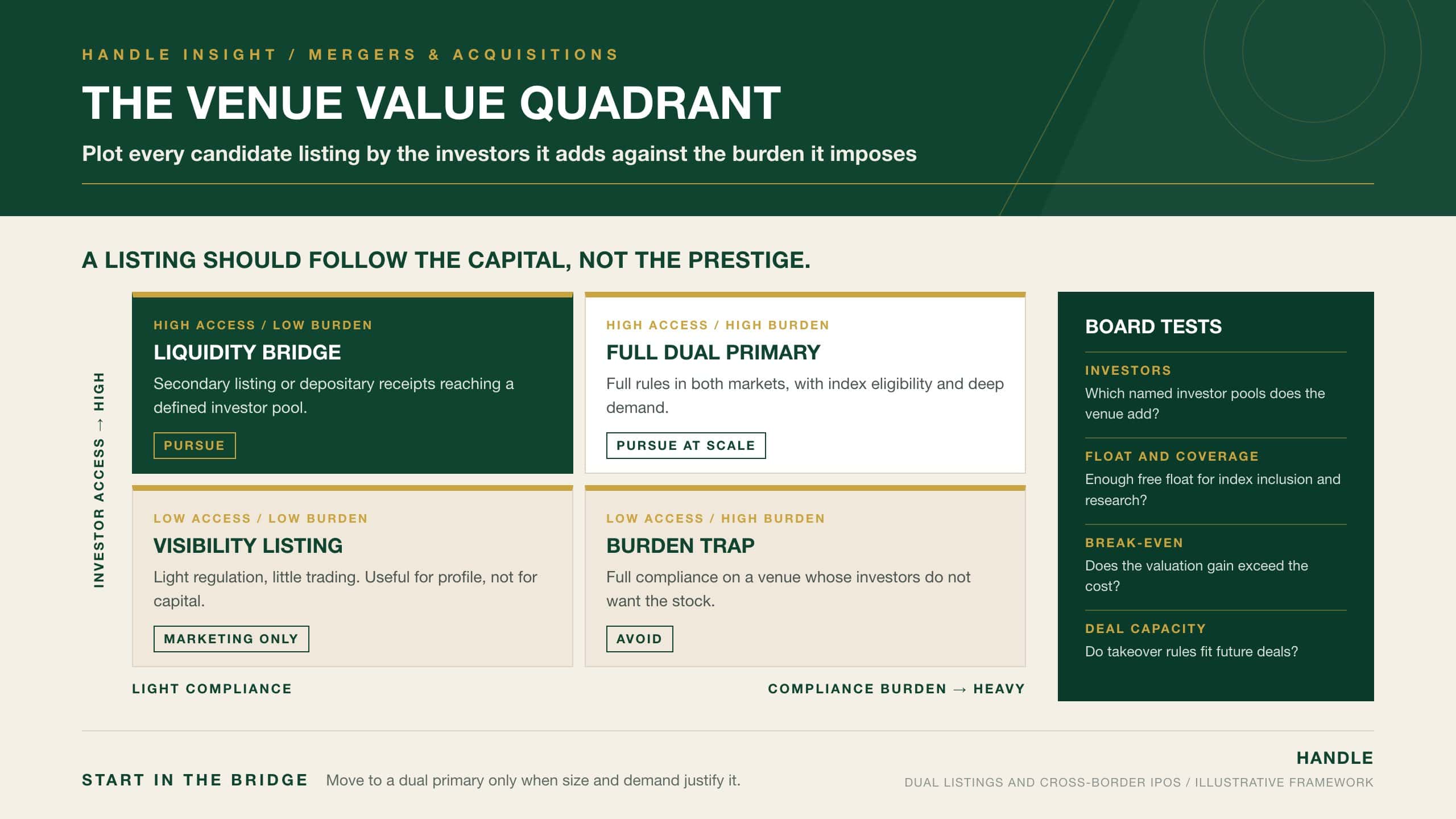
A listing decision can be reduced to two variables: the incremental investor access the venue genuinely adds, and the incremental compliance burden it imposes. Plotting a candidate venue or structure on these two axes produces four outcomes. We describe this as the Venue Value Quadrant.
| Quadrant | Access | Burden | Typical Form | Verdict |
|---|---|---|---|---|
| Liquidity Bridge | High | Low | Secondary listing or depositary receipts reaching a defined investor pool | Pursue |
| Full Dual Primary | High | High | Dual primary listing with index eligibility in both markets | Pursue only at scale |
| Visibility Listing | Low | Low | Lightly regulated listing with little trading | Treat as marketing, not capital |
| Burden Trap | Low | High | Full listing on a venue whose investors do not want the stock | Avoid |
The quadrant changes the board’s question from “which exchange is most prestigious” to “which investors will this venue actually deliver, and at what continuing cost”. Most companies belong in the Liquidity Bridge until their size, free float and investor demand justify a Full Dual Primary listing.
How a Second Listing Changes Future M&A
A listing is not only a fundraising event. It changes how the company can buy, sell and be bought. Shares listed on a venue familiar to a target’s shareholders can serve as acquisition currency in share-for-share transactions, which is often the strongest commercial reason for a cross-border listing by an acquisitive group.
The same listing also imports constraints. Takeover rules, mandatory offer thresholds, related-party approval requirements and shareholder voting rules may apply from both markets. A transaction that requires a simple board resolution at home may require a circular, an independent valuation and a shareholder vote under the second venue’s rules. Squeeze-out and delisting processes also become more complex where two sets of rules and two shareholder bases are involved.
For family-controlled and founder-led companies, the listing structure determines how control is preserved. Free float requirements, restrictions on weighted voting rights and lock-up obligations on controlling shareholders differ between exchanges. A family that wishes to retain control after an offering should test each venue’s rules against its intended post-IPO shareholding before choosing where to list, rather than discovering after admission that the rules limit future share sales or require a larger float than planned.
Boards should therefore model the listing against the company’s acquisition pipeline and the controlling shareholders’ long-term plans. The right venue supports both. The wrong one constrains the very transactions the listing was meant to enable.
Execution: Timing, Pricing and Market Communication
Execution risk is concentrated around the offering itself. Market windows open and close with sentiment, sector performance and interest rates. A cross-border offering involves more parties, more documents and more regulators than a domestic one, so preparation must be complete before the window opens rather than started when it does.
Pricing must balance demand in both markets. An offering priced to clear in the deeper market may leave the home market’s retail investors feeling excluded, and a price gap between venues after listing invites arbitrage and volatility. After listing, investor relations must operate across time zones and languages, with identical information released to both markets at the same moment.
Common Failures in Dual Listing Strategy
- Boards choose a venue for reputation rather than for a specific investor pool, and the second listing trades too thinly to matter.
- Free float on the second venue is too small to support index inclusion or research coverage.
- Companies underestimate the cost of reconciling reporting calendars, accounting policies and governance rules across two regimes.
- Disclosure processes are not synchronised, so price-sensitive information reaches one market before the other.
- The listing vehicle’s jurisdiction is chosen late, and its company law conflicts with the expectations of investors on the target exchange.
- Delisting from the second venue is not planned, although exit from an unsuccessful listing can be slow and costly.
Each of these failures turns a capital strategy into a compliance cost.
Conclusion
Dual listings and cross-border IPO strategy can transform a company’s access to capital, but only when the venue delivers investors the company could not otherwise reach. Every additional listing brings a regulator, a disclosure regime, governance standards and continuing cost. The right structure, whether a dual primary listing, a secondary listing, depositary receipts or a single foreign venue, depends on the relationship between investor access and compliance burden rather than on prestige. For UAE companies and international groups listing in the UAE, the choice of exchange should be made alongside the choice of listing vehicle, with DIFC and ADGM holding structures, onshore company law and tax all shaping the outcome. The Venue Value Quadrant gives boards a disciplined way to test that choice with honest assumptions about demand. Identify the investors first. Measure the burden second. List where access exceeds cost.


