

A special purpose vehicle is often described as a box that holds a deal. That description understates both its value and its fragility. The use of SPVs in M&A transactions is a set of deliberate structuring choices: which entity signs the purchase agreement, which entity borrows, where investors hold their rights, which law governs the board and how the asset can be sold later without disturbing the operating business. Within Deal Structuring & Syndication, the SPV is the instrument that turns a group of investors, lenders and a target company into one controllable transaction. It only works if it is built and maintained as a genuine company rather than a name on a register. An SPV protects only what its structure can prove.
What an SPV Actually Does in an Acquisition
A special purpose vehicle is a separate legal entity formed for a defined transaction. In an acquisition it usually performs four functions at once. It is the buyer that signs the share or asset purchase agreement. It is the borrower to which acquisition lenders advance funds. It is the holding entity in which investors subscribe capital and receive their economic and voting rights. It is the transfer point through which the investment is later sold or refinanced.
Combining these functions in one vehicle, or in a short chain of vehicles, gives the transaction a single point of control. Investors negotiate one shareholders’ agreement and lenders take security over a defined set of shares and accounts. The target’s management continues to run the business while strategic decisions sit with the SPV board.
The vehicle does not remove risk. It places risk where it can be seen, priced and contained.
Why Use an SPV Rather Than Acquire Directly?
A sponsor or corporate buyer can acquire a target directly from its main balance sheet. The SPV route is preferred when the transaction involves several investors, external debt, cross-border holders or a planned exit within a defined horizon. The comparison below shows how the choice changes the deal.
| Dimension | Direct Acquisition | Single SPV | Two-Tier SPV (HoldCo and BidCo) |
|---|---|---|---|
| Liability exposure | Buyer’s balance sheet exposed to deal liabilities and financing | Contained in the SPV, subject to guarantees given by sponsors | Contained, with debt separated from the equity layer |
| Investor participation | Investors must enter the target’s register or the buyer’s group | Investors hold shares in the SPV under one agreement | Investors hold HoldCo shares; lenders deal with BidCo |
| Acquisition debt | Raised by the buyer group, often with recourse to other assets | Raised by the SPV, secured on its shares and the target | Raised by BidCo; structural subordination of HoldCo equity is clear |
| Exit route | Sale of the target shares themselves | Sale of SPV shares or of the target | Sale at HoldCo or BidCo level, or refinancing at BidCo |
| Cost and maintenance | Lowest set-up cost | Moderate | Highest; justified by leverage or investor complexity |
The two-tier model is common in leveraged deals because lenders want their borrower directly above the target. The extra entity is not decoration. It is how the parties agree who is paid first.
Liability Ring-Fencing and Its Limits
The principal reason to use an SPV is limited liability. Creditors of the target or of the SPV generally look to the assets of that entity, not to its shareholders. Investors therefore risk the capital they subscribed rather than their wider balance sheets.
The ring-fence has limits that are frequently overlooked. Sponsors often give equity commitment letters, completion guarantees or warranty support that reach back to them directly. Lenders may require parent guarantees until leverage falls. Courts in most jurisdictions, including the UAE, can look behind a company where it has been used to commit fraud or to evade obligations, and directors can face personal exposure where the vehicle is managed improperly or trades while it cannot meet its debts.
Separation is therefore a matter of conduct as well as form. The SPV should have its own board that actually meets, its own bank accounts, accurate books, documented decisions and capital that is adequate for the obligations it assumes.
Capital Aggregation and Investor Rights
SPVs allow several investors to fund one acquisition without each becoming a shareholder of the target. Each subscribes for shares, preference instruments or shareholder loans in agreed proportions.
The SPV’s constitutional documents and shareholders’ agreement then carry the commercial bargain: board appointment rights, reserved matters, pre-emption on new issues, transfer restrictions, tag-along and drag-along rights, distribution waterfalls and any liquidation preference. Keeping these rights at SPV level leaves the target’s governance stable and avoids reopening its constitution every time the investor group changes.
Where investor rights must bind third parties or a future buyer, they should appear in the articles or memorandum of association, not only in a private agreement. That point matters particularly for onshore UAE companies, whose registered memorandum is the document the licensing authority and counterparties rely on.
Acquisition Financing Through the Vehicle
Lenders prefer to lend to an entity whose only business is owning the target. Debt is advanced to the SPV, or to BidCo in a two-tier structure, and repaid from dividends and other distributions paid up by the target. Security typically includes a pledge over the SPV’s shares, a pledge over the target shares it acquires, assignment of intra-group receivables and control over key bank accounts.
Three structural questions shape the financing. First, can the target lawfully support debt incurred to buy it? Restrictions on a company giving financial assistance or security for the acquisition of its own shares can apply, particularly to joint stock companies, and any upstream guarantee must be tested against the target’s governing company law and genuine corporate benefit. Second, where is the security perfected? Pledges over onshore UAE company shares, security over movable assets under the federal law on securing rights in movable property, and share charges in the DIFC or ADGM each follow their own registration steps. Third, how does tax treat the interest?
Tax and Jurisdiction: Where the SPV Sits Matters
Under the UAE Corporate Tax regime (Federal Decree-Law No. 47 of 2022), a UAE-resident SPV is a taxable person, taxed at 9% on taxable income above AED 375,000. A free zone SPV may qualify as a Qualifying Free Zone Person and apply 0% to qualifying income, which can include holding shares, provided it meets the substance, de minimis and other conditions. Dividends and capital gains from qualifying shareholdings can benefit from the participation exemption, which broadly requires an ownership interest of at least 5% held for at least twelve months and a minimum level of tax in the subsidiary’s jurisdiction.
Leverage brings the general interest limitation rule into play. Net interest expense is deductible up to the higher of 30% of adjusted EBITDA and AED 12 million, with disallowed amounts carried forward. An SPV whose only income is exempt dividends has little EBITDA of its own, which is why tax grouping with the target, available only at 95% ownership and not to a Qualifying Free Zone Person, can be decisive. Large multinational groups must also consider the domestic minimum top-up tax introduced for groups within the global minimum tax rules.
| UAE Vehicle Option | Governing Framework | Typical Use in M&A | Key Consideration |
|---|---|---|---|
| Onshore LLC | Federal Decree-Law No. 32 of 2021 and emirate licensing | Operating acquirer or local BidCo | Memorandum amendments and share transfers follow registry and notarisation steps |
| Free zone company | Relevant free zone regulations | Holding vehicle within a free zone group | Qualifying Free Zone Person status is conditional and excludes tax grouping |
| DIFC Prescribed Company | DIFC Companies Law No. 5 of 2018 and the Prescribed Company regime | HoldCo or co-investment vehicle | Common-law based governance; eligibility conditions apply |
| ADGM SPV or restricted scope company | ADGM Companies Regulations 2020 | HoldCo, BidCo or financing vehicle | English common law applies; ADGM Courts supervise disputes |
A Worked Example: Leverage Inside a Two-Tier Structure
Consider an illustrative acquisition of a UAE operating company for AED 400 million. Four investors subscribe AED 160 million into HoldCo in proportions of 40%, 30%, 20% and 10%. HoldCo capitalises BidCo, which borrows AED 240 million of senior debt at an illustrative 8% and acquires 100% of the target. The target generates AED 60 million of adjusted EBITDA.
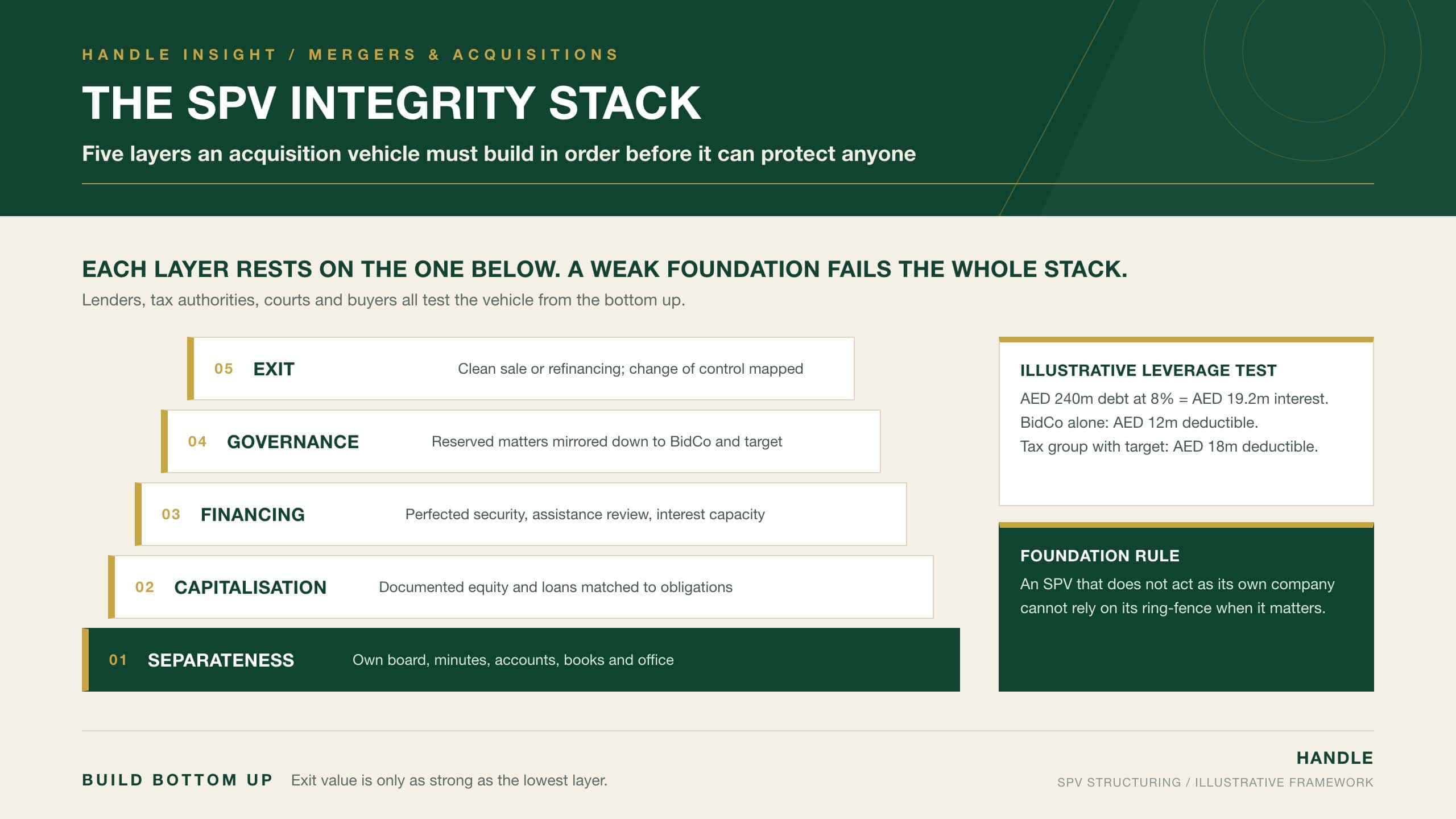
Annual interest is AED 19.2 million. If BidCo stands alone, its own EBITDA is negligible, so deductible net interest is limited to the AED 12 million floor and AED 7.2 million is carried forward. If BidCo and the target form a tax group, the group’s EBITDA supports deductions of up to AED 18 million, leaving only AED 1.2 million carried forward. The same debt, placed in the same vehicle, produces a different after-tax cost depending on ownership level and grouping. The figures are illustrative; the mechanism is not.
Governance at the Vehicle Level
The SPV board is where investors exercise control. Board seats, reserved matters and voting thresholds are set in the SPV documents, while day-to-day management remains with the target’s executives. Reserved matters typically include new issues of shares, additional borrowing, disposals, refinancing, material capital expenditure, related party transactions, appointment of senior executives and any change to the structure itself.
The governance chain must be continuous. A reserved matter at HoldCo level achieves nothing if BidCo or the target can take the same decision without reference to it. Delegations and mirror consent provisions should run down each level so that a decision blocked at the top cannot be taken further down.
Syndication, Secondary Transfers and Exit
An SPV makes later changes to the investor group easier. New investors can subscribe for SPV shares, existing investors can sell their SPV interests and a lead sponsor can syndicate part of its position after closing, all without changing the target’s own shareholding.
At exit, the parties can sell the SPV, sell the target out of the SPV or refinance at BidCo level and return capital. Transfers at holding level can avoid re-licensing the operating business, although change-of-control provisions in the target’s contracts, licences and financing still apply and must be reviewed. Merger control under the UAE Competition Law, Federal Decree-Law No. 36 of 2023, looks at the change of control over the target, not at the vehicle used to achieve it.
Original Analysis: The SPV Integrity Stack
An SPV delivers its benefits only when five layers are built in sequence, each supporting the one above. We call this the SPV Integrity Stack. A weakness in a lower layer undermines everything that rests on it.
| Layer | Question | Evidence Required |
|---|---|---|
| 1. Separateness | Is the SPV genuinely run as its own company? | Own board, minutes, bank accounts, books and registered office |
| 2. Capitalisation | Is it funded adequately for what it commits to? | Documented equity and shareholder loans matched to obligations |
| 3. Financing | Is the debt lawful, secured and tax-efficient? | Perfected security, financial assistance review, interest capacity analysis |
| 4. Governance | Do investor rights reach every entity in the chain? | Reserved matters mirrored down to BidCo and the target |
| 5. Exit | Can the investment be sold or refinanced cleanly? | Transfer provisions, change-of-control mapping, compliance records |
Separateness is the foundation. Lenders, tax authorities and courts all begin by asking whether the vehicle is real. Exit is the top of the stack because it is the point at which every lower layer is tested by a buyer’s due diligence. A stack built in the right order converts a vehicle into an asset that can be valued.
Common Failures in SPV Structuring
- Treating the SPV as a shell, with no functioning board or separate accounts, which weakens the liability ring-fence when it is most needed.
- Choosing a jurisdiction for headline cost without checking whether lenders, investors and courts will accept its governance and enforcement regime.
- Ignoring the interest limitation rule, so leverage that looked efficient produces non-deductible interest in a vehicle with no EBITDA of its own.
- Assuming a free zone vehicle can join a tax group with the target, when Qualifying Free Zone Person status and grouping are mutually exclusive.
- Placing investor protections only in a shareholders’ agreement, so they are not reflected in the constitutional documents that registries and buyers rely on.
- Failing to mirror reserved matters down the chain, allowing decisions blocked at HoldCo to be taken by BidCo or the target.
- Overlooking beneficial ownership registers and anti-money laundering obligations, which delays bank account opening and lender onboarding.
Each of these failures is cheaper to prevent at formation than to correct later.
Conclusion
The use of SPVs in M&A transactions is justified by what the vehicle allows the parties to control: where liability sits, how investors combine their capital, how lenders take security, where governance decisions are made and how the investment is eventually sold. None of these benefits is automatic. The ring-fence depends on genuine separateness and adequate capital. The financing depends on lawful security and a tax position that can carry the interest. Investor protections depend on rights that reach every entity in the chain and appear in the constitutional documents. In the UAE, the choice between onshore, free zone, DIFC and ADGM vehicles shapes each of these layers, including Corporate Tax grouping and the governing company law. A well-built SPV is a controlled transaction in legal form. A neglected one is only a name. Structure it in order. Maintain it with discipline.


