

A merger is announced once, but it is interpreted hundreds of times. Every lender, regulator, employee, customer and supplier decides for themselves what the transaction means for them, and they decide quickly. If leadership has not mapped who those stakeholders are, what they can affect and what they need to hear, those interpretations are formed from rumour, competitor messaging and silence. Transactions do not conclude when the legal documents close. The combined organisation immediately enters a new field of influence, and the first weeks determine whether that field stabilises or fragments. Within Integration Governance & Change Strategy, stakeholder mapping establishes visibility over every party capable of affecting integration stability, regulatory standing, capital structure and operational continuity, and engagement strategy determines the order, content and ownership of every communication that follows. The objective is not to please every stakeholder. It is to ensure that none of them is surprised. Sequence protects the narrative.
Why Does Stakeholder Mapping Matter After a Merger?
Mergers create uncertainty across an ecosystem connected to both legacy organisations. Investors test the strategic logic. Regulators examine compliance implications. Customers question continuity of service. Employees assess leadership stability and their own roles. Suppliers recalibrate commercial terms.
These expectations conflict. Investors want rapid synergy realisation, while regulators expect cautious compliance sequencing. Employees want early clarity, while some decisions cannot yet be made. Customers want nothing to change, while the integration plan requires change. Without structured stakeholder governance, each group fills the gap with its own assumptions.
Stakeholder mapping and engagement post-merger resolves this through disciplined identification and prioritisation. It produces three outcomes: leadership retains control of the integration narrative, capital and regulatory stakeholders retain confidence in execution, and operational stakeholders remain aligned with the new structure.
Who Are the Post-Merger Stakeholders?
Internal stakeholders shape operational success. They include board members and executive leadership, functional leaders across finance, legal, technology and operations, regional and divisional management, and the critical employees on whom continuity depends. They need immediate clarity on authority, reporting lines and priorities.
Capital stakeholders include institutional investors, private equity sponsors, lenders and sovereign-linked funds. Their focus is on value realisation timelines, financial stability during integration, governance transparency and protection of their commitments. Facility agreements frequently contain change-of-control and information covenants that make lender engagement a legal requirement as well as a relationship matter.
Regulatory and government stakeholders include competition authorities, financial and sector regulators, labour authorities and data protection authorities. Engagement concentrates on compliance with any clearance conditions, transparency over operational transition, legal entity restructuring and assurances about market conduct.
Commercial stakeholders include customers, suppliers and strategic partners. Their perception directly affects revenue continuity. They need confidence that the transaction strengthens the capabilities they rely on.
External observers include financial markets, analysts and the media. Their interpretation shapes wider market perception and, through it, the confidence of every other group.
How Should the Stakeholder Map Be Built?
The map begins with categorisation. Each stakeholder group is assessed on three variables: its influence over the organisation, its exposure to integration outcomes and its ability to affect regulatory, capital or operational stability. Groups with high influence and high exposure receive direct engagement from senior leadership. Groups with lower influence receive structured communication through operational channels.
| Stakeholder Group | Influence | Exposure | Engagement Owner | Primary Channel |
|---|---|---|---|---|
| Board and major shareholders | Very high | High | Chair and chief executive | Board sessions, direct briefings |
| Lenders | High | High | Chief financial officer | Bilateral meetings, covenant reporting |
| Regulators | Very high | Medium | General counsel and compliance | Formal correspondence, scheduled meetings |
| Key customers | High | High | Commercial leadership | Account-level calls and visits |
| Employees | Medium collectively | Very high | Chief executive and line managers | Town halls, manager cascades, FAQs |
| Suppliers | Medium | Medium | Procurement | Written notices, supplier briefings |
The map is not static. A supplier with a single-source dependency may move into the highest tier. A regulator that imposed conditions on clearance may need engagement at board level. The map should be reviewed at each integration governance meeting. Each entry should carry a named owner, the commitments already made to that group and the next scheduled contact, so that no stakeholder relationship depends on a single person’s memory during a period of leadership change.
In What Order Should Stakeholders Be Engaged?
Effective engagement follows a deliberate sequence. Stakeholders must receive information in the correct order to prevent confusion, speculation and contradictory messages. The sequence begins with executive alignment, because leaders who are not aligned cannot communicate consistently. Engagement then moves outward: board and executive leadership, capital providers and regulators, senior operational leaders, employees and operational teams, and then customers and suppliers. External observers receive the formal market narrative.
In practice, several steps occur within hours of each other on announcement day. The order still matters. A senior manager who learns about the merger from a customer has been placed in an impossible position, and a lender who reads about it in the press may question every other assurance it receives.
What Changes in the UAE Context?
Several UAE-specific factors shape stakeholder engagement. Where the transaction was notified under the Competition Law (Federal Decree-Law No. 36 of 2023) and cleared subject to conditions, those conditions become a standing regulatory engagement item, and integration decisions must be checked against them. Where either party is listed on a UAE exchange, disclosure obligations to the Securities and Commodities Authority and the exchange govern when and how material information is released. Internal and commercial communication must not run ahead of required market disclosure.
Workforce engagement must reflect the employment framework. UAE onshore employment law (Federal Decree-Law No. 33 of 2021) does not provide an automatic transfer mechanism equivalent to European business-transfer rules, so changes of employer, visas and end-of-service entitlements need explicit handling and clear explanation. Emiratisation commitments must be maintained through any restructuring. Entities in the DIFC and ADGM apply their own employment and data protection regimes. Where employee or customer data is combined across the merged group, the Personal Data Protection Law (Federal Decree-Law No. 45 of 2021) or the applicable free zone regime should guide how that data is shared and used.
A Worked Example: Day-One Engagement for a Healthcare Merger
Consider an illustrative merger of two UAE private healthcare groups with a combined workforce of 3,200, facilities licensed in two emirates, five lending banks and insurance payers who account for most revenue. All details are illustrative.
- Before announcement: the combined leadership team agrees one narrative, a list of questions that cannot yet be answered and the date by which each will be answered.
- Hour 0: board resolutions and briefing of major shareholders; any required market disclosure is made in line with exchange rules.
- Hours 1 to 3: lenders and the two health regulators are briefed by the chief financial officer and general counsel, with written follow-up.
- Hours 3 to 5: the top 150 managers are briefed and given a cascade pack.
- Hour 6: all-staff town hall in both organisations, followed by manager-led team sessions within 48 hours.
- Within 24 hours: calls to the largest insurance payers and corporate clients by named relationship owners.
- Within 72 hours: written notices to suppliers, prioritising single-source and clinical suppliers.
Sentiment is then tracked weekly: lender questions, employee pulse responses, payer feedback and regulator correspondence. In the illustrative case, a spike in nurse resignations in week three prompts a targeted retention announcement in week four, before attrition reaches critical units.
Original Analysis: The Engagement Ripple Model
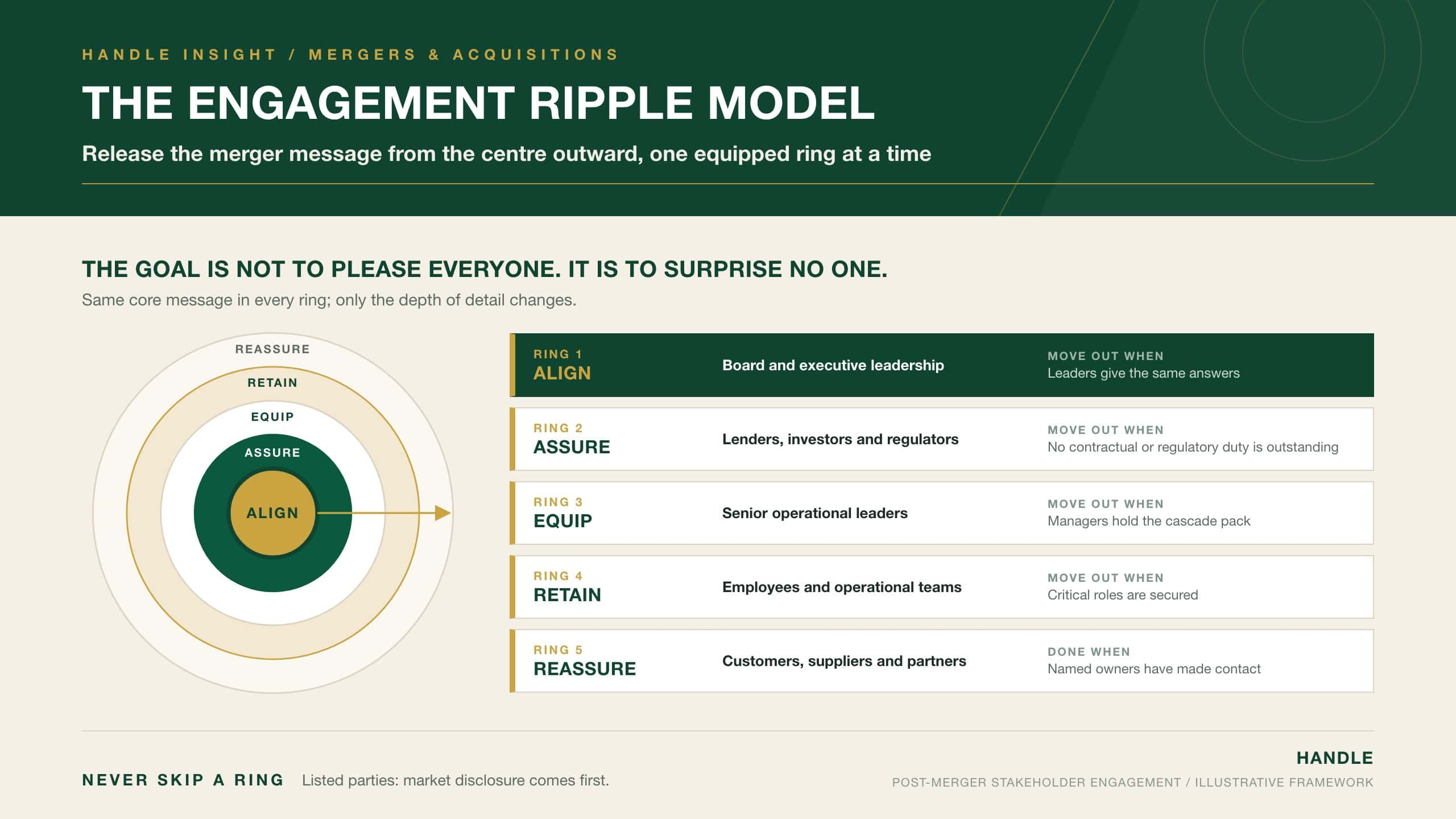
The Engagement Ripple Model treats stakeholder engagement as a series of concentric rings, released from the centre outward. Each ring has a distinct job, and no ring is engaged until the ring inside it can carry the message consistently.
| Ring | Stakeholders | Job of Engagement | Ready to Move Outward When |
|---|---|---|---|
| 1. Align | Board and executive leadership | One narrative, one decision authority | Leaders can answer the same questions the same way |
| 2. Assure | Capital providers and regulators | Confidence in governance, compliance and stability | No obligation to these parties remains unaddressed |
| 3. Equip | Senior operational leaders | Ability to explain and answer for the change | Managers hold the cascade pack and the open questions list |
| 4. Retain | Employees and operational teams | Clarity on roles, reporting lines and timelines | Critical roles have been secured |
| 5. Reassure | Customers, suppliers and partners | Continuity of service and terms | Named relationship owners have made contact |
The model also explains how integration narratives fail. A ripple that skips a ring, such as briefing customers before managers are equipped, creates questions the organisation cannot answer at the point of contact. A ripple released before the centre is aligned spreads inconsistency rather than confidence. The same core message travels through every ring. Only the depth of detail changes.
What Does Each Stakeholder Need to Hear?
A single narrative does not mean a single message. Each group needs the same core story at a different depth, framed around the question it is actually asking. Treating every audience identically either overwhelms employees with financial detail or leaves lenders without the information their agreements entitle them to.
| Stakeholder | Question They Are Asking | What They Need | What to Avoid |
|---|---|---|---|
| Lenders | Is our exposure still sound? | Structure, leverage, covenant position, timetable | Synergy claims without financial support |
| Regulators | Will obligations and conditions still be met? | Entity changes, licence continuity, compliance ownership | Informal updates with no written record |
| Employees | What happens to my role? | Reporting lines, timelines, the date open questions will be answered | Reassurances that later prove untrue |
| Customers | Will service and terms change? | Continuity commitments and a named contact | Silence that competitors will fill |
When a question cannot yet be answered, the honest message is the date by which it will be. Uncertainty with a date is manageable. Uncertainty without one invites speculation.
Maintaining Message Discipline and Monitoring Sentiment
Every stakeholder interaction should reinforce the same institutional narrative: the strategic rationale for the merger, the governance framework guiding integration, the operational benefits expected and the leadership responsible for execution. Divergent messages from different leaders quickly create uncertainty. Message discipline is enforced through a shared narrative document, an approved list of answers and a clear rule on who may speak to which audience.
Engagement does not end at announcement. Leadership should monitor sentiment continuously through investor and lender communications, employee engagement indicators, customer relationship data and regulatory dialogue. Changes in sentiment reveal emerging risks, and early response keeps alignment intact.
Common Failures in Post-Merger Stakeholder Engagement
- Announcing externally before internal leaders are aligned, so managers learn about decisions from customers or the press.
- Treating lenders as a courtesy audience rather than parties with contractual change-of-control and information rights.
- Allowing internal or commercial communication to run ahead of required market disclosure for a listed party.
- Assuming employees transfer automatically, and leaving visa, contract and gratuity questions unanswered.
- Promising answers by a date and then missing it, which converts uncertainty into distrust.
- Stopping sentiment monitoring after day one, so attrition and customer loss are discovered in the numbers rather than prevented.
Each failure lets someone else define the merger. Each is prevented by mapping first and releasing in sequence.
Conclusion
Post-merger integration unfolds within a network of stakeholders whose expectations, authority and interests intersect with the combined organisation’s objectives. Stakeholder mapping provides visibility over who can affect integration and how much they are exposed to it. Engagement strategy then determines the order, content and ownership of every communication. In the UAE, merger clearance conditions, listed-company disclosure rules, the absence of automatic employee transfer and data protection obligations all shape what can be said, to whom and when. The Engagement Ripple Model gives leadership a simple discipline: align the centre first, then release the message outward ring by ring, with each ring equipped before the next is engaged. When that discipline holds, leadership retains control of the narrative and integration proceeds without external disruption. Strategy defines the destination. Stakeholder governance protects the route.


