

Closing a merger transfers ownership. It does not complete integration. The acquiring group inherits two sets of subsidiaries, holding companies, branches, special purpose vehicles and dormant shells, each with its own licences, contracts, bank accounts, filings and directors. Left untouched, that legacy structure keeps generating cost, compliance obligations and liability long after the deal team has moved on. Within M&A Risk & Legal Structuring, legal entity consolidation post-merger is the programme that decides, entity by entity, what should be dissolved, merged, emptied or deliberately retained, and then executes those decisions without disrupting customers, regulators or lenders. The goal is not the smallest possible number of entities. It is a structure in which every entity exists for a reason the board can state. Every entity must earn its place.
Why Legal Entity Consolidation Post-Merger Matters
Mergers rarely produce a clean structure. Each organisation brings entities created for historical reasons: a previous acquisition, a regional expansion, a financing, a tax arrangement that no longer applies or a licence that was easier to obtain in a new vehicle. After closing, the combined group may hold two companies doing the same work in the same jurisdiction, two holding layers above them and several shells that have not traded for years.
Each of those entities carries a cost. It needs a licence renewal, audited accounts, tax filings, a registered address, directors, a bank account and a place in the group’s compliance calendar. Each is also a potential source of liability, because obligations can sit in entities that no one is actively managing.
Consolidation removes that fragmentation. It also gives the group a structure aligned with how the combined business will actually operate, report and raise capital. The administrative savings are real, but the larger benefit is control: clear ownership of contracts and assets, clear lines of liability and a governance model that can be enforced.
What Drives the Consolidation Decision?
Four drivers usually shape the programme. Operational efficiency reduces duplicated filings, audits and administrative overhead. Capital structure alignment brings financing arrangements, intercompany balances and cash pooling into a single framework. Regulatory simplification reduces the number of licensed or registered entities and the reporting obligations attached to each. Risk containment places higher-risk activities in defined subsidiaries and lower-risk operations in core entities, so that the legal structure becomes a deliberate instrument for managing exposure.
These drivers can conflict. A tax-efficient structure may require an entity to be kept for a period. A regulated activity may require a separate licensed company even where merging would be simpler. The programme must weigh each driver entity by entity rather than applying a single rule.
How Entities Are Consolidated: The Available Methods
The legal route depends on where each entity sits and what it holds.
| Method | How It Works | When It Fits | Key Consents and Risks |
|---|---|---|---|
| Statutory merger | One company absorbs another, which ceases to exist; assets and liabilities pass to the survivor | Entities in the same legal regime carrying on compatible activities | Shareholder approvals, creditor protection procedures, registry and licensing approvals |
| Asset and contract transfer, then liquidation | Assets, contracts and employees move to the survivor; the emptied entity is wound up | Entities in different regimes, or where a statutory merger is unavailable | Counterparty consent to novation, employee transfers, tax on transfers |
| Share transfer within the group | Ownership of a subsidiary moves to a new parent | Holding company rationalisation | Change-of-control clauses, regulatory approvals for licensed subsidiaries |
| Voluntary liquidation or striking off | A dormant or emptied entity is closed and removed from the register | Entities with no remaining assets, contracts or liabilities | Settlement of liabilities, tax deregistration, final filings |
| Continuation | A company transfers its incorporation from one jurisdiction to another where both permit it | Moving a holding company into a preferred regime | Availability in both regimes, creditor and regulatory requirements |
The UAE Legal Routes
The UAE contains several company law regimes, and the available route depends on where each entity is registered. Onshore companies are governed by the Commercial Companies Law (Federal Decree-Law No. 32 of 2021), which provides for mergers between companies, subject to the approvals of the relevant shareholders, the competent licensing authority and procedures that allow creditors to object within a set period. Free zone companies are governed by the regulations of their free zone. Companies in the DIFC are governed by DIFC Companies Law No. 5 of 2018, and companies in ADGM by the ADGM Companies Regulations 2020, each with its own merger, continuation and winding-up procedures administered by the relevant Registrar.
A statutory merger is generally straightforward only where the entities sit in the same regime. Where a group needs to consolidate an onshore company into a DIFC entity, or a free zone company into an onshore one, the usual route is to transfer assets, contracts and employees to the surviving entity and then liquidate the emptied company, unless a continuation route is available in both regimes. Licensed activities add a further layer: the survivor must hold the necessary licence before it can carry on the activity, and regulators such as the Central Bank of the UAE, the DFSA or the FSRA may need to approve changes affecting licensed firms.
Employment requires specific attention. UAE onshore employment law does not provide an automatic transfer of employees on a restructuring, so staff generally move under new contracts and, where the sponsor changes, new visas and work permits. End-of-service gratuity must be settled or carried over by agreement.
Tax Consequences of Consolidation
Under UAE Corporate Tax (Federal Decree-Law No. 47 of 2022), transfers of assets between group entities can give rise to taxable gains unless a relief applies. Qualifying group relief and business restructuring relief can allow qualifying transfers without an immediate tax charge, subject to ownership conditions and clawback if the assets or shares are disposed of within the specified period. Groups with sufficient common ownership of resident entities may also form a tax group and file as a single taxable person.
Tax losses require care. Losses may be restricted or lost where ownership or business continuity conditions are not met, so a merger that eliminates the entity holding the losses can destroy a valuable attribute. For VAT, the transfer of a business as a going concern can fall outside the scope of VAT where the conditions are met, and VAT group registrations may need to be updated. Tax analysis should be completed before the disposition of each entity is fixed, not after.
Worked Example: An Illustrative Post-Merger Entity Map
Consider an illustrative combined group with 46 legal entities after closing. The entity review classifies them as follows: 14 dormant shells, 11 duplicates in the same legal regime, 6 duplicates across different regimes, 9 licensed operating entities and 6 entities ring-fenced for financing, joint venture or liability reasons.
The programme dissolves the 14 dormant shells, merges the 11 same-regime duplicates into 5 survivors, transfers the business of the 6 cross-regime duplicates into existing survivors in the group’s preferred regime before liquidating all six, and retains the licensed and ring-fenced entities. The group falls from 46 entities to 20.
If each entity costs an illustrative AED 150,000 a year in licence fees, audit, tax compliance, registered office and administration, the annual saving is around AED 3.9 million. With one-off restructuring costs of an illustrative AED 6 million, the programme pays back in under two years. The larger benefit does not appear in the calculation: 26 fewer places for contracts, liabilities and compliance failures to hide.
Sequencing the Consolidation Programme
Consolidation is a programme, not a single transaction, and the order of steps determines how much disruption it causes. The first phase is discovery: a complete entity map covering ownership, licences, contracts, employees, bank accounts, financing, litigation and tax attributes for every company in both legacy groups. The second is classification, in which each entity is assigned a disposition and the legal, tax and regulatory route is confirmed. The third is approval, where boards, shareholders, lenders, regulators and key counterparties give the consents the plan requires.
Execution then proceeds in waves. Dormant entities are usually closed first because they carry the least risk and release administrative capacity. Same-regime mergers follow. Cross-regime transfers and licensed entities come last because they depend on third-party consents and regulatory timetables. Each wave should be completed and reconciled before the next begins, so that no contract, liability or employee is left in an entity that no longer exists. Speed matters less than completeness.
Governance Integration After Consolidation
Once the structure is simplified, governance must follow. Board composition, delegations of authority, signatory mandates, intercompany agreements and compliance oversight should be aligned across all remaining entities. Each surviving entity should have a stated purpose, an accountable director and a place in the group’s reporting and control framework.
The group should also maintain an entity register that records ownership, licences, directors, filings and the reason each entity exists. That register becomes the baseline for future acquisitions, disposals and audits.
Original Analysis: The Entity Disposition Ladder
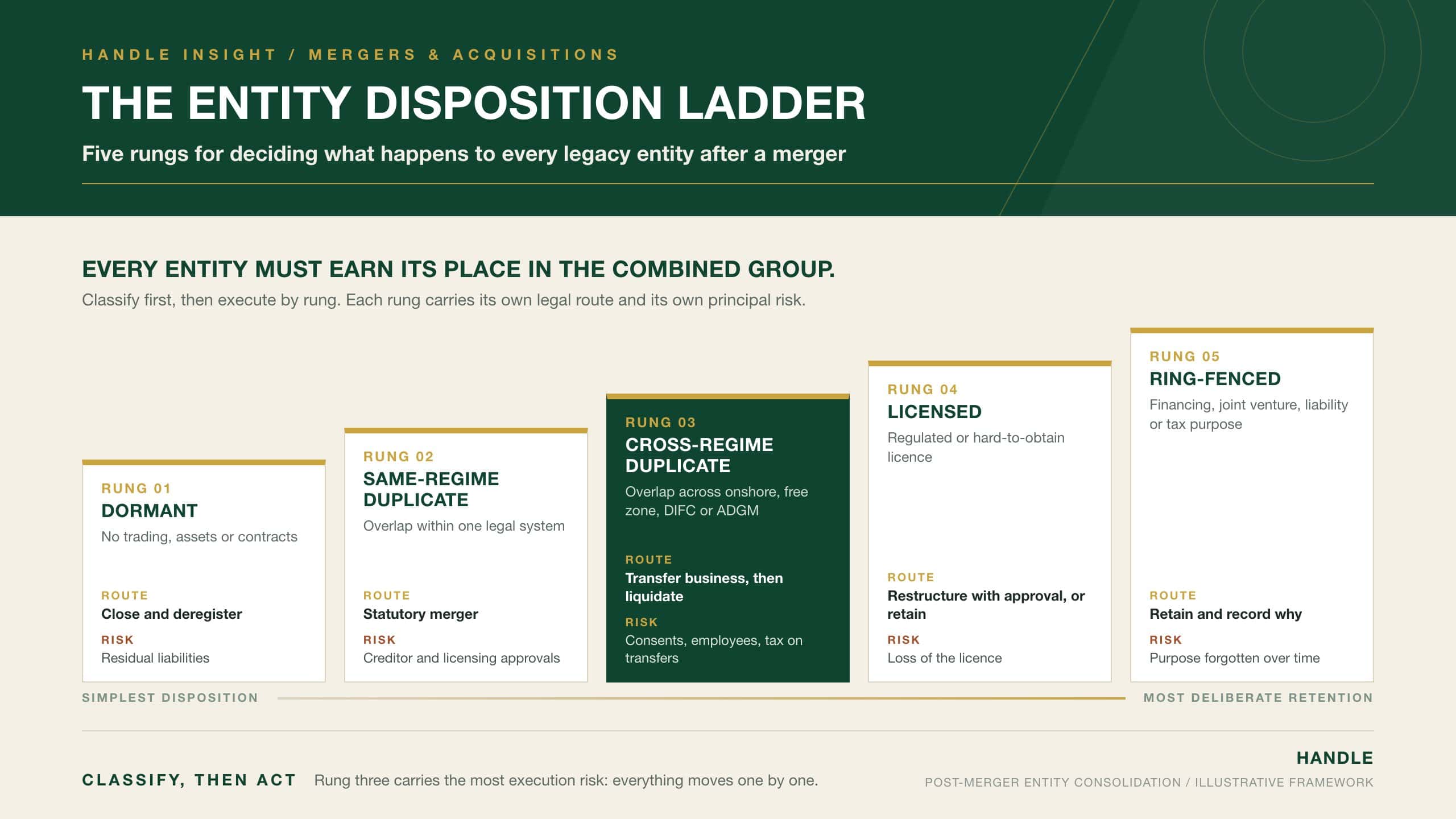
The Entity Disposition Ladder classifies every legacy entity on one of five rungs, from the simplest disposition to the most deliberate retention. Each rung carries its own legal route and its own principal risk.
Rung 1: Dormant. No trading, assets or contracts. Settle residual liabilities, deregister for tax and close.
Rung 2: Same-regime duplicate. Overlapping activity in the same legal system. Merge into a survivor by statutory merger where available.
Rung 3: Cross-regime duplicate. Overlapping activity in a different legal system. Transfer assets, contracts and people, then liquidate. This rung carries the highest execution risk because every contract, licence and employee must move individually.
Rung 4: Licensed. Holds a regulated or hard-to-obtain licence. Restructure only with the regulator’s approval, or retain.
Rung 5: Ring-fenced. Exists for financing, joint venture, liability or tax reasons. Retain deliberately and document why.
| Rung | Entity Profile | Disposition | Principal Risk |
|---|---|---|---|
| 1. Dormant | No trading, assets or contracts | Close and deregister | Unsettled residual liabilities |
| 2. Same-regime duplicate | Overlapping activity in the same legal system | Statutory merger into a survivor | Creditor objections and licensing approvals |
| 3. Cross-regime duplicate | Overlapping activity in a different legal system | Transfer business, then liquidate | Counterparty consents, employee moves, tax on transfers |
| 4. Licensed | Regulated or hard-to-obtain licence | Restructure with approval, or retain | Loss of the licence or regulatory breach |
| 5. Ring-fenced | Financing, joint venture, liability or tax purpose | Retain and document the reason | Purpose forgotten, entity drifts out of control |
The ladder prevents two opposite errors: keeping entities by default and eliminating entities that protect value. Classification comes first. Execution follows the rung.
Common Post-Merger Entity Consolidation Failures
- Starting consolidation without a complete entity map, so liabilities and contracts surface in entities already being wound up.
- Assuming a statutory merger is available between entities in different legal regimes, then rebuilding the plan late.
- Transferring contracts without checking anti-assignment and change-of-control clauses, triggering consent requirements or termination rights.
- Eliminating the entity that holds tax losses or a valuable licence without recognising the value being lost.
- Triggering clawback of a tax relief by disposing of transferred assets or shares within the restricted period.
- Moving employees without addressing visas, work permits and end-of-service gratuity.
- Closing entities without settling final tax, licensing and registry obligations, leaving directors exposed.
Each failure turns a simplification programme into a source of new risk. Sequence and evidence prevent it.
Conclusion
Legal entity consolidation post-merger converts an inherited collection of companies into a structure the combined group can control. The work begins with a complete entity map and a decision for each entity: dissolve, merge, transfer and liquidate, restructure with regulatory approval, or retain deliberately. In the UAE, the route depends on whether entities sit onshore, in a free zone, in the DIFC or in ADGM, because statutory mergers generally work within a regime and cross-regime consolidation usually requires transfers followed by liquidation. Corporate Tax reliefs, tax losses, licences, contracts and employees each set constraints on sequence. Groups that classify first and execute by rung reduce cost and liability together. Groups that consolidate by default either keep entities they do not need or remove entities that protect value. Structure follows purpose. Control follows structure.


