

Most acquisition disputes are not caused by risks nobody saw. They are caused by risks that were seen but placed on the wrong side of the closing line. A buyer that relies on a warranty claim for a problem it could have made a condition to closing has chosen litigation over leverage. A seller that accepts an open-ended indemnity for a risk it could have resolved before completion has chosen exposure over certainty. Pre-closing vs post-closing legal risks are therefore not two lists to be managed separately. They are one allocation exercise with a hinge in the middle. Before closing, the buyer is exposed to deterioration in a business it does not yet control. After closing, it owns the business and is exposed to liabilities that originated before it arrived. Within M&A Risk & Legal Structuring, the acquisition agreement is the instrument that decides which risks are controlled by conditions, covenants and walk rights, and which are priced and paid for through warranties, indemnities and retained funds. The closing line moves leverage. Allocate before it does.
Why Do Pre-Closing and Post-Closing Risks Differ?
In many acquisitions, signing and completion do not happen on the same day. The parties sign the share or asset purchase agreement, then spend weeks or months obtaining regulatory clearances, finalising financing, securing third-party consents and completing restructuring steps. During that interim period the seller still operates the business, while the buyer is contractually committed to buy it.
The nature of the buyer’s exposure changes at completion. Before closing, the danger is that the business the buyer agreed to acquire is not the business it receives: value leaks out, approvals fail or financing collapses. After closing, the danger is that the business carries liabilities from its past that were not disclosed or not priced. The first is a problem of preservation. The second is a problem of allocation. Each requires different tools.
| Dimension | Pre-Closing Risk | Post-Closing Risk |
|---|---|---|
| Period | Signing to completion | Completion onwards, for the agreed survival periods |
| Who controls the business | Seller | Buyer |
| Core danger | Deterioration, failed approvals, failed financing | Historical liabilities, inaccurate disclosure, integration failure |
| Buyer’s main leverage | The right not to close | Contractual claims against the seller and retained funds |
| Primary tools | Conditions precedent, interim covenants, MAC clause, termination rights | Warranties, indemnities, limitations, escrow, insurance |
What Are the Main Pre-Closing Legal Risks?
Regulatory approval risk. Many transactions require clearance from competition authorities, sector regulators or foreign investment authorities. If approval is delayed, conditioned or refused, the transaction cannot proceed as signed. The agreement therefore makes the required approvals conditions precedent, sets a long-stop date and allocates responsibility for obtaining them, including how far the buyer must go in accepting remedies.
Operational deterioration. The seller continues to run the business, and performance may decline through market conditions, management decisions or disruption. Interim operating covenants address this by requiring the business to be run in the ordinary course and prohibiting specified actions without buyer consent, such as disposing of key assets, incurring material debt, changing senior employment terms or entering unusual contracts.
Material adverse change. A significant negative event may occur before closing: loss of a critical licence, a major customer or a key facility. A material adverse change clause may give the buyer the right not to complete. Its value depends on its drafting, because general MAC clauses are typically interpreted narrowly and are difficult to invoke.
Financing and capital risk. Where the buyer relies on external funding, a failure of financing before closing leaves the seller with a counterparty unable to pay. Sellers increasingly require certain funds or evidence of committed financing at signing, so this risk sits with the buyer rather than as a condition.
What Are the Main Post-Closing Legal Risks?
Undisclosed liabilities. Even thorough due diligence leaves gaps. Contractual breaches, regulatory non-compliance and financial irregularities may only surface after the buyer takes control. Warranties confirm the accuracy of the seller’s statements about the business, and a breach gives the buyer a claim, subject to disclosure and limitations.
Tax and regulatory exposure. Tax audits, investigations and enforcement actions relating to pre-completion periods can arise long after closing. Specific indemnities place these costs on the seller on a dirham-for-dirham basis, without the buyer having to prove a reduction in the value of the shares.
Integration and governance risk. Integration failures are operational rather than strictly legal, but documents can support integration through transitional service agreements, cooperation covenants and access to records and personnel.
Which Mechanism Controls Which Risk?
The skill in structuring lies in matching each identified risk to the right side of the closing line. A known, quantifiable issue is usually better resolved before closing or covered by a specific indemnity. An unknown risk is covered by warranties. A risk that would make the deal pointless belongs in the conditions.
| Risk Identified in Diligence | Better Controlled By | Why |
|---|---|---|
| Required merger or regulatory clearance | Condition precedent with long-stop date | Closing without it may be unlawful or void |
| Key customer contract with change-of-control clause | Condition precedent or pre-closing consent covenant | Loss after closing cannot be reversed by a damages claim |
| Known tax dispute for a prior period | Specific indemnity, supported by escrow | Quantifiable, seller-originated and likely to crystallise later |
| General accuracy of accounts and compliance | Warranties with agreed limitations | Unknown risks are allocated, not eliminated |
| Value leakage between signing and closing | Interim covenants or locked-box leakage protection | Prevents value leaving while the seller still controls the business |
Does the Price Mechanism Change the Risk Profile?
The choice of price mechanism decides who bears economic risk during the interim period. Under a completion accounts mechanism, the price is adjusted after closing by reference to the target’s actual cash, debt and working capital at completion. The buyer pays for what it receives, but the adjustment process creates a post-closing negotiation and, at times, a dispute.
Under a locked-box mechanism, the price is fixed by reference to a balance sheet at a date before signing, and economic risk passes to the buyer from that date. The buyer’s protection then shifts to leakage covenants: an undertaking that no value, such as dividends, management fees or non-arm’s length payments, has left the business since the locked-box date, with dirham-for-dirham recovery if it has.
Neither mechanism is inherently safer. Completion accounts move risk into the post-closing span. A locked box concentrates it in the pre-closing span, where the leakage covenant does the work. The mechanism must be chosen with the rest of the risk allocation, not in isolation.
How Does UAE Law Shape Both Phases?
In the UAE, the pre-closing phase is heavily influenced by approval requirements. Under the Competition Law (Federal Decree-Law No. 36 of 2023), economic concentrations that meet the thresholds set by implementing resolutions must be notified to the Ministry of Economy and cannot be completed before clearance. Acquisitions of regulated businesses may also require prior approval from the Central Bank of the UAE, which supervises banks and insurers, from the Securities and Commodities Authority where listed securities are involved or, in the financial free zones, the DFSA or FSRA for changes in control of authorised firms. These requirements belong in the conditions, with realistic long-stop dates.
Completion mechanics also differ by jurisdiction. Transfers of shares in onshore companies under the Commercial Companies Law (Federal Decree-Law No. 32 of 2021) involve the licensing authority’s procedures and, for limited liability companies, the other partners’ pre-emption rights unless waived. Companies in the DIFC and ADGM follow their own registrar processes under the DIFC Companies Law No. 5 of 2018 and the ADGM Companies Regulations 2020.
Post-closing protection must be drafted with the governing law in mind. Under the UAE Civil Transactions Law, a court may adjust agreed compensation so that it corresponds to the actual loss suffered, which can affect liquidated amounts and, in some analyses, contractual caps. Exclusions of liability for fraud are not effective, and limitation periods differ between civil and commercial claims. For these reasons, many UAE transactions choose DIFC law or English law, with DIFC Courts, ADGM Courts or arbitration as the forum, so that warranty and indemnity provisions operate as the parties intended.
A Worked Example: Allocating Risk in an AED 200 Million Acquisition
Consider an illustrative acquisition of a UAE distribution company for AED 200 million, signed in March with closing expected in July. All figures are illustrative.
- Pre-closing: merger clearance and consent from the two largest customers are conditions precedent, with a long-stop date of 30 September. Interim covenants prohibit capital expenditure above AED 5 million and any new borrowing without consent.
- Post-closing: general warranties are capped at 20 percent of the price, AED 40 million, with a de minimis of AED 250,000 per claim and a basket of AED 2 million. A specific indemnity covers a known customs and VAT dispute, capped at the price.
- Security: AED 20 million, 10 percent of the price, is held in escrow for 18 months.
In May, one key customer refuses consent. Because consent is a condition, the buyer renegotiates the price downward by AED 12 million rather than closing and suing later. In the following year, a VAT assessment of AED 6 million for a pre-closing period is issued. It falls under the specific indemnity, so no basket applies, and it is paid from escrow without litigation. Both risks were identified in diligence. Each was placed on the correct side of the closing line.
Original Analysis: The Closing Line Risk Bridge
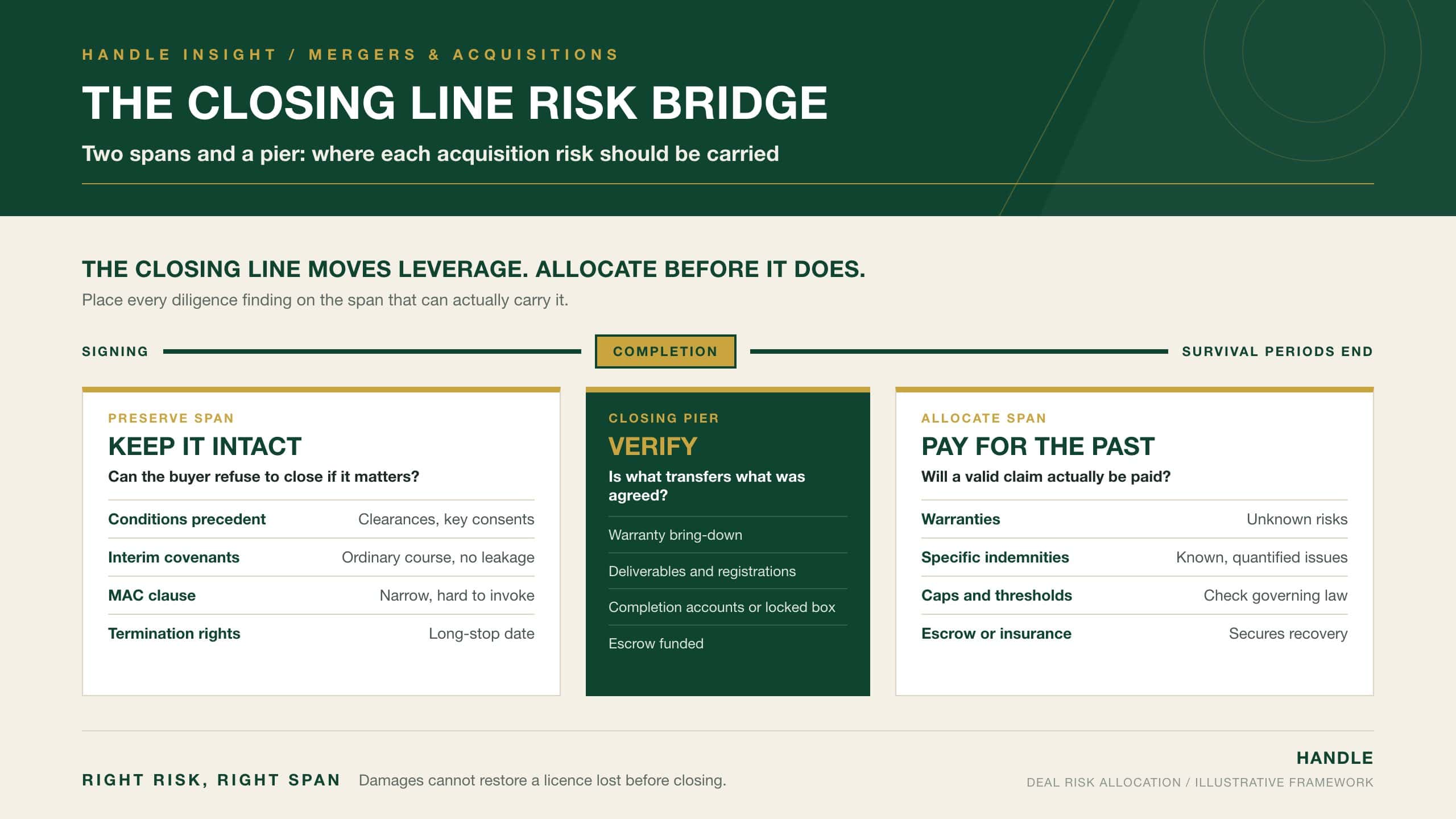
The Closing Line Risk Bridge treats the acquisition agreement as a structure with two spans and a central pier. The pre-closing span preserves value: conditions, interim covenants, MAC protection and termination rights keep the business intact and give the buyer the right to walk. The post-closing span allocates liability: warranties, specific indemnities, limitations and retained funds determine who pays for the past. The pier is completion itself: bring-down of warranties, closing deliverables, price mechanics and the funding of escrow.
| Element | Purpose | Core Instruments | Test |
|---|---|---|---|
| Preserve span | Keep the business intact until completion | Conditions precedent, interim covenants, MAC, termination rights | Can the buyer refuse to close if it matters? |
| Closing pier | Transfer control on verified terms | Warranty bring-down, deliverables, completion accounts or locked box, escrow funding | Is what transfers what was agreed? |
| Allocate span | Assign the cost of the past | Warranties, specific indemnities, caps, thresholds, escrow, insurance | Will a valid claim actually be paid? |
The bridge fails where a risk is loaded onto the wrong span. A risk that would destroy the deal’s purpose cannot be carried by the allocate span, because damages do not restore a lost licence. A known, quantified liability should not stay on the preserve span, because it gives the buyer a walk right it does not need and the seller an uncertainty it cannot price.
Common Failures in Allocating Deal Risk
- Relying on warranties for known issues, which invites disclosure against the warranty and leaves the buyer without a remedy.
- Setting long-stop dates without reference to realistic regulatory timetables, forcing extensions on the seller’s terms.
- Drafting generic MAC clauses and assuming they will be easy to invoke when they rarely are.
- Agreeing caps and survival periods without retained funds, so a successful claim depends on the seller’s later solvency.
- Ignoring how the chosen governing law treats agreed compensation, caps and limitation periods.
- Treating completion as administrative, so bring-down, deliverables and price adjustments are not verified before control passes.
Each failure moves a risk to the span where it is weakest. Each is corrected by deciding, risk by risk, where it belongs.
Conclusion
Acquisition risk changes character at completion. Before closing, the buyer is exposed to deterioration in a business it does not control, and its protection is the right not to close: conditions precedent, interim covenants, material adverse change provisions and termination rights. After closing, the buyer owns the business and is exposed to its history, and its protection is the right to be paid: warranties, specific indemnities, limitations, escrow and insurance. In the UAE, merger control, sector approvals, onshore transfer formalities and the treatment of agreed compensation under the Civil Transactions Law all affect where each risk should sit and which governing law should apply. The Closing Line Risk Bridge reduces the exercise to one discipline: place every identified risk on the span that can actually carry it, and verify the transfer at the pier. Preservation protects the deal. Allocation protects the price.


