

Signing an acquisition agreement does not transfer a company. In a regulated UAE transaction, the buyer and seller sign a binding contract whose central obligation, the transfer of ownership, cannot lawfully be performed until one or more authorities have approved it. Regulatory conditions precedent in UAE M&A are the contractual provisions that hold the deal in that suspended state and decide what happens while it waits. They operate within the wider framework of Regulatory Approvals in the UAE, where the competition authority, financial regulators, sector licensing bodies and free zone authorities each control a different gate. The drafting question is not whether approvals are needed. It is who must obtain them, how hard they must try, what they must accept, and when either party can walk away. A condition precedent does not remove regulatory risk. It allocates it.
What Is a Regulatory Condition Precedent?
A condition precedent is an event that must occur before the parties are obliged to complete. Until it is satisfied, or waived where waiver is permitted, the agreement is binding but completion is suspended. UAE civil law recognises obligations that depend on a future, uncertain event, and the Civil Transactions Law requires contracts to be performed in good faith. That principle colours how a court or tribunal will view a party that drags its feet on a filing.
A regulatory condition precedent is one that depends on a decision by a public authority rather than on the parties themselves. That distinction matters. The parties control their own board approvals and third-party consents to a large degree. They do not control the timetable, information requests or outcome of a regulator’s review. The contract must therefore manage uncertainty that neither side can eliminate.
Which UAE Approvals Commonly Become Conditions?
The approvals required depend on the target’s activities, its licensing jurisdiction, the parties’ market positions and the identity of the buyer. The table below summarises the categories most often encountered.
| Approval Category | Typical Authority | Usual Trigger | Timing Risk |
|---|---|---|---|
| Merger control | Federal competition authority under Federal Decree-Law No. 36 of 2023 | Economic concentration meeting the notification thresholds | Statutory review period, extendable, plus information requests |
| Banking, finance and insurance | Central Bank of the UAE | Acquisition of a controlling or significant holding in a licensed institution | Fit and proper review of the acquirer and its owners |
| Financial free zones | DFSA in the DIFC; FSRA in ADGM | Change in controller of an authorised firm | Prior approval required before control passes |
| Listed companies | Federal capital markets regulator and the relevant exchange | Takeover or acquisition of a significant stake in a public joint stock company | Offer timetable and disclosure rules |
| Sector licences | Telecommunications, health, energy, education and other sector regulators | Change of ownership of a licensee | Discretionary and often unpublished timelines |
| Foreign ownership | Licensing authority applying federal and emirate rules | Foreign acquirer in an activity of strategic impact | Possible restriction or conditions on ownership |
Not every deal triggers every category. Mapping which gates apply, and in what order, is the first and most consequential piece of regulatory work.
How Does UAE Merger Control Affect Closing?
The UAE Competition Law, Federal Decree-Law No. 36 of 2023, replaced the 2012 regime and introduced a materially stricter merger control system. Its implementing Cabinet resolution, effective from 2025, sets notification thresholds based on the parties’ combined annual sales in the relevant UAE market and their combined market share. Where a transaction amounts to an economic concentration that meets either test, it must be notified and cannot be completed until clearance is granted. The regime is suspensory.
Several features shape the drafting. The review period runs from the date the authority accepts the filing as complete, and it can be extended, so parties should plan for a review of several months rather than weeks. The authority may clear the transaction outright, clear it subject to conditions, or prohibit it. Completing before clearance, often called gun-jumping, exposes the parties to fines that can be calculated by reference to sales in the relevant market. Free zone status does not of itself take a transaction outside the law; the question is the effect on competition in the UAE. Certain entities and activities fall outside the regime or under a sector regulator’s own competition powers, and that scope should be confirmed early rather than assumed.
Because the thresholds are market-based, the analysis requires a defensible definition of the relevant market and reliable sales data from both sides. That work belongs before signing, not after.
Sector and Financial Regulator Approvals
Where the target holds a licence from a financial or sector regulator, the regulator typically has to approve the new controller before control passes. These reviews focus on the acquirer rather than on market structure: its ownership chain, financial standing, governance, compliance history and the source of funds. Information requests reach upward to ultimate beneficial owners, which can surprise investor consortia and fund structures.
In the financial free zones, the DFSA and FSRA each require prior approval for a change in controller of an authorised firm. Onshore, the Central Bank of the UAE supervises banks, finance companies and insurers, and its approval is required for qualifying acquisitions in those institutions. Sector licensing bodies in telecommunications, healthcare, education and energy apply their own criteria and timetables, which are rarely fixed by statute.
Since the 2021 reforms to the Commercial Companies Law, Federal Decree-Law No. 32 of 2021, most onshore activities permit full foreign ownership. Activities designated as having strategic impact remain subject to additional conditions, so a foreign buyer of a business in those activities should treat ownership eligibility as a condition in its own right.
Allocating Regulatory Risk in the Agreement
A condition precedent tells the parties what must happen. The surrounding covenants tell them who must make it happen and at what cost. Four provisions carry most of the weight: the efforts standard, the remedies commitment, control of the regulatory process and the financial consequences of failure.
| Provision | Buyer-Leaning Position | Seller-Leaning Position | Balanced Position |
|---|---|---|---|
| Efforts standard | Reasonable endeavours to obtain approvals | Hell-or-high-water: whatever is required | All reasonable endeavours with defined limits |
| Remedies | No obligation to accept any condition | Obligation to accept any condition imposed | Accept conditions below a defined materiality threshold |
| Process control | Buyer leads filings and strategy alone | Seller reviews and approves all submissions | Buyer leads; seller consulted with rights to comment and attend |
| Failure consequences | No payment if approvals fail | Reverse break fee payable by buyer | Reverse break fee only where failure stems from buyer-side issues |
The right balance depends on where the regulatory risk originates. If clearance risk arises from the buyer’s existing market share or ownership profile, the seller has a strong case for a higher efforts standard and a reverse break fee. If the risk arises from the target’s own licence history, the buyer has a strong case for protection.
Can a Regulatory Condition Be Waived?
Commercial conditions, such as the absence of a material adverse change or the delivery of third-party consents, are usually drafted for the benefit of one party, who may waive them and complete regardless. Regulatory conditions are different. Where the law itself prohibits completion without approval, the condition reflects a legal requirement rather than a commercial preference, and no contractual waiver can make an unlawful completion lawful.
The agreement should therefore separate mandatory approvals from discretionary ones. A mandatory merger control clearance or controller approval should be expressed as non-waivable. Where the parties have included a filing out of caution, for example a voluntary approach to an authority in a borderline case, the agreement can permit waiver by both parties jointly once advice confirms that completion would not breach the law.
The same discipline applies to conditional clearances. If an authority approves subject to undertakings, the agreement should state whether that approval satisfies the condition, and at what level of burden. Without that language, a conditional clearance can become a fresh negotiation at the worst possible moment.
Long-Stop Dates and Interim Period Discipline
The long-stop date is the point at which either party may terminate if conditions remain unsatisfied. Set too early, it hands an option to whichever party has changed its mind. Set too late, it leaves the seller running a business in limbo. Many agreements include an automatic extension where only regulatory conditions remain outstanding and the parties are still pursuing them in good faith.
Between signing and completion, the seller is usually bound by conduct-of-business covenants and the buyer gains information and consent rights. Those rights must stop short of the buyer taking control before clearance. Integration planning is permitted; integration in practice is not.
A Worked Example: Setting the Long-Stop Date
Consider an illustrative acquisition of a UAE finance company by a regional group with existing activity in the same market. The parties sign on 1 February. The merger control filing is accepted as complete on 15 March, and the parties assume a review of three months with a possible extension of six weeks. The Central Bank controller approval runs in parallel, with an assumed four to five months from submission on 1 March.
On these illustrative assumptions, clearance could arrive by mid-June or slip to the end of July, and Central Bank approval by July or August. A long-stop date of 31 July would allow either party to walk away while both reviews were proceeding normally. A long-stop of 30 September, with one automatic three-month extension if only regulatory conditions remain outstanding, matches the realistic path and keeps both parties bound. The dates are illustrative. The method of building the long-stop from mapped timelines is not.
Original Analysis: The Closing Certainty Pathway
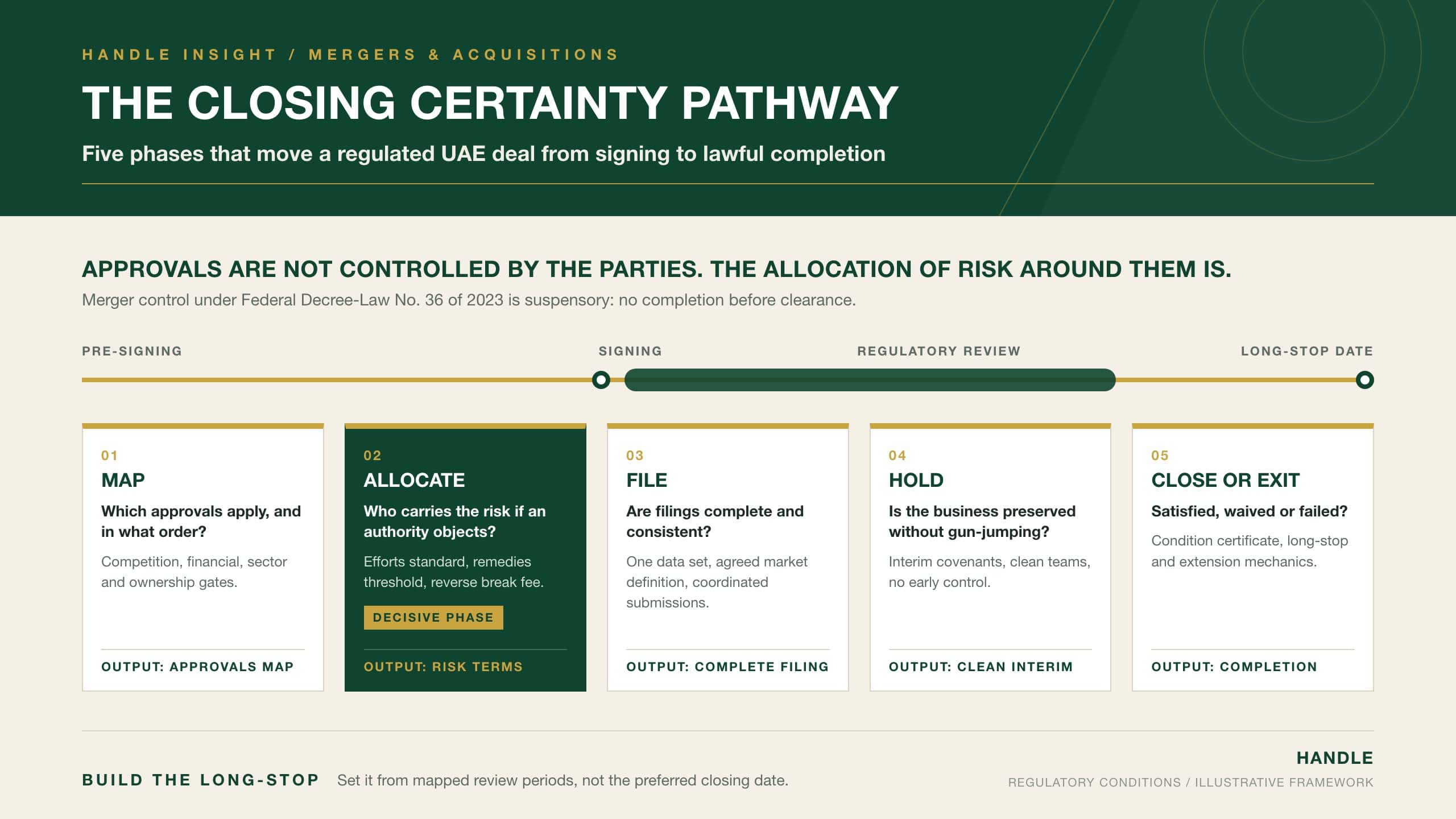
Regulatory conditions precedent are best managed as a sequence rather than a clause. We call this the Closing Certainty Pathway: five phases that move a transaction from signing to lawful completion with risk allocated at every step.
| Phase | Core Question | Control Point |
|---|---|---|
| 1. Map | Which approvals apply, and in what order? | Pre-signing approvals map covering competition, sector, financial and ownership gates |
| 2. Allocate | Who carries the risk if an authority objects? | Efforts standard, remedies threshold, reverse break fee |
| 3. File | Are the filings complete and consistent? | Coordinated submissions, single data set, agreed market definition |
| 4. Hold | Is the business preserved without gun-jumping? | Interim covenants, clean team protocols, no early control |
| 5. Close or Exit | Are all conditions satisfied, waived or failed? | Condition certificate, long-stop and extension mechanics |
Allocation is the decisive phase. Every later phase executes a risk allocation that was agreed, or left unclear, before signing. A pathway that is mapped and allocated in advance turns regulatory review from a source of dispute into a managed timetable.
Common Failures in Structuring Regulatory Conditions
- Signing before completing the merger control analysis, so the timetable and long-stop date rest on an assumption that no filing is required.
- Using a vague efforts standard that leaves both parties free to argue later about whether a remedy should have been offered.
- Setting the long-stop date from the parties’ preferred closing date rather than from the realistic review periods of each authority.
- Overlooking controller approvals for regulated subsidiaries in the DIFC or ADGM, where control passes indirectly through an onshore acquisition.
- Allowing the buyer to influence pricing, customers or hiring before clearance, which can amount to completing early in substance.
- Submitting inconsistent information to different regulators, which invites further questions and delays every review.
- Treating condition satisfaction as a formality and failing to document it, leaving room for dispute at the completion meeting.
Each failure arises from treating approvals as an administrative step instead of a negotiated allocation of risk.
Conclusion
Regulatory conditions precedent in UAE M&A define the interval between a binding contract and a lawful transfer of ownership. Merger control under Federal Decree-Law No. 36 of 2023 is suspensory, financial and free zone regulators must approve new controllers, and sector licensing bodies apply their own discretionary reviews. None of these timetables is controlled by the parties. What the parties do control is the allocation of risk around them: the efforts standard, the remedies each side must accept, who leads the process, what happens on failure and how long the deal can remain conditional. Those terms should be built from a pre-signing approvals map, not from the preferred closing date. The interim period must preserve the business without handing control to the buyer early. Conditions do not merely protect the transaction. They set the terms on which it may become lawful.


