

An acquirer does not only buy a company. It buys every counterparty, shipment, shareholder and payment route that company has relied on, and it inherits the regulatory exposure attached to them. Sanctions and export controls are the area where that inheritance is least forgiving, because several regimes can apply to the same transaction at once and liability can attach regardless of whether the buyer knew. Within Regulatory & Compliance in M&A, trade and sanctions screening in M&A is the diligence workstream that tests who really owns and controls the target, who it trades with, what it ships, where it operates and how the deal money will move. Its purpose is not to produce a clean screening report. It is to decide, before signing, whether the risk can be cleared, remediated, priced or must be walked away from. Capital should move only where exposure has been identified and closed.
Why Sanctions Exposure Transfers With the Target
Sanctions regimes prohibit dealings with designated persons, restrict trade with certain jurisdictions and sectors, and control the export of sensitive goods and technology. When a buyer acquires shares, the target remains the same legal person. Its past conduct, its contracts and any ongoing breaches continue inside the buyer’s group. Regulators assess the enforcement position of the combined organisation, and an acquirer that continues a prohibited relationship after closing is likely to be treated as responsible for it.
Exposure also arises in ways that have nothing to do with past misconduct. A minority shareholder of the target may be designated. A distributor may re-export goods to a restricted destination. A bank in the payment chain may refuse to process the purchase price. Each of these can delay or block a transaction even when the target’s own compliance record is sound.
The practical consequence is simple. Sanctions screening is not a box ticked at the end of legal diligence. It belongs at the start, because its findings can change the structure, the price and the counterparties of the deal.
Which Sanctions Regimes Apply to a UAE Transaction?
A transaction involving a UAE buyer or target is rarely subject to one regime only. The applicable set depends on the nationality of the parties and their personnel, the currency of payment, the origin of goods and technology, and where the target does business.
United Nations and UAE measures. The UAE implements United Nations Security Council targeted financial sanctions and maintains its own Local Terrorist List. The framework is set out in Cabinet Decision No. 74 of 2020, with the Executive Office for Control and Non-Proliferation acting as the coordinating authority. Persons in the UAE, including in the DIFC and ADGM, must freeze funds of listed persons without delay, must not make funds or economic resources available to them and must report matches through the prescribed channels. The UAE also operates a strategic goods and dual-use export control regime.
United States measures. US primary sanctions bind US persons, US-incorporated companies and transactions with a US nexus, which commonly includes payments cleared in US dollars and the export or re-export of US-origin goods, software and technology. Certain US programmes also carry secondary sanctions risk for non-US persons who engage in specified activity.
European Union and United Kingdom measures. EU and UK sanctions bind their nationals and entities incorporated in their jurisdictions, and conduct within their territories. A UAE target with EU or UK national directors, staff, banks or subsidiaries can be drawn into these regimes.
| Regime | Who It Typically Binds | Ownership Test for Listed Persons | Main M&A Relevance |
|---|---|---|---|
| UN and UAE | All persons in the UAE, including the DIFC and ADGM | Funds owned or controlled, directly or indirectly, by listed persons are caught | Freezing and reporting duties; ownership chain of target and seller |
| United States | US persons, US dollar transactions, US-origin items | Entities owned 50 percent or more in aggregate by blocked persons are blocked | USD payment of price, US-origin technology, secondary sanctions |
| European Union | EU nationals and entities, conduct in the EU | Ownership above 50 percent or control by a listed person | EU-national management, EU banks and subsidiaries |
| United Kingdom | UK nationals and entities, conduct in the UK | Ownership above 50 percent or control by a designated person | UK financing, UK-national directors and advisers |
The ownership tests differ in detail, and control can be found below the ownership thresholds. Analysis should be carried out against each regime that applies rather than against a single global list.
What Does Sanctions Screening in M&A Actually Test?
Effective screening covers five areas. Each answers a separate question, and a clear result in one does not imply a clear result in another.
Ownership and control. The full chain of shareholders, beneficial owners, directors and senior managers of the target, and of the seller, is screened against applicable lists. Aggregation matters: two designated persons holding 30 percent each can make an entity blocked under US rules even though neither holds a majority. Control through voting agreements, board nomination rights or nominee arrangements is examined as well as legal title.
Counterparties and channels. Customer, supplier, agent and distributor lists are screened, with emphasis on high-risk sectors and intermediaries. The question is not only whether a counterparty is listed, but whether it is owned by a listed person or acts as a channel to a restricted destination.
Goods, technology and end use. The product range is classified against applicable export control lists, including dual-use controls. Software, encryption, industrial equipment and components incorporating US-origin content frequently require analysis. End-user declarations and licensing records are reviewed.
Geography and trade routes. Sales records, shipping documents and logistics data are reviewed for activity involving comprehensively sanctioned jurisdictions and for patterns that suggest diversion through third countries.
Deal funds flow. The route of the purchase price, financing, escrow and any deferred consideration is mapped. Banks screen every leg. A payment that touches a designated person, a restricted institution or a currency with a nexus to a stricter regime can be frozen or rejected.
A Worked Example: A Minority Shareholder Problem
Consider an illustrative acquisition of a Dubai-based industrial distributor for AED 400 million, to be paid in US dollars. The target itself is not listed, and screening of its direct shareholders returns no matches.
Enhanced ownership tracing reveals that an 18 percent shareholder is an investment company 60 percent owned by an individual designated under US sanctions. Under the US 50 percent rule, that investment company is itself treated as blocked. The target, at 18 percent, is not blocked, but any dividend, consent fee or share of the purchase price flowing to the 18 percent holder would be a dealing with a blocked person, and the dollar payment of that share would almost certainly be rejected by the clearing bank.
Counterparty screening adds a second finding: around 4 percent of revenue, roughly AED 9 million a year on illustrative figures, comes from two resellers whose shipping records show onward deliveries to a comprehensively sanctioned jurisdiction.
The buyer’s response is structured, not binary. It requires the blocked shareholder’s stake to be dealt with lawfully before signing, with specialist advice on whether any licence is needed for that step. It makes termination of the two reseller relationships and an independent look-back review conditions precedent. It obtains specific sanctions warranties and a dedicated indemnity backed by an escrow, and it revises the valuation to exclude the at-risk revenue. The deal proceeds, but on different terms and with a different shareholder register.
Original Analysis: The Five-Layer Sanctions Screen
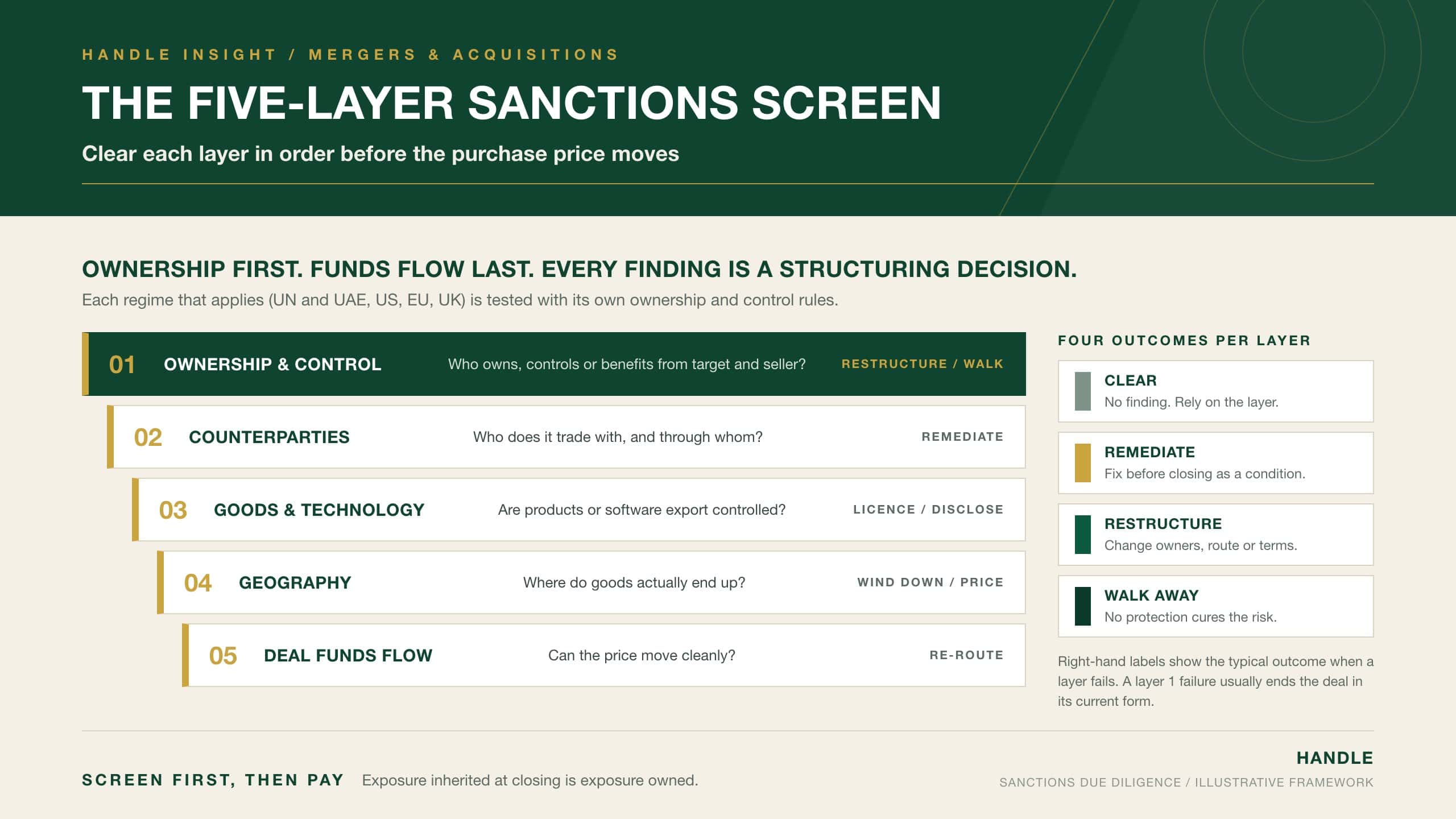
The five areas above can be organised as a sequential model in which each layer is cleared before the next is relied upon. The Five-Layer Sanctions Screen treats sanctions diligence as a filter rather than a list check.
Layer 1: Ownership and control. Who ultimately owns, controls or benefits from the target and the seller? A failure here usually stops the deal in its current form, because no contractual protection cures a prohibited counterparty on the other side of the share purchase agreement.
Layer 2: Counterparties and channels. Who does the target trade with, and through whom? Failures are often remediable by terminating relationships before closing.
Layer 3: Goods, technology and end use. What does the target make, ship or license, and is it controlled? Failures may require licences, voluntary disclosure or product-line changes.
Layer 4: Geography and trade routes. Where do goods and services actually go? Failures point to diversion risk and the need for look-back reviews.
Layer 5: Deal funds flow. Can the purchase price, financing and future dividends move without touching a restricted person, bank or currency route? Failures here can block completion even after every other layer is clear.
Each layer produces one of four outcomes: clear, remediate before closing, restructure the transaction or walk away. The model’s value lies in the order. Ownership is tested first because a failure there makes the remaining work irrelevant, and funds flow is tested last because it depends on the answers to every earlier layer.
| Finding | Typical Outcome | Contractual and Structural Response |
|---|---|---|
| Designated person in ownership chain | Restructure or walk away | Lawful exit of the interest before signing; licence analysis; deal paused until resolved |
| Restricted counterparty or channel | Remediate | Termination as condition precedent; look-back review; specific indemnity |
| Unlicensed controlled exports | Remediate or restructure | Voluntary disclosure assessment; licensing plan; escrow for penalties |
| Activity in sanctioned jurisdictions | Remediate or price | Wind-down plan; exclusion of revenue from valuation; warranties |
| Restricted payment route | Restructure | Change currency, bank or escrow agent; staged consideration |
Historical Breaches, Disclosure and Remediation
Where diligence finds past violations, the acquirer must decide how to deal with them before it owns them. The options include requiring the seller to make, or prepare, a voluntary disclosure to the relevant authority, building remediation into the integration plan, and pricing the risk through escrow or indemnity. The availability and effect of voluntary disclosure varies by regime and should be assessed with specialist advice for each jurisdiction involved.
Prior enforcement actions also deserve attention. Undertakings, monitorships or compliance commitments given by the target to a regulator usually continue after a change of ownership, and the acquirer must be able to meet them.
Integration: Closing the Gap After Closing
Screening before signing is a snapshot. Exposure returns if the target’s systems are not brought up to the acquirer’s standard quickly. Post-closing integration should migrate the target’s customer and supplier data into the group screening system, align sanctions and export control policies, assign compliance ownership in each business unit and train staff whose roles involve trade, logistics or payments. The first months after closing are when legacy relationships are most likely to continue unnoticed.
Common Failures in Sanctions Screening for M&A
- Screening only the target entity and its direct shareholders, which misses aggregated or indirect ownership by designated persons.
- Relying on a single global list, when the applicable regimes use different ownership and control tests.
- Treating export control classification as a technical afterthought, so controlled products are discovered only during integration.
- Ignoring the purchase price route until completion, when a bank rejection can delay closing or freeze funds.
- Accepting general compliance warranties instead of specific sanctions warranties, conditions precedent and a funded indemnity.
- Assuming that a UAE transaction is outside US, EU or UK reach without checking currency, personnel and product origin.
- Leaving the target on its legacy screening system after closing, which allows prohibited relationships to continue under new ownership.
These failures share one cause. Screening was treated as a search result rather than as a structuring decision.
Conclusion
Trade and sanctions screening in M&A determines whether an acquirer buys a business or a regulatory problem. In a UAE transaction, United Nations and UAE targeted financial sanctions apply as a baseline, and US, EU and UK measures can attach through currency, personnel, financing and the origin of goods. Each regime tests ownership and control differently, so screening must trace the full chain and apply the right test. The Five-Layer Sanctions Screen gives the work its order: ownership and control first, then counterparties, goods and technology, geography and, finally, the route of the deal money. Every finding leads to a decision to clear, remediate, restructure or walk away, and that decision is written into conditions precedent, warranties, indemnities and escrow. The work does not end at closing. Integration must bring the target onto the acquirer’s systems quickly. Exposure inherited is exposure owned. Screen first. Then pay.


