

Regulatory approvals for sellers decide whether a signed deal becomes a completed one. Between signing and closing, a transaction can be stopped, delayed or reshaped by competition authorities, sector regulators, licensing bodies and foreign investment regimes, none of which are parties to the purchase agreement. Within Sell Side Mergers and Acquisitions, regulatory planning is the seller’s tool for controlling that interval. The buyer usually makes the filings, but the seller carries much of the cost of failure: a business held in limbo, employees and customers unsettled, competing bidders gone and a price that no longer reflects the market. A seller that maps every approval before signing can choose the right buyer, fix the right timetable and allocate the right risk. A seller that does not is selling an option to the buyer. Clearance is not assumed. It is engineered.
Why Should Sellers Own Regulatory Planning?
It is tempting for a seller to treat approvals as the buyer’s problem. The buyer’s identity, market position and ownership structure largely determine whether a competition review or a change-in-control approval is required, and the buyer prepares most of the filings.
The seller’s exposure is different but no less real. Between signing and closing, the seller is usually bound by conduct-of-business covenants that restrict its freedom to run the company. It has taken the business off the market. If approvals fail or are delayed beyond the long-stop date, the seller is left with a business that has been through a public sale process and did not complete. That outcome affects valuation, staff retention and customer relationships long after the deal falls away.
Regulatory planning therefore begins in the preparation phase. It informs which bidders are invited, how bids are compared and which protections the seller demands in the purchase agreement.
Which Approvals Can a Sale Trigger?
Approvals fall into five broad categories. Each has a different trigger, a different authority and a different timing profile.
Merger control. Competition authorities review transactions that meet notification thresholds, usually based on turnover or market share. In the UAE, the Competition Law (Federal Decree-Law No. 36 of 2023) requires notification of economic concentrations that meet thresholds set by implementing regulation, and the transaction may not complete before clearance. The Ministry of Economy reviews the notification within statutory periods that can be extended where further information is requested. Where the buyer or target also has turnover abroad, filings in other jurisdictions may be required in parallel.
Sector change-in-control approvals. Regulated businesses usually require the regulator’s approval before anyone acquires control or a significant shareholding. In the UAE this includes the Central Bank for banks, finance companies and insurers, the Dubai Financial Services Authority for firms in the DIFC and the Financial Services Regulatory Authority for firms in the ADGM, together with sector bodies for telecommunications, healthcare, education, energy and aviation.
Ownership and licensing rules. Onshore licensing authorities and free zone authorities must approve or record share transfers and amend trade licences. Although most onshore activities are now open to full foreign ownership, some activities of strategic impact remain subject to specific conditions, and the buyer’s nationality and ownership structure must be checked against them.
Foreign investment screening. Where the target has subsidiaries or assets abroad, the buyer’s acquisition may require approval under foreign investment regimes in those countries, particularly in defence, technology, critical infrastructure and data-intensive sectors.
Contractual and government consents. Change-of-control clauses in government contracts, concessions, leases, licences and financing agreements may require consent. These are not regulatory approvals in the strict sense, but they behave like them on the closing timetable.
The Approval Map: Authority, Trigger and Timing
| Approval | Typical Trigger | Timing Risk | Seller’s Lever |
|---|---|---|---|
| UAE merger control | Thresholds met by the concentration | Extended review if information requests or concerns arise | Early analysis of buyer overlaps; long-stop date sized to the review |
| Foreign merger control | Turnover thresholds in other jurisdictions | Phase two investigations in some regimes | Require a multi-jurisdiction filing analysis before exclusivity |
| Financial services regulator | Acquisition of control or a qualifying holding | Fit and proper assessment of the buyer and its controllers | Prefer buyers already known to the regulator; pre-filing engagement |
| Other sector regulators | Change of ownership of a licensed entity | Discretionary review with limited statutory deadlines | Map licence conditions during vendor due diligence |
| Licensing and registry | Transfer of shares in an onshore or free zone company | Usually procedural, but can stall on missing documents | Prepare corporate approvals and attested documents in advance |
| Contractual consents | Change-of-control clauses | Counterparty leverage to renegotiate | Approach key counterparties under confidentiality before signing |
How Approval Risk Shapes Buyer Selection
Two bids at similar prices can carry very different regulatory risk. A strategic buyer with overlapping market share may face an extended competition review or demands for remedies. A financial buyer with a complex fund structure may struggle with a regulator’s fit and proper assessment of its ultimate controllers. A foreign buyer may trigger screening in jurisdictions where the target has assets.
Sellers should therefore require bidders to disclose, with their bids, the approvals they expect to need, their analysis of competition overlaps, the information they will provide to regulators about their ownership and source of funds, and their proposed approach to remedies. A bid that is lower in headline price but certain to clear may produce more value than a higher bid that carries a material chance of failure or a long delay.
Allocating Regulatory Risk in the Purchase Agreement
The purchase agreement determines who bears the cost if approvals are slow, conditional or refused. The key provisions are the conditions precedent, the efforts standard, the long-stop date and any break fee.
| Provision | Seller-Protective Position | Buyer-Protective Position |
|---|---|---|
| Conditions precedent | Only mandatory, suspensory approvals | Broad conditions including discretionary consents |
| Efforts standard | Buyer accepts any remedy required to clear the deal | Reasonable efforts with no obligation to accept remedies |
| Filing obligations | Buyer files within a fixed number of days of signing | Filing when practicable |
| Long-stop date | Realistic date with no unilateral extension by the buyer | Long date with buyer extension rights |
| Reverse break fee | Payable by the buyer if regulatory conditions are not met | None |
| Ticking fee | Price increases with time from an agreed date | Fixed price regardless of delay |
No seller obtains every protective position. The purpose of the table is to identify which positions matter most given the specific approval map. Where the main risk is a competition review, the efforts standard and reverse break fee carry the most weight. Where the main risk is a slow but predictable sector approval, a realistic long-stop date and a ticking fee may matter more.
A Worked Example: Pricing the Delay
The following example is illustrative. A seller agrees to sell a licensed financial services business for AED 400 million. Approvals from the relevant financial regulator and the competition authority are expected to take four months. The seller expects annual free cash flow of AED 30 million to remain in the business until closing under a locked-box mechanism.
If approvals take ten months instead of four, the seller loses roughly six months of time value on AED 400 million while continuing to operate under conduct restrictions. At an assumed 8 percent cost of capital, that delay costs approximately AED 16 million. A ticking fee of 8 percent per annum from month five, or a locked-box interest mechanism, would transfer that cost to the buyer. A reverse break fee of 3 percent, or AED 12 million, would compensate the seller if approvals were ultimately refused because of the buyer’s own profile. Neither protection prevents delay. Both make the buyer care about it.
Managing the Interim Period Without Gun-Jumping
While approvals are pending, the seller still owns and runs the business. The purchase agreement will normally restrict the seller from taking significant actions without the buyer’s consent, such as entering major contracts, incurring new debt, changing senior management or paying dividends outside agreed limits. These covenants protect the value the buyer has agreed to pay for.
They must not go further. Where merger control applies, the buyer may not exercise control over the target before clearance. Covenants that give the buyer influence over ordinary commercial decisions, such as pricing, customer terms or day-to-day hiring, and integration planning that involves exchanging competitively sensitive information between competitors, can amount to premature implementation of the transaction. That exposure falls on both parties, and authorities in many jurisdictions treat it seriously.
The practical controls are well established. Interim covenants should be limited to protecting value rather than directing the business. Any exchange of sensitive information should pass through a clean team of advisers or ring-fenced employees under written protocols. Integration planning can proceed, but implementation waits for clearance. For the seller, discipline in this period also preserves the business if the deal does not complete.
The interim period is also when regulators ask questions. The seller should agree with the buyer who responds to requests about the target, how quickly, and with what review rights, so that information requests do not stall because the parties are waiting for each other.
Original Analysis: The Approval Perimeter Map
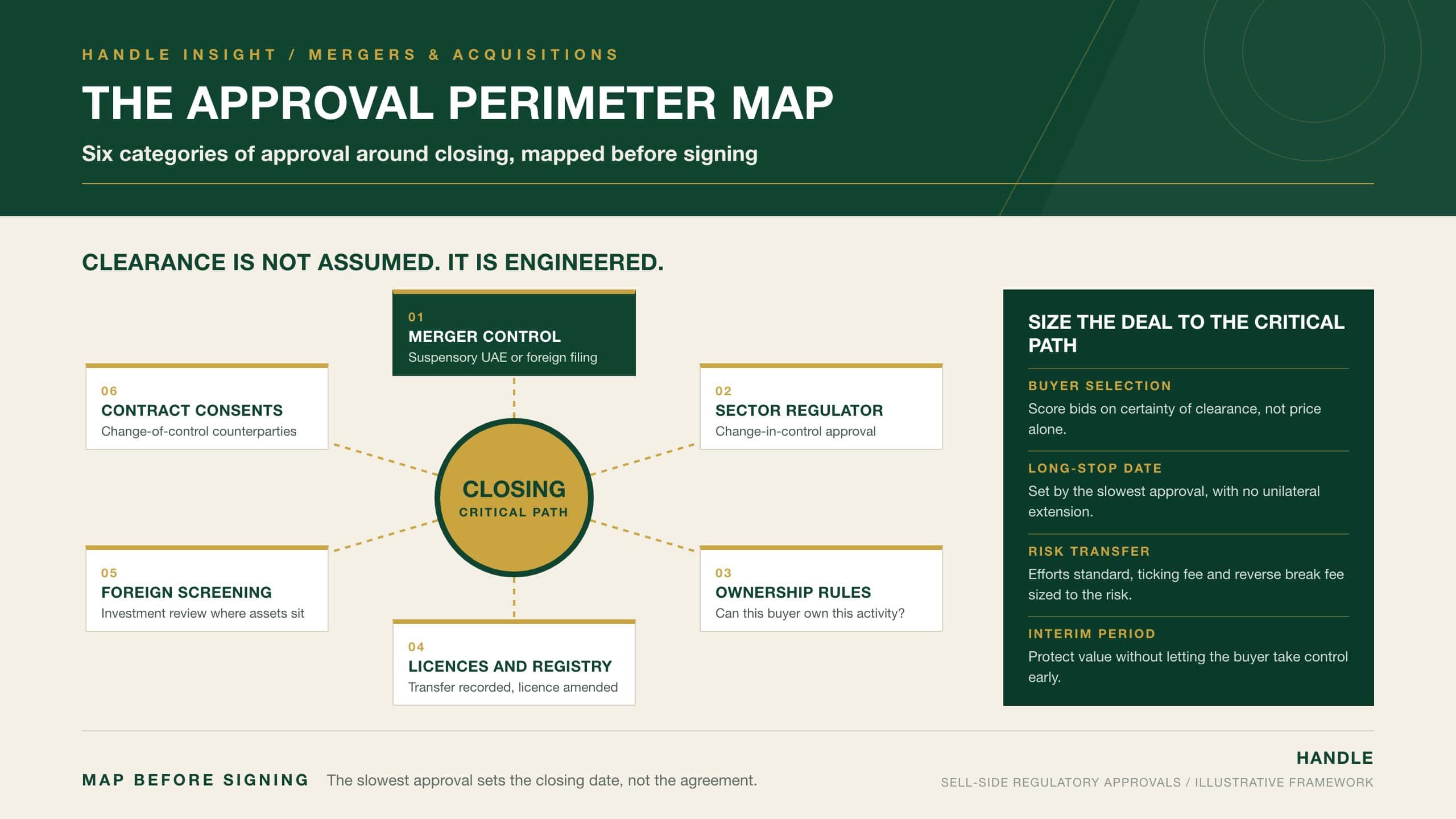
Sellers often discover approvals one at a time, as advisers raise them. A better approach is to map the full perimeter of approvals around the closing before signing, and to identify which one sits on the critical path. We describe this as the Approval Perimeter Map: closing sits at the centre, and six categories of approval surround it.
| Spoke | Question for the Seller | Control Before Signing |
|---|---|---|
| 1. Merger control | Is a UAE or foreign filing triggered, and is clearance suspensory? | Threshold analysis and overlap review for each bidder |
| 2. Sector regulator | Does the buyer need change-in-control approval? | Regulator engagement and buyer controller information |
| 3. Ownership rules | Can this buyer lawfully own this activity? | Activity and nationality check against current rules |
| 4. Licences and registry | What must the licensing authority record? | Corporate approvals and documents ready for filing |
| 5. Foreign screening | Do foreign assets trigger investment review? | Asset map by jurisdiction and sector |
| 6. Contractual consents | Which counterparties can block or reprice? | Consent strategy for key contracts |
The map has one practical output: the critical path. In most UAE transactions involving a regulated target, the sector change-in-control approval or merger control review sets the closing date. Once the critical path is known, the long-stop date, the efforts standard and the break fee can be sized to it rather than to a generic timetable.
Common Seller Failures on Regulatory Approvals
- Sellers compare bids on price alone and accept a buyer whose market overlaps make an extended competition review likely.
- Approval analysis is left to the buyer’s counsel, so the seller learns of a foreign filing or sector approval after signing.
- Long-stop dates are set by convention rather than by the actual review periods, and the buyer gains a free walk right.
- Efforts clauses allow the buyer to refuse remedies, so the seller bears the risk of the buyer’s own market position.
- Licence conditions restricting changes of ownership are discovered during the buyer’s due diligence rather than the seller’s own preparation.
- Key counterparties are approached for consent only after announcement, giving them leverage to renegotiate commercial terms.
Each failure transfers control of the timetable from the seller to someone else.
Conclusion
Regulatory approvals for sellers determine whether a transaction moves from signature to completion on terms the seller can accept. Merger control, sector change-in-control approvals, ownership and licensing rules, foreign investment screening and contractual consents each sit between signing and closing, and each can delay, condition or prevent the deal. Sellers who treat these approvals as the buyer’s problem discover too late that the cost of delay or failure falls largely on them. Sellers who map the full approval perimeter before signing can select buyers on certainty as well as price, set a long-stop date that matches the critical path, and negotiate efforts obligations, ticking fees and reverse break fees that make the buyer share the regulatory risk. In the UAE, that map should cover the federal Competition Law, the relevant financial and sector regulators and the onshore or free zone registry. Map the approvals. Find the critical path. Price the delay.


