

Joint ventures rarely fail because collaboration is a bad idea. They fail because the partners agreed on an opportunity without agreeing on what would happen when their interests diverged. Strategy shifts, capital needs grow, one partner’s capability proves weaker than promised, or one side wants liquidity while the other wants to keep building. If the venture’s documents do not answer those questions in advance, each becomes a dispute. Within the framework of Strategic Partnerships & Joint Ventures, the study of JV failures is useful precisely because the causes repeat. They are visible at formation, they can be named and they can be closed by structure. The lessons learned from failed ventures are not about trust. They are about design. A joint venture fails along the fault lines its partners chose not to draft.
Why JV Failures Follow Predictable Patterns
Every joint venture combines two or more independent institutions with different owners, boards, incentives and time horizons. At signing, those differences are outweighed by a shared opportunity. Over time, the opportunity changes and the differences remain.
Failure therefore tends to appear at the points where the partners’ interests can separate: the direction of strategy, the timing of returns, control of decisions, delivery of promised contributions, funding of the plan and the route out. These six fault lines account for most JV failures. Each can be anticipated. Each can be addressed in the shareholders’ agreement, the constitution and the business plan before capital is committed.
The Six Fault Lines Behind Most JV Failures
| Fault Line | How It Appears | Early Warning Sign | Control at Formation |
|---|---|---|---|
| Strategy | Partners pursue different goals for the venture | Disagreement over the first annual budget | Written purpose, scope and non-compete boundaries |
| Horizon | One partner seeks liquidity while the other seeks growth | Pressure for early distributions | Agreed holding period, lock-up and exit windows |
| Governance | Equal votes produce deadlock, or shareholders run operations | Repeated deferral of board decisions | Reserved matters list, delegation to management, deadlock mechanism |
| Capability | A partner’s promised contribution does not materialise | Missed milestones on technology, licences or market access | Defined contribution obligations, milestones and remedies |
| Capital | The plan needs more funding than one partner can provide | Revised forecasts requiring new equity | Funding obligations, capital call mechanics and dilution rules |
| Exit | No agreed route when the partnership ends | Informal approaches to third-party buyers | Transfer restrictions, pre-emption, call and put options, valuation method |
Strategic and Horizon Misalignment
The most common root cause of JV failures is that the partners never agreed precisely what the venture was for. One partner sees a platform for regional expansion. The other sees a vehicle for a specific project. Both read the same business plan and assume their interpretation is shared.
Horizon misalignment compounds the problem. A financial investor with a defined fund life needs an exit within a set period. A corporate partner may view the venture as a permanent strategic asset. When the investor seeks liquidity, the corporate partner may refuse to sell, refuse to buy and refuse to allow a third party in. The venture becomes a hostage of its own ownership.
Both risks are reduced by a written statement of purpose and scope, by agreed lock-up and exit windows, and by a valuation method that applies when either partner wishes to leave.
Governance Failure: Deadlock and Interference
Equal ownership is attractive at signing because neither partner concedes control. It is dangerous later because neither partner can decide. Without a deadlock mechanism, a disagreement on budget, leadership or investment can freeze the venture.
| Deadlock Mechanism | How It Works | Best Suited To | Main Risk |
|---|---|---|---|
| Escalation | Dispute referred to senior executives of each partner | Operational disagreements | Delay if executives also disagree |
| Chair’s casting vote | A rotating or appointed chair breaks ties | Defined categories of decisions | Effectively hands control to one side |
| Expert determination | An independent expert decides a technical question | Valuation, accounting or technical disputes | Unsuitable for strategic questions |
| Russian roulette or Texas shoot-out | One partner names a price; the other must buy or sell at it | Partners of similar financial strength | Favours the partner with deeper funding |
| Put, call or winding up | A defined trigger allows exit or dissolution | Persistent, fundamental deadlock | Value loss if the business is wound up |
The opposite failure is interference. When shareholders bypass the board and direct management on daily matters, accountability disappears. Effective ventures define reserved matters that require shareholder approval and delegate everything else to a management team with clear authority.
Capability and Due Diligence Gaps
Many ventures are formed because each partner brings something the other lacks: technology, licences, distribution, local relationships or capital. Those contributions are often described in general terms and assumed rather than tested.
Partner due diligence should be as rigorous as acquisition due diligence. It should verify the partner’s financial capacity to fund its share of the plan, the ownership and transferability of any technology or licence it contributes, its regulatory standing and the depth of the people it will second. Contributions should be defined in the agreement with milestones and remedies if they are not delivered.
Culture and Execution: The Failures That Appear After Launch
Some ventures are well designed on paper and still fail in operation. Partners with different management styles, approval processes and reporting standards struggle to work together. A partner that decides quickly through a single executive grows frustrated with one that requires several committee approvals. Seconded staff remain loyal to their parent organisations rather than the venture. Systems and processes from two organisations are combined without a clear owner.
These problems are harder to draft away, but they can be reduced. The venture should have its own leadership team with authority to act, its own operating policies rather than a patchwork of each partner’s, and a defined approach to seconded staff, including reporting lines and incentive alignment. Integration of systems and processes should be planned and owned, not left to emerge.
Performance Monitoring: Seeing Failure Early
Many JV failures are recognised only when financial results deteriorate. By then, positions have hardened. A structured monitoring framework gives both partners the same information at the same time and turns early warning signs into board agenda items rather than private grievances.
The framework should cover financial performance against plan, delivery of each partner’s contributions, progress on licences and approvals, key personnel and compliance. Agreed information rights for both partners, regardless of shareholding, prevent one side from controlling the narrative. Visibility does not prevent disagreement. It prevents surprise.
Capital Structure and Funding Failures
Business plans underestimate capital requirements more often than they overestimate them. When additional funding is needed, a partner who cannot or will not contribute can block the plan or force a dispute.
The agreement should therefore set out how capital calls are made, what happens if one partner does not fund, whether shareholder loans are permitted and how dilution is calculated. The answer should be agreed before the money is needed, when both partners are still negotiating in good faith.
Worked Example: An Illustrative Funding Gap
Consider an illustrative 50/50 joint venture capitalised with AED 100 million of equity. In year two the board approves expansion requiring a further AED 40 million. Partner A is willing to fund. Partner B cannot.
Without a funding mechanism, the venture stalls. Partner A cannot fund alone without changing ownership, and Partner B can refuse consent to any new share issue. With a pre-agreed mechanism, Partner A funds the full AED 40 million and new shares are issued at an independently determined value. If the venture is valued at AED 100 million before the new money, Partner A ends with AED 90 million of a AED 140 million equity base, or approximately 64%, and Partner B with approximately 36%. If the agreement instead provides for punitive dilution at a discount to fair value, Partner B’s stake falls further, which strengthens the incentive to fund but increases the risk of dispute over whether the discount is enforceable.
The arithmetic is simple. Agreeing it in advance is what keeps the venture moving.
The UAE Dimension: Vehicle, Documents and Forum
For ventures operating in the UAE, three choices shape how well the lessons can be applied. The first is the vehicle. Under the Commercial Companies Law (Federal Decree-Law No. 32 of 2021), many onshore activities can now be fully foreign owned, although activities with strategic impact and certain regulated sectors remain subject to additional requirements. Many partners also use a holding company in the DIFC, governed by DIFC Companies Law No. 5 of 2018, or in ADGM, governed by the ADGM Companies Regulations 2020, because those regimes offer familiar tools for shareholder arrangements and share transfers.
The second is alignment between the shareholders’ agreement and the constitution. Rights that matter, such as reserved matters, transfer restrictions and deadlock provisions, should be reflected in the constitutional documents so that they bind the company and can be relied on with the registry, not only between the partners.
The third is the dispute forum. Arbitration seated onshore under Federal Law No. 6 of 2018, as amended, or seated in the DIFC or ADGM under their own arbitration laws, offers confidentiality and enforceability, including under the New York Convention, to which the UAE acceded in 2006. Larger ventures should also check at formation whether the transaction requires merger control notification under the federal Competition Law.
Original Analysis: The JV Fault-Line Wheel
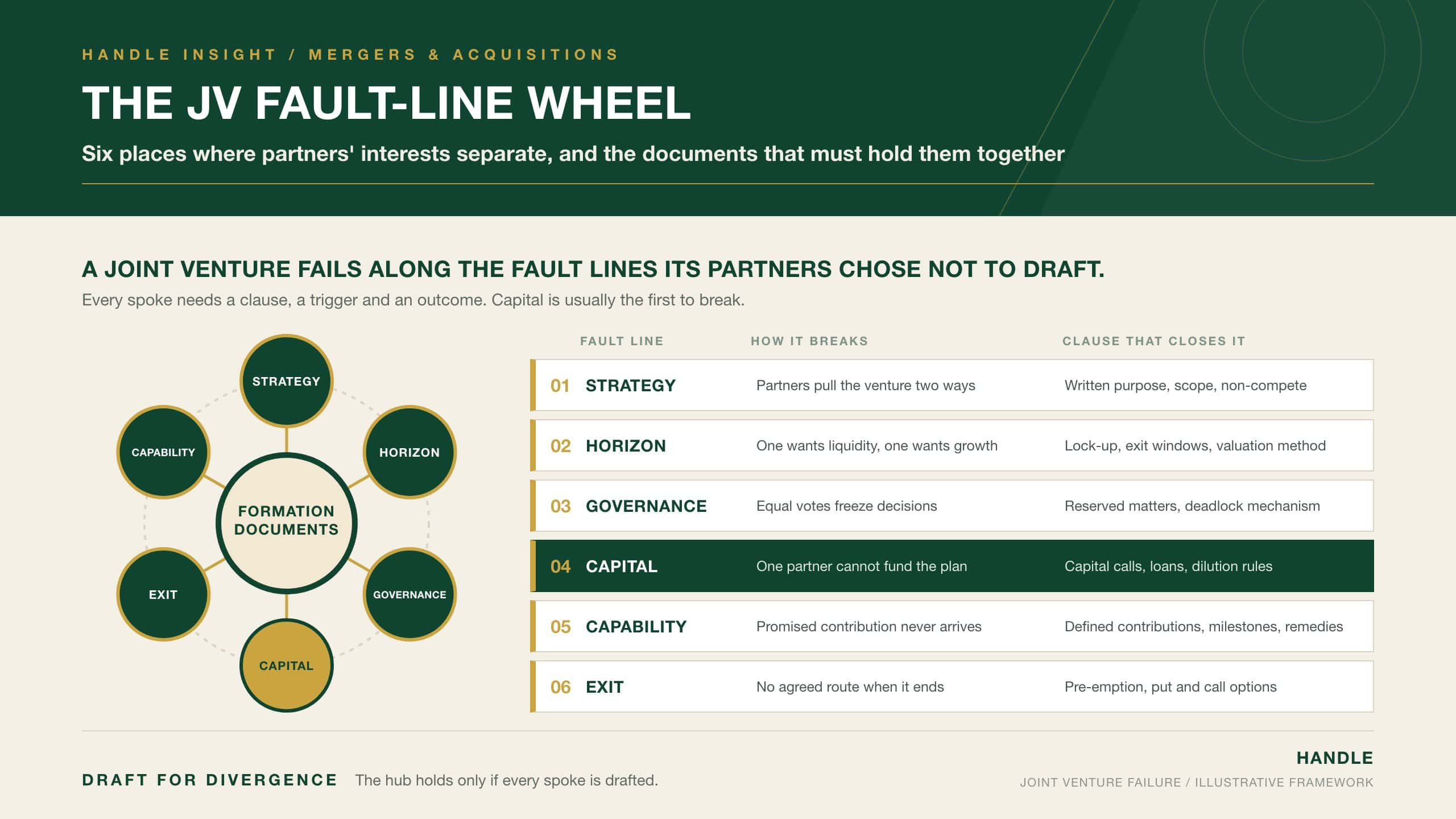
The Fault-Line Wheel arranges the six causes of JV failure around a single hub: the formation documents. Strategy, horizon, governance, capability, capital and exit are the spokes. Each spoke represents a point where the partners’ interests can separate, and each is closed only by a specific provision in the agreement and constitution.
The wheel is used as a formation checklist. For each spoke, the partners should be able to point to the clause that governs it, the trigger that activates it and the outcome it produces. A spoke without a clause is an open fault line. In practice, the capital spoke deserves the closest attention, because funding disputes arrive early and force every other fault line open at once. The wheel also shows why partial drafting is not enough. A venture with strong governance and funding provisions but no exit route will still fail when one partner wants to leave, because the pressure finds the one spoke that was left open. The hub holds only if every spoke is drafted.
Common JV Failures and the Lessons They Teach
- Partners agree the opportunity but not the purpose, so the venture is pulled in two directions from the first budget.
- Equal ownership is adopted without a deadlock mechanism, leaving no route to a decision when the partners disagree.
- Contributions of technology, licences or market access are assumed rather than verified and documented with milestones.
- Funding obligations and dilution rules are left open, so the first capital call becomes a dispute about control.
- Key rights sit only in a side agreement and are not reflected in the constitution, weakening their enforceability.
- No valuation method or exit route is agreed, so a partner’s wish to leave turns into litigation.
Each lesson points to the same conclusion. The time to resolve a joint venture dispute is before the venture exists.
Conclusion
JV failures are rarely failures of collaboration. They are failures of design along six predictable fault lines: strategy, horizon, governance, capability, capital and exit. Each appears as a disagreement that the documents did not anticipate, and each can be closed at formation by a written purpose, defined contributions, a reserved matters list, a deadlock mechanism, funding and dilution rules and an agreed exit route. In the UAE, those protections work best when the vehicle is chosen deliberately, the constitution reflects the shareholders’ agreement and disputes are referred to an enforceable forum. Partners who draft for divergence keep control of the venture when interests separate. Partners who draft for the opportunity alone hand that control to a dispute. Alignment is assumed at signing. Structure is what holds it.


