

A minority stake does not come with minority protection attached. Company law supplies a thin statutory floor, and everything above it must be negotiated, drafted and made enforceable before the capital is paid in. After closing, the majority controls the board calendar, the budget, the next funding round and the timing of any exit, and the minority’s leverage is at its lowest. In Handle’s Shareholder & Term Sheet Advisory, minority shareholder rights are treated as control architecture: a defined set of rights to see, shape, block, share and exit, each tied to a remedy that works in the jurisdiction where the company sits. The question is never how many protections a term sheet lists. It is which ones will still operate when the shareholders disagree. A right that cannot be enforced is only a preference.
Why Minority Shareholder Rights Must Be Negotiated at Entry
Before signing, the company and the majority need the minority’s capital, and the minority can set conditions. After closing, that bargaining position disappears. Any later amendment to the constitution or shareholders’ agreement will usually require the majority’s consent, which it has little reason to give.
The risks to a minority holder rarely arrive as a single dramatic event. They arrive through process: a board meeting held without its nominee, a share issue priced to favour an insider, a related party contract, a debt facility that subordinates its economics, or a sale timed to suit the controlling shareholder. Each step may be lawful on its own. Together they can move value away from the minority without any clear breach. Rights negotiated at entry are designed to interrupt those steps.
Start With the Control Map, Not the Precedent
Minority protections copied from a previous deal often protect against the wrong risks. A founder-led company presents concentration of executive power. A family business presents overlapping ownership, management and related party dealings. A private equity platform with several funding rounds presents dilution and preference stacking. The right package follows from where control actually sits and how value could leave.
A useful starting exercise is to list the decisions that could most affect the value of the minority stake, identify who can take each one under the current documents and by what vote, and then decide which of those decisions the minority must be able to see, influence or block. Rights that do not change any of those outcomes are negotiation currency, not protection.
Governance Rights: Board Seats, Reserved Matters and Quorum
Board representation. A board seat gives the minority direct visibility of strategy, budgets, financing and management performance. The right must cover appointment, removal and replacement of the nominee, notice periods for meetings and delivery of board papers in advance. An observer right is weaker but can be adequate for smaller stakes if access to papers is guaranteed.
Reserved matters. These are decisions that require the minority’s consent or a supermajority it can block. They typically include new share issues, changes to share rights or the constitution, material borrowing, acquisitions and disposals, winding up, approval of the annual budget, related party transactions, dividend policy and senior appointments. Each item needs a definition and, where relevant, a monetary threshold. A reserved matter for “material contracts” with no threshold invites dispute; one for contracts above an agreed value does not.
Quorum. Consent rights can be bypassed if meetings proceed without the minority. Quorum provisions should require the minority nominee or class representative for reserved matters, with a short adjournment mechanism so that deliberate absence cannot paralyse the company.
Economic Rights: Pre-Emption, Anti-Dilution and Distributions
Pre-emption rights allow existing shareholders to subscribe for new shares pro rata before they are offered to others. In growth companies with repeated funding rounds, pre-emption is the primary defence against creeping dilution. The clause should fix notice periods, subscription windows, treatment of convertible instruments and the consequences if shares are later issued to a third party on better terms.
Anti-dilution protection goes further by adjusting the investor’s position if new shares are issued below the price it paid. Weighted average adjustments are the usual market compromise. Full ratchet protection reprices the investor’s entire holding to the new, lower price, and can seriously disturb founder and management incentives. Distribution rights complete the economic package: a dividend policy, restrictions on non-arm’s-length payments and controls over remuneration paid to controlling shareholders prevent value being extracted through channels other than dividends.
A Worked Example: Anti-Dilution in a Down Round
Consider an illustrative investor that subscribes AED 50 million at AED 10 per share for 5,000,000 shares, giving it 20% of 25,000,000 shares. The company later raises AED 30 million at AED 7 per share, issuing about 4,285,714 new shares.
| Protection | Adjusted Price | Investor Shares | Post-Round Holding |
|---|---|---|---|
| None (pre-emption not exercised) | AED 10.00 | 5,000,000 | About 17.1% |
| Broad-based weighted average | About AED 9.56 | About 5,229,600 | About 17.7% |
| Full ratchet | AED 7.00 | About 7,142,900 | About 22.7% |
Weighted average protection softens the dilution without rewarding the investor for the down round. Full ratchet leaves the investor with a larger holding than before the round, at the expense of founders and other holders. The figures are illustrative, and the mechanism must be implementable in the company’s jurisdiction. Onshore UAE limited liability companies offer less flexibility for share classes and conversion mechanics than DIFC or ADGM companies, which is one reason investors often hold through a financial free zone vehicle.
Information Rights: Visibility Before Dispute
Information asymmetry is the quietest form of control. Annual accounts arrive too late to influence anything. A minority holder should receive monthly or quarterly management accounts, annual audited financial statements, budgets and business plans, board packs in advance of meetings and prompt notice of litigation, regulatory events and proposed financings. Inspection rights in defined circumstances complete the package.
Information rights do not interfere with management. They allow the minority to identify a problem while there is still time to use its other rights.
Exit Rights: Tag, Drag, Puts and Liquidity Triggers
Tag-along rights allow the minority to sell on the same terms when the majority sells, and must capture indirect transfers through holding companies. Drag-along rights allow the majority to deliver a whole-company sale; the minority’s task is to condition them on equal consideration per share of the same class, a minimum price or return where negotiable, and full disclosure. Put options and liquidity triggers, tied to deadlock, material breach, missed milestones or change of control, give the minority a route out when ordinary exits are uncertain, particularly in joint ventures and family businesses.
Mechanics matter as much as principle. An onshore share transfer usually requires the parties to attend before a notary or complete registry formalities, so a drag right is only effective if the documents include irrevocable powers of attorney or equivalent mechanisms to complete without the dragged holder’s active cooperation.
What Happens When Consent Is Withheld?
A veto creates deadlock by design. If the minority blocks a budget, a financing or a disposal, the company must still operate, and the documents should say what happens next. Without a defined path, a blocking right can damage the very value it was meant to protect, or push the majority to look for ways around it.
A workable deadlock mechanism usually escalates in stages. The matter first goes back to the board with a fixed period for further discussion, then to senior representatives of each shareholder, and then, for technical or valuation questions, to an independent expert whose determination binds the parties. Only where those steps fail should more drastic tools apply, such as a put option at fair value or a buy-sell mechanism. Buy-sell clauses favour the party with deeper funding, so a minority holder should accept one only where it could realistically buy as well as sell.
Some matters should never reach deadlock. Running the business within an approved budget, paying debts as they fall due and meeting regulatory obligations should continue on the existing basis while a dispute is resolved. A clear default position for the interim period protects both shareholders.
Where Do Minority Rights Live in the UAE?
The same right can be robust in one UAE jurisdiction and fragile in another. The governing company law determines what the statute provides by default, which documents bind the company and third parties, and what remedy is available if the majority acts oppressively.
| Dimension | Onshore (Federal Decree-Law No. 32 of 2021) | DIFC (Companies Law No. 5 of 2018) | ADGM (Companies Regulations 2020) |
|---|---|---|---|
| Statutory baseline | Special resolution thresholds; pre-emption on LLC share transfers | Common-law based protections and class rights | English-law based protections and class rights |
| Where rights should sit | Memorandum of association as well as the shareholders’ agreement | Articles and shareholders’ agreement | Articles and shareholders’ agreement |
| Oppression remedy | Claims for breach of law or constitution; no direct unfair prejudice petition | Unfair prejudice petition to the DIFC Courts | Unfair prejudice petition to the ADGM Courts |
| Share class flexibility | More limited | Broad | Broad |
For onshore companies, a right that appears only in a private shareholders’ agreement binds the parties to that agreement but may not bind the company, a registry or a future transferee. Key protections should be mirrored in the memorandum of association. Dispute resolution should be chosen deliberately: arbitration under the Federal Arbitration Law No. 6 of 2018, or seated in the DIFC or ADGM, can offer confidentiality and specialist tribunals, provided interim relief is available quickly enough to stop a contested transaction.
Original Analysis: The Minority Leverage Wheel
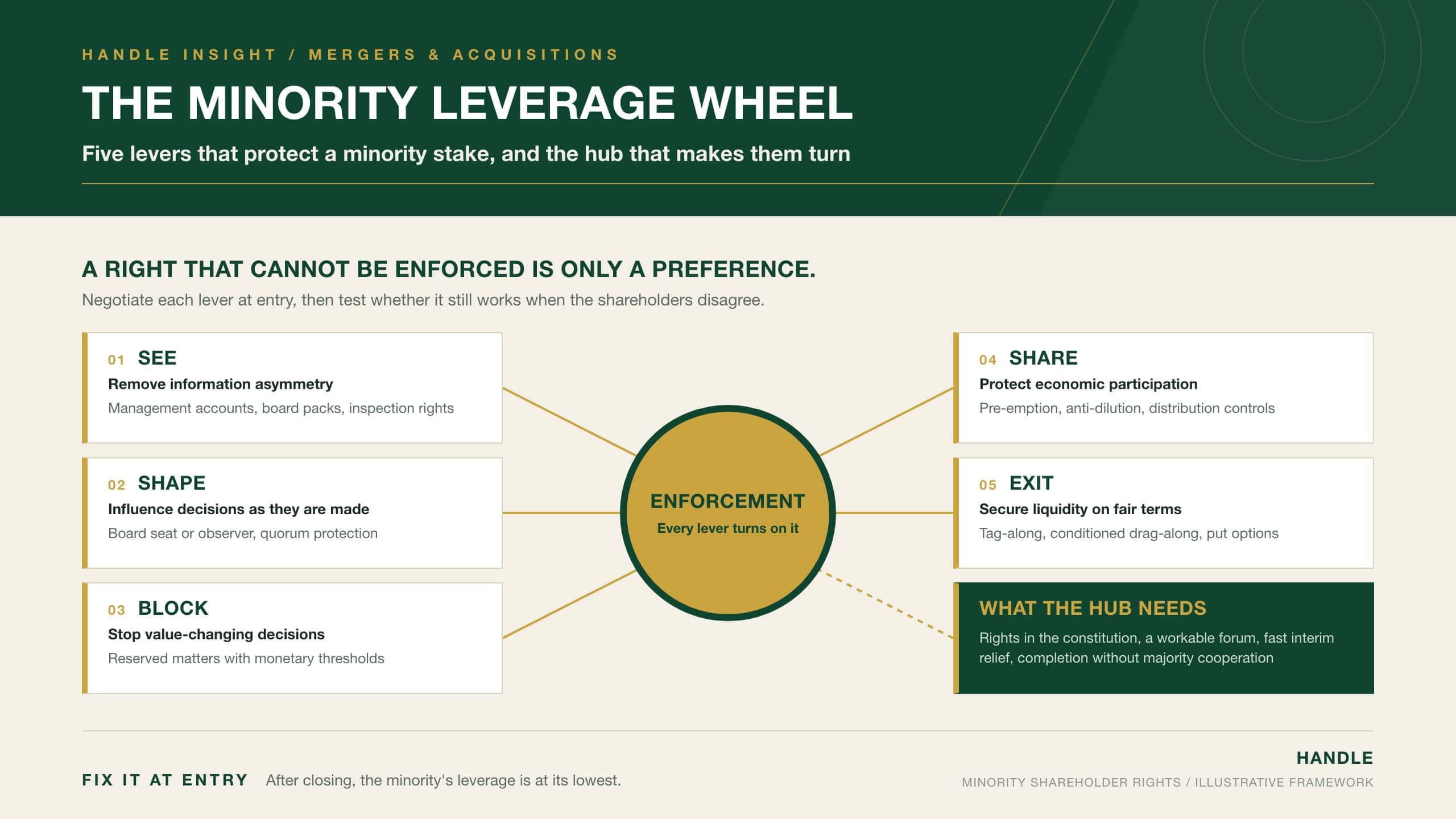
Minority protection works as a system of five levers around a single hub. We call it the Minority Leverage Wheel. Each lever addresses a distinct way in which value can move away from a minority holder. The hub, enforcement, is what makes every lever turn.
| Lever | Purpose | Core Rights |
|---|---|---|
| See | Remove information asymmetry | Management accounts, board packs, inspection rights |
| Shape | Influence decisions as they are made | Board seat, observer right, quorum protection |
| Block | Stop value-changing decisions | Reserved matters with thresholds |
| Share | Protect economic participation | Pre-emption, anti-dilution, distribution controls |
| Exit | Secure liquidity on fair terms | Tag-along, conditioned drag-along, put options |
Enforcement sits at the centre because every lever depends on it: constitutional entrenchment, a workable forum, interim relief and completion mechanics that function without the majority’s cooperation. A wheel with strong levers and no hub does not turn.
Common Mistakes When Negotiating Minority Rights
- Copying a precedent package without mapping where control actually sits in the target company.
- Drafting reserved matters as broad categories without thresholds, which invites dispute over whether consent was required.
- Securing a board seat without quorum protection, so meetings can proceed and decide reserved matters in the nominee’s absence.
- Relying on a shareholders’ agreement alone for an onshore company, when the memorandum of association is the document third parties rely on.
- Accepting an unconditioned drag-along right that allows the majority to force a sale on terms the minority would never accept.
- Negotiating tag-along rights that apply only to direct transfers, leaving a sale of the majority’s holding company outside the clause.
- Choosing a dispute forum without checking how quickly it can grant interim relief while the contested decision is still reversible.
Each mistake is cheap to correct in the term sheet and expensive to correct afterwards.
Conclusion
Negotiating minority shareholder rights is an exercise in anticipating how value could leave a company and closing each route before the capital is committed. Information rights let the minority see problems early. Board representation and quorum protection let it shape decisions. Reserved matters with clear thresholds let it block those that change the value of its stake. Pre-emption, calibrated anti-dilution and distribution controls protect its economics, and conditioned exit rights secure liquidity on fair terms. In the UAE, the jurisdiction of the company decides how much of this the law supplies and how much must be built: onshore companies need key rights in the memorandum of association, while DIFC and ADGM companies add an unfair prejudice remedy and greater share class flexibility. Every lever depends on enforcement. Minority protection is not a courtesy. It is negotiated control, fixed at entry.


