

In a private company, the right to leave is rarely free. Shares cannot be sold on a market, buyers need consents and the controlling shareholder may have every reason to say no. Exit rights and put/call options exist to settle that problem before it arises, by fixing in the shareholder agreement who can force a transfer, when, at what price and with whose money. Within Handle’s Shareholder & Term Sheet Advisory, these clauses are treated as the point where an investment thesis meets its liquidity reality. A put is a promise of an exit. A call is a promise of control. Both are worth only what the counterparty can pay and what a court or tribunal will enforce. An option that cannot be completed is not an exit right. It is the start of a dispute.
Why Exit Rights and Put/Call Options Matter in Private Companies
Investors in private companies accept illiquidity in exchange for return, but they rarely accept it indefinitely. Financial investors work to fixed fund terms and return horizons. Strategic partners need a route out if the venture no longer serves their purpose. Founders and controlling shareholders, by contrast, need assurance that ownership will not fragment or pass to unsuitable holders.
Exit rights reconcile these interests. The main routes to liquidity, a sale of the company, a listing or a shareholder buyout, all depend on cooperation. Put and call options convert some of that cooperation into contractual obligation. They do not replace a sale or listing. They provide a fallback when the preferred route does not materialise, and a mechanism to reshape ownership when defined events occur.
Put Options Versus Call Options
A put option gives its holder the right to require another party, usually a controlling shareholder or the company, to buy the holder’s shares on agreed terms. A call option gives its holder the right to require another party to sell its shares on agreed terms. The economic logic is mirrored, but the risk allocation is not.
| Feature | Put Option | Call Option |
|---|---|---|
| Holder typically | Minority or financial investor, joint venture partner | Controlling shareholder, founder, company |
| Purpose | Guaranteed liquidity route; downside protection | Consolidation of ownership; removal of departing or defaulting holders |
| Typical triggers | Expiry of investment period, missed milestones, change of control, deadlock | Founder or manager departure, breach, deadlock, change of control of the other shareholder |
| Main risk for the obligor | Large contingent payment obligation, possibly at a difficult time | Loss of shareholding at a price that may be below perceived value |
| Main risk for the holder | Obligor cannot fund the purchase | Transfer cannot be completed without the seller’s cooperation |
The final row is the one most often neglected in negotiation. Parties spend weeks on price formulas and very little time on whether the obligor will have the money, or whether the shares can actually be transferred if the seller refuses to sign.
What Should Trigger an Option?
Triggers should be objective, verifiable and drafted so that their occurrence can be established from documents. A put triggered by “failure to pursue an exit” invites argument. A put exercisable in a defined window after the fifth anniversary of completion, if no sale or listing has occurred, does not.
Leaver provisions are a common source of call options. When a founder or manager leaves, the company or other shareholders may call their shares. The price usually depends on whether the leaver is a good leaver, such as on death, disability or retirement, or a bad leaver, such as on dismissal for cause or breach of restrictive covenants. Definitions must be precise, because the gap between a good leaver and a bad leaver price can be large.
Deadlock triggers are common in joint ventures with equal ownership. After a defined escalation process fails, one party may be able to buy the other out, or both may be subject to a buy-sell mechanism in which one names a price and the other chooses whether to buy or sell at it.
How Are Option Prices Set?
Pricing is the commercial heart of the clause. Each approach allocates valuation risk differently.
| Pricing Method | How It Works | Advantage | Weakness |
|---|---|---|---|
| Fixed price | Price agreed at signing | Certainty | Diverges from value over time |
| Formula | Multiple of a defined metric, such as EBITDA, less net debt | Predictable and auditable | Metric can be managed; definitions disputed |
| Fair market value | Independent valuer determines value at exercise | Reflects current value | Slower; valuer appointment and instructions disputed |
| Floor or cap | Formula or valuation subject to minimum or maximum | Limits extreme outcomes for one side | May be challenged where it guarantees a return irrespective of performance |
Fair market value clauses should state whether a minority discount applies, the valuation date, the valuer’s qualifications, the information the valuer receives and whether the determination is final and binding. Each of these points has been the subject of disputes in practice.
A Worked Example: Testing a Put Before Signing
Consider an illustrative investment in which a financial investor acquires 30% of a UAE company for AED 90 million. The shareholder agreement gives the investor a put against the founder, exercisable in a six-month window after year five if no exit has occurred. The price is the greater of 30% of eight times EBITDA less net debt, and the original investment amount.
In year five, EBITDA is AED 40 million and net debt is AED 70 million. Equity value on the formula is AED 250 million, and 30% is AED 75 million. Because the floor applies, the put price is AED 90 million.
The founder’s liquid assets outside the company are AED 25 million. Without further provisions, the founder cannot complete. The parties therefore negotiate three additions before signing: payment in three annual instalments secured by a pledge over the purchased shares, a right for the founder to nominate a third-party buyer at the same price, and a right for the investor to trigger a drag-along sale of the whole company if the instalments are missed. The headline protection is unchanged. Its enforceability has been transformed.
The example also illustrates a legal point. A floor that guarantees the return of capital regardless of performance should be reviewed carefully where the company is governed onshore in the UAE, because arrangements that exempt a partner from sharing in losses can be challenged under UAE law. Structuring the floor as a negotiated price term, testing it against the governing law and using a DIFC or ADGM holding company can reduce that risk.
Original Analysis: The Option Lifecycle Timeline
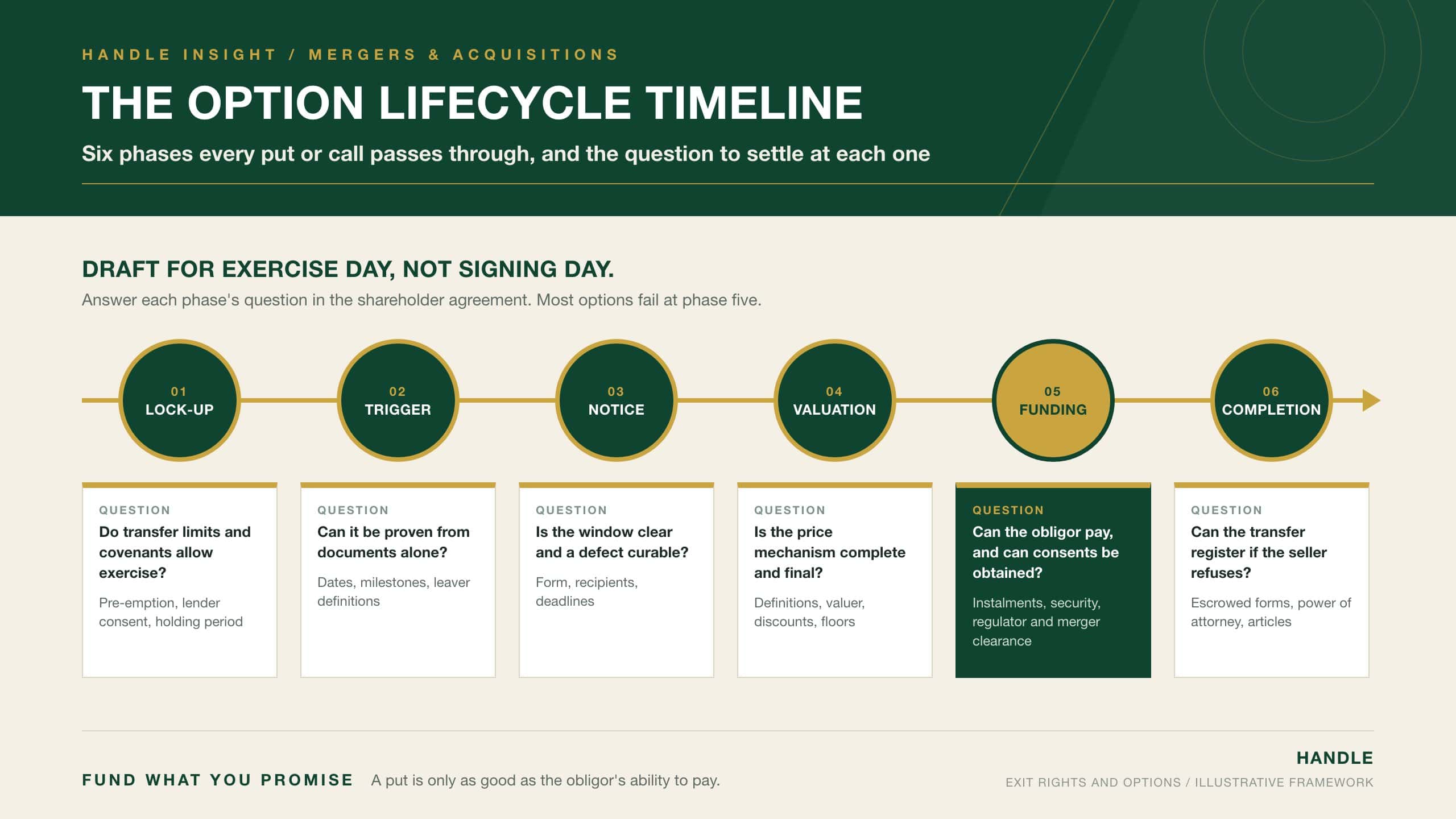
Options fail at predictable stages. The Option Lifecycle Timeline maps the six phases every put or call passes through, and the question that must be answered at each phase when the clause is drafted rather than when it is exercised.
Phase 1: Lock-Up
Is there a minimum holding period, and do transfer restrictions, pre-emption rights and financing covenants permit exercise when it ends?
Phase 2: Trigger
Can the trigger be established from documents without argument about interpretation?
Phase 3: Notice
Are the form, recipients, timing and exercise window clear, and is a late or defective notice fatal or curable?
Phase 4: Valuation
Is the price mechanism complete, including definitions, valuer appointment, information rights and finality?
Phase 5: Funding and Consents
Can the obligor pay, and are regulatory, lender, merger control and licensing consents identified and obtainable within the timetable?
Phase 6: Completion
Can the transfer be registered if the seller refuses to cooperate, through powers of attorney, escrowed transfer forms or a company constitution that obliges the registrar to act?
The fifth phase is where most options fail in practice. A perfect trigger and a precise valuation are of little use if the obligor has no cash or the transfer needs a consent that cannot be obtained. The following stress test converts the timeline into drafting controls.
| Phase | Stress Scenario | Drafting Control |
|---|---|---|
| Lock-up | A lender’s change of control covenant prohibits the transfer | Carve-out negotiated in financing documents, or option conditional on lender consent with a duty to seek it |
| Trigger | The parties disagree whether a milestone was missed | Milestone defined by reference to audited accounts or an expert determination |
| Notice | Notice is served one day late or on the wrong address | Clear service clause, deemed receipt rules and a short cure period |
| Valuation | The parties cannot agree on a valuer | Named appointing body, fixed timetable, binding determination save for manifest error |
| Funding and consents | The obligor cannot pay the full price on completion | Instalments with security, nomination of a third-party buyer, step-in drag-along right |
| Completion | The seller refuses to sign transfer documents | Escrowed signed transfer forms, security power of attorney, constitutional transfer obligation |
Running each clause through this table before signing usually reveals at least one gap. It is far cheaper to close it in negotiation than in arbitration.
Making Options Enforceable in the UAE
Where the company is an onshore limited liability company under the Commercial Companies Law (Federal Decree-Law No. 32 of 2021), share transfers must be reflected in the company’s memorandum of association and registered with the competent licensing authority. Other partners may also have statutory pre-emption rights that need to be addressed. Rights that appear only in a side shareholder agreement may be difficult to enforce against the company or a non-cooperating partner. Key exit provisions should therefore be reflected in the constitutional documents as far as the law permits.
For this reason, many investors and joint venture partners hold their interests through a holding company in the Dubai International Financial Centre or Abu Dhabi Global Market. The DIFC Companies Law No. 5 of 2018 and the ADGM Companies Regulations 2020 support detailed articles and shareholder agreements, and transfers are registered by the relevant registrar. Disputes are often referred to arbitration, with enforcement under the UAE Federal Arbitration Law No. 6 of 2018 or the DIFC or ADGM arbitration regimes, depending on the seat.
Two further points apply. If a call results in one party acquiring control and the relevant thresholds are met, merger control clearance under the UAE Competition Law, Federal Decree-Law No. 36 of 2023, may be required before completion. And where the company holds a regulated licence, a change in shareholding may need the regulator’s prior approval.
How Options Interact With Other Exit Provisions
Options sit within a wider set of transfer provisions. Drag-along rights allow a majority to require minorities to join a sale. Tag-along rights allow minorities to join a sale by the majority. Rights of first refusal and pre-emption control transfers to outsiders. These provisions must be drafted together. A put that conflicts with a pre-emption right, or a call that can be exercised during a drag-along process, creates uncertainty about which right prevails. The agreement should state the order of priority expressly.
Common Failures in Exit Option Design
- The price formula is precise but the obligor’s ability to pay is never tested, so the put cannot be completed when exercised.
- Triggers are drafted in subjective terms, so the first dispute concerns whether the option has arisen at all.
- Good leaver and bad leaver definitions overlap, leaving the price for a departing founder open to argument.
- Option rights exist only in a side agreement and are not reflected in the company’s constitution, so the transfer cannot be registered without cooperation.
- Regulatory, lender and merger control consents are not identified, delaying completion beyond the exercise window.
- Options, drag-along, tag-along and pre-emption rights are drafted separately and conflict with one another.
Each failure turns a negotiated exit into litigation. Each is avoidable by testing the clause against the lifecycle before signing.
Conclusion
Exit rights and put/call options give private company shareholders what the market cannot: a defined route to liquidity and a defined route to consolidation. Puts protect investors against indefinite lock-in. Calls protect controlling shareholders and companies against fragmented or unsuitable ownership. Their value depends less on the headline right than on the mechanics behind it: objective triggers, clear notices, complete pricing, funding capacity, identified consents and a transfer that can be registered without the seller’s cooperation. In the UAE, that means reflecting key provisions in the company’s constitution, considering a DIFC or ADGM holding structure and checking floors, regulatory approvals and merger control in advance. The Option Lifecycle Timeline turns those checks into a drafting discipline. Test each phase before signing. Fund what you promise. Draft for the day the counterparty refuses.


