

Transaction pricing rarely fails because a team lacks models. It fails because the wrong model is given control. In Valuation & Synergy Analysis, the DCF vs multiples debate is usually framed as a contest between two techniques. That framing misses the real decision. The question an investment committee must answer is which method leads the valuation, which method tests it, and which evidence sets the perimeter within which the team is allowed to negotiate. Discounted cash flow derives value from forecast cash generation. Multiples derive value from what markets and recent buyers pay for comparable assets. Each disciplines a different risk, and each hides a different weakness. Methods do not set prices. Committees do, using methods they have ranked in advance.
DCF vs Multiples: What Each Method Actually Measures
DCF is an intrinsic valuation method. It prices a business as the present value of the free cash flows it is expected to generate, discounted at a rate that reflects risk and the cost of capital. Multiples are relative valuation methods. They price a business by reference to how comparable listed companies trade, or how comparable businesses were priced in precedent transactions, typically expressed as a ratio of enterprise value to EBITDA, revenue or another operating measure.
The distinction determines how each behaves under pressure. DCF asks what the asset is worth if the business plan holds and the capital cost is understood. Multiples ask what buyers are paying today for broadly similar earnings. One is built from internal economics. The other is anchored to external evidence.
| Dimension | Discounted Cash Flow | Trading and Transaction Multiples |
|---|---|---|
| Source of value | Forecast free cash flow and terminal value | Observed prices for comparable companies or deals |
| Key inputs | Revenue growth, margins, capital expenditure, working capital, tax, discount rate, terminal assumptions | Peer selection, normalised earnings, choice of multiple, adjustments for size and quality |
| Main strength | Captures company-specific economics and value creation plans | Reflects live market pricing and is easy to communicate |
| Main weakness | Highly sensitive to discount rate and terminal value | Imports market sentiment and hides differences in quality |
| Best use in a deal | Underwriting the investment case and valuing synergies | Testing price against market tolerance and framing negotiations |
Why DCF Commands Serious Attention
DCF forces the acquirer to underwrite the business. Growth, margins, capital intensity, working capital, tax and terminal economics must all be stated explicitly. That discipline is essential where value depends on operating performance rather than market mood.
It also captures what multiples compress. Founder-led platforms, regional leaders, intellectual property-heavy businesses, carve-outs and companies in transition rarely fit neat peer sets. Differences in cash conversion, contracted revenue, capital intensity and margin potential are visible in a DCF and invisible in a sector average.
Finally, DCF is the natural language of strategic acquirers. If the thesis rests on integration savings, cross-selling or post-deal margin improvement, only a cash flow model can show where that value arises, when it arrives and what it depends on.
Why Multiples Remain Powerful
Acquisitions happen in live markets. Sellers know precedent outcomes. Lenders size leverage against market norms. Boards compare offers to trading ranges. Multiples matter because they show what capital is actually paying.
They also provide external validation. Where a DCF can be challenged as assumption-driven, multiples impose a market check. They are strongest in mature, stable sectors with deep comparable sets, in competitive auctions that require fast pricing views and in industries where buyers benchmark heavily on EBITDA.
Multiples are less sensitive to modelling choices. That does not make them more accurate. It makes them faster, more transparent and more useful when the question is whether a price sits inside market tolerance.
Where Each Method Misleads
DCF creates false precision. A detailed model can look robust while resting on fragile assumptions, and small changes in discount rate or terminal growth can move enterprise value materially. In many transactions most of the DCF value sits in the terminal period, which means the conclusion depends on a steady state that may never arrive.
Multiples misprice quality. Two companies in the same sector and of similar size can differ sharply in cash conversion, customer concentration, regulatory exposure and management depth. A sector multiple flattens those differences. Multiples also carry market sentiment: they expand in buoyant markets and compress when credit tightens, so they can justify overpayment at the top of a cycle and understate strategic value at the bottom. A weak comparable set produces a weak conclusion, however clean the arithmetic.
Which Multiple, and Which Comparables?
The phrase “the multiple” conceals several choices, and each can move value as much as a change in DCF assumptions. Enterprise value to EBITDA is the most common reference in M&A because it is independent of capital structure and broadly comparable across companies with different leverage. Enterprise value to revenue is used where earnings are negative or distorted, typically in early-stage or turnaround businesses, but it ignores profitability entirely. Price to earnings is affected by leverage and tax, which makes it less reliable for comparing private targets.
The earnings base matters as much as the multiple. Historic, current-year and forward EBITDA can differ substantially, and applying a forward multiple to historic earnings, or the reverse, is a common source of error. Earnings must also be normalised for one-off items, owner-related costs in private companies and, in carve-outs, the full cost of operating on a standalone basis.
Finally, trading multiples and transaction multiples answer different questions. Trading multiples reflect the value of minority stakes in listed companies. Transaction multiples reflect prices paid for control, which normally include a premium. Using one in place of the other without adjustment overstates or understates value.
UAE-Specific Inputs That Change the Answer
Valuations of UAE businesses require some adjustments that are easy to miss. Since the introduction of UAE Corporate Tax under Federal Decree-Law No. 47 of 2022, taxable income above AED 375,000 is generally taxed at 9%, while a Qualifying Free Zone Person may benefit from a 0% rate on qualifying income if it meets the conditions. Forecast cash flows must reflect the tax position the business will actually have, not the position it had before the regime began. Historic earnings multiples drawn from a period before Corporate Tax applied may not be directly comparable on a post-tax basis.
Comparable sets are another challenge. The number of listed peers on UAE exchanges is limited in many sectors, so analysts often draw on regional and international comparables and must adjust for size, growth, liquidity and market risk. The UAE dirham’s long-standing peg to the US dollar simplifies currency assumptions, but it does not remove the need to consider country and business-specific risk in the discount rate. These adjustments are judgements, and they should be documented as such.
Original Analysis: The Method Command Matrix
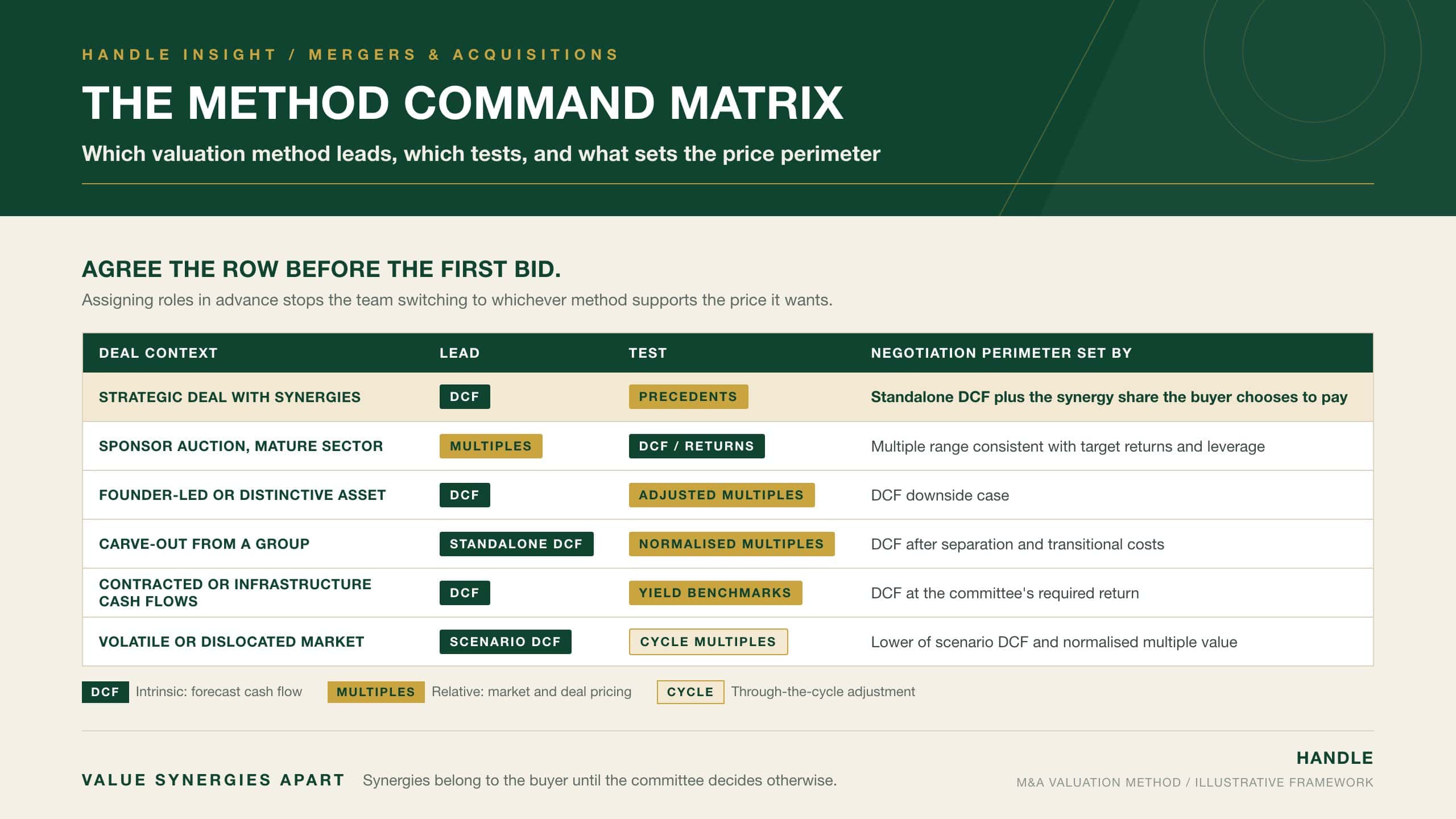
Institutional teams do not choose between DCF and multiples in the abstract. They assign roles by deal context. The Method Command Matrix sets out which method leads, which tests and what defines the negotiation perimeter in six common situations.
| Deal Context | Lead Method | Test Method | Negotiation Perimeter Set By |
|---|---|---|---|
| Strategic acquisition with synergies | DCF, standalone and with synergies separately | Precedent transaction multiples | Standalone DCF plus the share of synergies the buyer is willing to pay away |
| Sponsor auction in a mature sector | Trading and transaction multiples | DCF and returns analysis | Multiple range consistent with target returns and available leverage |
| Founder-led or distinctive business | DCF | Adjusted multiples | DCF downside case |
| Carve-out from a group | DCF on standalone costs | Multiples on normalised standalone EBITDA | DCF after separation and transitional costs |
| Contracted or infrastructure-style cash flows | DCF | Yield and transaction benchmarks | DCF at the committee’s required return |
| Volatile or dislocated market | DCF with scenario weighting | Through-the-cycle multiples | Lower of scenario-weighted DCF and normalised multiple value |
The matrix converts a debate into a decision rule. Before the first bid, the committee agrees which row applies. That agreement prevents the team from switching to whichever method supports the price it already wants to pay.
Why Synergies Belong Outside the Base Case
Synergies are the point at which DCF discipline most often breaks down. A buyer that builds expected cost savings and revenue gains into its base DCF has, in effect, agreed to pay the seller for value that only the buyer can create. Once that value is embedded in the offer, it is rarely recovered.
The disciplined approach values the target on a standalone basis first, then values synergies separately, net of the costs and time required to achieve them and adjusted for the probability of delivery. Cost synergies under the buyer’s control are usually more reliable than revenue synergies that depend on customer behaviour. The committee then decides explicitly how much of the synergy value, if any, it is prepared to share with the seller to win the asset. That decision is commercial, not technical, and it should be recorded.
Worked Example: Triangulating a Price
Consider an illustrative UAE services business with EBITDA of AED 50 million. Listed peers trade at 8 to 10 times EBITDA, implying an enterprise value of AED 400 million to AED 500 million. Recent transactions in the sector, which include a control premium, imply 9.5 to 11 times, or AED 475 million to AED 550 million.
The acquirer’s standalone DCF produces AED 540 million, with around two thirds of that value in the terminal period. Raising the discount rate by one percentage point reduces value to roughly AED 470 million. Lowering terminal growth by one point reduces it to roughly AED 490 million. Identified synergies add a further AED 80 million in present value, but they depend on integration the buyer controls.
The committee classifies the deal as a strategic acquisition with synergies. It sets an opening offer of AED 460 million, a target price of AED 490 million and a walk-away price of AED 520 million. The walk-away price sits below the standalone DCF base case and well inside the precedent range, and it shares only a small portion of the synergy value with the seller. The DCF set the ceiling. The multiples confirmed it was negotiable.
Building the Valuation Conclusion
A defensible conclusion presents the methods side by side, explains why one leads, shows the sensitivity of each and states the price range the committee has authorised. Precedent transactions frame control premiums. Leveraged buyout analysis tests what a financial buyer could afford to pay. Each piece of evidence has a defined function.
The output should be a perimeter, not a point. A single number invites anchoring. A perimeter with an opening position, a target and a walk-away price gives the negotiating team authority and limits at the same time.
Common DCF and Multiples Failures in M&A
- Allowing the method that produces the most convenient number to lead, rather than the method that fits the deal context.
- Paying away synergies by embedding them in the base DCF instead of valuing them separately and deciding how much to share.
- Selecting peer groups for headline similarity while ignoring differences in growth, cash conversion and risk.
- Presenting a DCF without sensitivity analysis, so the committee cannot see how much value depends on the terminal period.
- Using pre-tax era earnings or multiples for UAE businesses without adjusting for the Corporate Tax regime.
- Applying peak-cycle transaction multiples as if they represented normal market value.
- Setting no walk-away price before negotiations begin, so the price drifts with process pressure.
Each failure replaces method discipline with convenience. The cost appears later, in returns.
Conclusion
DCF and multiples do not compete for supremacy. They control different risks. DCF protects against shallow pricing by forcing a view on future cash generation, tax, capital intensity and execution. Multiples protect against inward-looking pricing by anchoring value to what markets and recent buyers actually pay. In M&A, the right question is not which method is better but which should lead, which should test and what sets the negotiation perimeter in this deal. For UAE targets, that judgement must also reflect Corporate Tax, thin local comparable sets and adjustments for regional risk. Synergies belong to the buyer until the committee decides otherwise. Committees that agree the method hierarchy before bidding, value synergies separately and fix a walk-away price negotiate from evidence. Committees that do not negotiate from momentum. Method sets discipline. Discipline protects returns.


