

Every acquisition price rests on an argument about where value comes from. If value comes from what the market will pay for comparable earnings, the price is set by multiples. If value comes from what the business owns, the price is set by its assets. Market-based vs asset-based valuation is therefore not a technical choice between two spreadsheets. It is a decision about which evidence is allowed to anchor the price, and which is used to test it. Market-based valuation anchors enterprise value to comparable public companies and precedent transactions. Asset-based valuation derives value from the fair value of the assets the business holds, less its liabilities. Within Valuation & Synergy Analysis, disciplined deal teams apply both, decide which one leads for the target in front of them, and use the gap between them as information rather than noise. The method follows the source of value. Never the other way round.
What Is Market-Based Valuation?
Market-based valuation estimates enterprise value by reference to what investors pay for similar businesses. It assumes that capital markets and recent transactions provide reliable pricing signals, and translates those signals into multiples that can be applied to the target’s financial performance.
The most common multiples are enterprise value to EBITDA, enterprise value to revenue and price to earnings. Applying a range of these multiples to the target’s normalised metrics produces a valuation range grounded in observable evidence. The quality of that range depends almost entirely on the quality of the comparison set.
Comparable Public Companies
Comparable company analysis examines listed businesses in the same sector with similar revenue scale, growth trajectory, profitability and market position. Because these companies trade continuously, their multiples provide current pricing indicators. They reflect minority, liquid positions, so they generally exclude any premium for control.
Precedent Transactions
Precedent transaction analysis examines the multiples paid in past acquisitions of similar companies. These multiples often include a control premium, reflecting the value of acquiring decision-making authority, and they capture the pricing conditions of real acquisition processes. Their weakness is age and disclosure: transactions may be several years old, and private deal terms are often only partly published.
What Is Asset-Based Valuation?
Asset-based valuation calculates value by establishing the fair value of the company’s assets and deducting its liabilities. It concentrates on the economic value embedded in the asset base: real estate and infrastructure, plant and equipment, inventory and receivables, and identifiable intangible assets.
Adjusted Net Asset Value
The adjusted net asset value method restates the balance sheet at current fair values rather than historical cost. Property is revalued, equipment is priced at market, intangibles are recognised where they can be reliably measured and contingent liabilities are brought onto the analysis. The result is a measure of the net economic resources available to investors today.
Liquidation Value
In distressed or restructuring situations, the analysis may move to liquidation value: what could be recovered if the assets were sold individually. Orderly liquidation assumes assets are sold over a reasonable period. Forced liquidation assumes a rapid sale under pressure. The gap between the two can be substantial, and liquidation value is generally treated as a floor rather than an estimate of going-concern value.
Market-Based Versus Asset-Based Valuation: How Do They Compare?
| Dimension | Market-Based Valuation | Asset-Based Valuation |
|---|---|---|
| Source of value | Earnings capacity as priced by investors | Fair value of assets less liabilities |
| Primary evidence | Trading multiples and transaction multiples | Revaluations, appraisals, recoverable amounts |
| Captures intangibles | Yes, implicitly through earnings | Only where separately identifiable and measurable |
| Sensitivity to sentiment | High; multiples rise and fall with market cycles | Lower, though property and asset markets also cycle |
| Best suited to | Stable earners with credible peer groups | Asset-heavy, holding, distressed or loss-making businesses |
| Principal risk | Importing mispricing from a weak comparison set | Undervaluing brands, relationships and scalable models |
Where Does Each Method Mislead?
Market-based valuation is persuasive in negotiation because it is anchored in what others have paid. That is also its vulnerability. Comparables may differ from the target in operating model, geographic exposure, capital intensity or margin structure, and adjustments for those differences are judgements rather than observations. Market cycles distort multiples: periods of optimism inflate them and downturns compress them, so a valuation that relies only on multiples imports the mood of the market into the price.
Asset-based valuation provides a baseline independent of sentiment, but it can understate businesses that create value through intangible capabilities. A company with strong brands, contracted customer relationships or proprietary technology may be worth far more than its balance sheet, even after intangibles are recognised. Relying solely on assets in such a case produces a price no rational seller will accept.
The useful question is not which method is correct. It is which method’s weaknesses are least exposed by the target in front of you.
How Should Deal Teams Choose Between the Approaches?
Market-based valuation typically leads where credible comparables exist and the business generates consistent earnings. Asset-based valuation becomes more relevant where the company operates in an asset-heavy sector such as real estate, natural resources or capital-intensive manufacturing, where profitability is unstable or declining, where the entity is a holding vehicle whose value lies in what it owns, or where the business faces financial distress.
In most institutional processes both methods are run. The lead method sets the central estimate. The secondary method tests it: an asset value well above the market range suggests the earnings are depressed or the multiples are too low, while a market value far above the asset value is a claim about intangible value that must be evidenced.
Why Do the Inputs Matter More Than the Method?
Both methods are only as reliable as the figures fed into them. Before a multiple is applied, EBITDA should be normalised: one-off gains and costs removed, related-party arrangements restated at market terms and owner remuneration adjusted to what a professional manager would cost. In founder-led and family businesses these adjustments are often material, because rents paid to family entities, shared group services and personal expenses can sit inside the operating accounts.
The same discipline applies to the asset side. Property should be valued on its current use and condition, with title, permitted use and any encumbrances confirmed. Receivables should be tested for recoverability, inventory for obsolescence and equipment for remaining useful life. Off-balance-sheet obligations, such as end-of-service gratuity liabilities, guarantees and pending claims, belong in the analysis even when they are not fully provided for in the accounts.
A sophisticated method applied to unadjusted inputs produces a precise number for the wrong business. Normalisation is where most valuation disputes are actually won or lost.
Valuation in the UAE Context
Several features of the UAE market affect how the two methods are applied. Listed peer groups on local exchanges can be thin for some sectors, so comparable sets often draw on regional and international companies, which requires careful adjustment for market, currency and growth differences. Private transaction terms are frequently undisclosed, which limits the depth of precedent analysis.
Asset-based work in the UAE leans heavily on real estate. Property valuations used in transactions should come from appropriately qualified valuers, and in Dubai the Dubai Land Department operates an accreditation regime for property valuers. UAE companies generally report under IFRS, where fair value measurement follows IFRS 13, which provides a familiar hierarchy for the evidence supporting asset values.
Valuation also has legal and tax consequences. Contributions in kind to company capital generally require valuation under the Commercial Companies Law (Federal Decree-Law No. 32 of 2021). Under the UAE Corporate Tax regime (Federal Decree-Law No. 47 of 2022), transactions between related parties must reflect the arm’s length standard, and reliefs for qualifying intra-group transfers and business restructurings depend on how and at what value assets move. A valuation prepared for negotiation may therefore also become evidence before the tax authority.
A Worked Example: Triangulating a Logistics Target
Consider an illustrative UAE logistics business with normalised EBITDA of AED 50 million, owning its warehouses and fleet. All figures are illustrative.
| Method | Basis | Indicated Enterprise Value (AED m) |
|---|---|---|
| Trading comparables | 7x to 9x EBITDA | 350 to 450 |
| Precedent transactions | 9x to 10x EBITDA, including control premium | 450 to 500 |
| Adjusted net asset value | Warehouses revalued from 180 to 260; fleet 45; net working capital 75 | 380 |
| Orderly liquidation | Assets sold over twelve months | 300 |
| Forced liquidation | Assets sold within weeks | 220 |
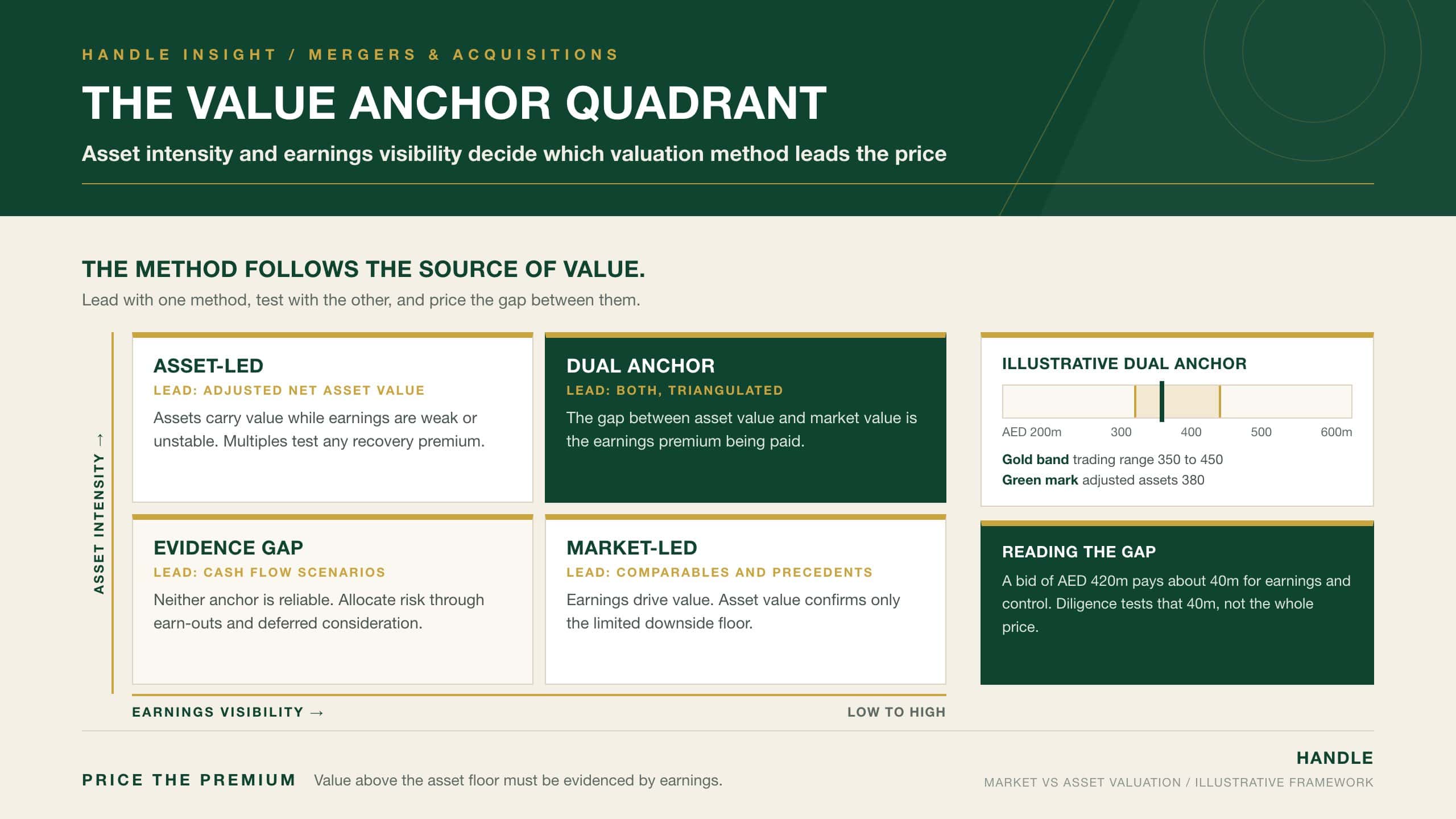
The adjusted asset value of AED 380 million sits inside the trading range, which tells the buyer that roughly AED 380 million of the price is supported by assets it could, in principle, realise. Anything above that is a payment for earnings and control. A bid of AED 420 million therefore carries about AED 40 million of earnings-dependent value, which the buyer can test through due diligence on contract durability. A seller pressing for 500 must justify why the full precedent premium applies. The orderly liquidation value of AED 300 million frames the buyer’s downside. The negotiation becomes a discussion about the earnings premium, not about the whole price.
Original Analysis: The Value Anchor Quadrant
The Value Anchor Quadrant determines which method should lead by placing the target on two axes. The horizontal axis measures earnings visibility: how stable, contracted and comparable the earnings are. The vertical axis measures asset intensity: how much of value is held in assets that can be separately measured and realised.
| Quadrant | Profile | Lead Method | Role of the Other Method |
|---|---|---|---|
| Dual Anchor | High asset intensity, high earnings visibility | Both, triangulated | Gap between them shows the earnings premium being paid |
| Asset-Led | High asset intensity, low earnings visibility | Adjusted net asset value | Multiples test whether a recovery premium is justified |
| Market-Led | Low asset intensity, high earnings visibility | Comparables and precedents | Asset value confirms the limited downside floor |
| Evidence Gap | Low asset intensity, low earnings visibility | Neither alone; cash flow and scenario analysis | Both used only as boundary checks |
The quadrant prevents the most common pricing error: applying the method that produces the most convenient number. A buyer in the Asset-Led quadrant who prices on market multiples is paying for earnings that are not yet visible. A seller in the Market-Led quadrant who argues from asset value is leaving the earnings premium on the table. In the Evidence Gap quadrant, both parties should recognise that neither method provides a reliable anchor and allocate risk through structure, such as earn-outs or deferred consideration, rather than price alone.
Common Mistakes in Market and Asset Valuation
- Selecting comparables for convenience rather than relevance, so the multiple reflects a different business model from the target.
- Mixing trading multiples and transaction multiples without recognising that one excludes a control premium and the other includes it.
- Using book values in an asset-based analysis, which ignores revaluation gains on property and impairment on obsolete equipment.
- Treating liquidation value as a negotiating anchor for a healthy going concern, which signals bad faith rather than discipline.
- Ignoring the tax and legal uses of a valuation, so a figure prepared for negotiation later undermines an arm’s length or restructuring relief position.
- Reporting a single point estimate, which hides the gap between methods that should inform deal structure.
Each mistake moves the price away from the evidence. Each is corrected by stating which method leads and why.
Conclusion
Market-based and asset-based valuation describe enterprise value from two different directions. Market-based methods rely on the pricing signals of comparable listed companies and precedent transactions, and capture earnings power and control. Asset-based methods derive value from the fair value of what the business owns, and establish a floor that does not depend on sentiment. Neither is complete on its own. Disciplined deal teams decide which method leads based on asset intensity and earnings visibility, use the other to test it and treat the gap between them as the price of earnings and control that must be evidenced. In the UAE, thin peer groups, undisclosed private deal terms, the weight of real estate and the tax uses of valuation make that discipline more important, not less. The method follows the source of value. The price follows the evidence.


