

A business continuity strategy defines how an organisation will maintain control when a disruption compromises its people, premises, technology, suppliers, data or operating model. It establishes which functions must continue, how quickly services must be restored, who holds decision authority and which resources are activated when normal operations fail. Within an integrated Business Strategy, continuity planning protects the organisation’s ability to execute its objectives under adverse conditions. The strategy does not attempt to preserve every activity at full capacity. It identifies the operations that protect cash flow, customers, regulatory standing and enterprise value, then structures the people, systems, facilities and third-party arrangements required to sustain them. The objective is not simply to recover after disruption. It is to maintain command throughout it.
What Is a Business Continuity Strategy?
A business continuity strategy is the operating framework used to preserve critical business functions during and after a material interruption. It converts disruption risk into defined priorities, recovery requirements, decision rights and executable response measures.
The strategy addresses a central management question: if ordinary operating conditions become unavailable, what must the organisation continue doing, at what level, for how long and through which alternative resources?
A complete strategy covers more than documented emergency procedures. It aligns:
- Business priorities.
- Critical processes.
- Technology and data dependencies.
- Workforce availability.
- Facilities and physical infrastructure.
- Supplier and outsourcing arrangements.
- Liquidity and financial capacity.
- Crisis governance and communications.
- Regulatory and contractual obligations.
Each element must operate as part of one continuity architecture. A backup system without trained personnel does not preserve operations. An alternative facility without data access does not restore service. A crisis team without delegated authority does not control the response.
Business Continuity Is a Strategic Discipline
Business continuity is frequently treated as an administrative plan owned by risk, compliance or technology teams. That approach understates its strategic significance.
A disruption can alter revenue, liquidity, customer retention, contractual performance, regulatory exposure and transaction value within hours. Continuity therefore affects the same outcomes governed by corporate strategy and executive leadership.
The strategy determines which parts of the business receive priority when resources become constrained. It also establishes which services may be reduced, suspended or transferred to preserve the functions that matter most.
This is capital allocation under pressure. Leadership decides where redundancy is justified, where exposure can be accepted and which dependencies require structural correction before a disruption occurs.
What Events Should a Continuity Strategy Address?
The strategy should not be designed around one predicted event. It should be designed around the loss of critical capabilities, regardless of what causes that loss.
Potential disruptions include:
- Cyberattacks, ransomware and data compromise.
- Cloud, network or telecommunications failures.
- Loss of access to offices, plants, warehouses or data centres.
- Supply chain interruption or supplier insolvency.
- Utilities and infrastructure failure.
- Fraud, misconduct or internal control breakdown.
- Regulatory intervention or licence restrictions.
- Geopolitical instability and border disruption.
- Public health events and workforce unavailability.
- Natural hazards and severe weather.
- Liquidity constraints or banking interruption.
- Failure of an outsourced service provider.
Scenario planning remains useful, but capability planning creates greater resilience. The organisation prepares for the loss of a facility, system, supplier or decision-maker rather than attempting to predict the precise event that causes it.
Business Continuity Versus Disaster Recovery
Business continuity and disaster recovery are connected but not interchangeable.
| Area | Business Continuity | Disaster Recovery |
|---|---|---|
| Primary objective | Maintain critical business operations | Restore technology, systems and data |
| Scope | Enterprise-wide | Primarily technology-focused |
| Core dependencies | People, processes, premises, suppliers, finance and technology | Applications, infrastructure, networks, backups and data |
| Activation point | When a disruption threatens critical operations | When technology services or data become unavailable |
| Executive ownership | Board and senior management | Technology leadership within the wider continuity structure |
| Measure of success | Critical services remain within approved disruption tolerances | Systems and data are restored within approved recovery targets |
Disaster recovery is one component of business continuity. Restoring a server does not restore an operation if employees cannot access it, a supplier remains unavailable or the organisation lacks authority to resume regulated activity.
The Business Impact Analysis
The business impact analysis establishes the factual basis of the continuity strategy. It identifies the functions whose interruption would create unacceptable financial, operational, legal or reputational consequences.
The analysis should determine:
- Which services generate or protect material revenue.
- Which processes satisfy regulatory and contractual duties.
- Which customers or counterparties depend on uninterrupted delivery.
- Which systems, employees, facilities and suppliers support each process.
- How disruption impacts escalate over time.
- When the loss of a function becomes intolerable.
- What minimum operating capacity must be maintained.
The output is not merely a list of important departments. It is a sequenced map of business services, dependencies, tolerances and recovery priorities.
Recovery Metrics That Convert Intent Into Control
Continuity strategies require measurable recovery parameters. Statements such as “restore systems quickly” or “resume operations as soon as possible” do not create accountable execution.
Maximum Tolerable Period of Disruption
The maximum tolerable period of disruption defines how long a business activity can remain unavailable before the consequences become unacceptable. This establishes the outer boundary for continuity planning.
Recovery Time Objective
The recovery time objective defines the target period within which a process, system or service must be restored following disruption.
Recovery Point Objective
The recovery point objective defines the maximum acceptable amount of data loss measured in time. An RPO of four hours means the organisation must be able to restore data to a point no more than four hours before the incident.
Minimum Business Continuity Objective
The minimum business continuity objective defines the minimum level of service that must be maintained during recovery. A critical function may not require immediate restoration to full capacity. It may require 30% capacity within four hours, 60% within 24 hours and normal capacity within three days.
These metrics must align. A recovery time objective cannot exceed the maximum tolerable disruption period. Technology restoration targets must also match the time requirements of the business processes they support.
A Continuity Priority Matrix
Functions should be prioritised according to business impact and required recovery speed. The following matrix illustrates how executive teams can structure that assessment.
| Continuity Tier | Business Impact | Illustrative Recovery Requirement | Strategic Response |
|---|---|---|---|
| Tier 1: Critical | Immediate threat to safety, revenue, regulatory standing or contractual performance | Minutes to four hours | Live redundancy, immediate failover and pre-authorised crisis control |
| Tier 2: Essential | Material impact within one business day | Four to 24 hours | Alternative systems, trained substitutes and priority supplier arrangements |
| Tier 3: Important | Escalating impact within several days | One to three days | Structured restoration after critical services stabilise |
| Tier 4: Deferrable | Limited short-term effect on core operations | Three days or longer | Temporary suspension with controlled backlog recovery |
This prevents every department from declaring itself critical. Priority must be determined by consequence, dependency and time sensitivity rather than organisational status.
Core Components of the Strategy
Critical Service Architecture
Each critical service should be mapped from customer or regulatory outcome back through the processes, people, applications, data, facilities and external providers required to deliver it. This exposes hidden concentrations and single points of failure.
Alternative Operating Arrangements
The strategy must identify how operations continue when primary resources are unavailable. Measures may include remote working, alternate sites, manual procedures, reciprocal arrangements, cloud failover, backup equipment and temporary service transfers.
Technology and Data Resilience
Technology continuity requires secure backups, replicated infrastructure, alternative communication channels, tested recovery procedures and defined system restoration sequences. Cyber recovery must also prevent compromised systems or corrupted data from being restored into the operating environment.
Supplier and Outsourcing Resilience
Contracts do not remove operational dependency. The organisation must assess supplier concentration, subcontracting, geographic exposure, financial stability, recovery capability and access to alternative sources.
Critical contracts should define continuity obligations, incident notification, data access, audit rights, recovery commitments and exit assistance.
Workforce Continuity
Critical processes must not depend on one individual or an inaccessible group. Cross-training, delegated authority, succession arrangements, remote access and documented procedures preserve execution when key employees are unavailable.
Financial Continuity
Liquidity forms part of operational resilience. The strategy should assess emergency funding, banking access, payment authority, insurance response, customer collections and the working-capital consequences of prolonged disruption.
Crisis Governance and Decision Authority
A continuity plan fails when responsibility is distributed but authority is unclear. Crisis governance must establish who can declare an incident, activate continuity measures, suspend normal controls, communicate externally and commit emergency expenditure.
A controlled structure commonly includes:
- An executive crisis committee with enterprise authority.
- An incident leader responsible for coordinated execution.
- Operational workstreams for technology, people, facilities, suppliers, finance, legal and communications.
- Defined escalation thresholds.
- Documented decision and action logs.
- Named alternates for every critical role.
The framework should also distinguish strategic decisions from technical incident management. Technology teams can contain a cyber event. Executive leadership determines whether customer services are suspended, regulators are notified, contractual commitments are reprioritised or capital is deployed.
Communication Is an Operating Control
Communication during disruption is not a public relations exercise. It controls behaviour, protects credibility and prevents inconsistent decisions.
The strategy should define:
- Which stakeholders require notification.
- Who approves each communication.
- Which channels remain available if primary systems fail.
- What information can be disclosed.
- When regulators, insurers, customers, employees and investors are informed.
- How message consistency is maintained across jurisdictions.
Communication templates can be prepared in advance, but they must allow factual adaptation. Premature reassurance creates exposure. Delayed communication allows speculation to control the narrative.
Original Analysis: The Continuity Control Chain
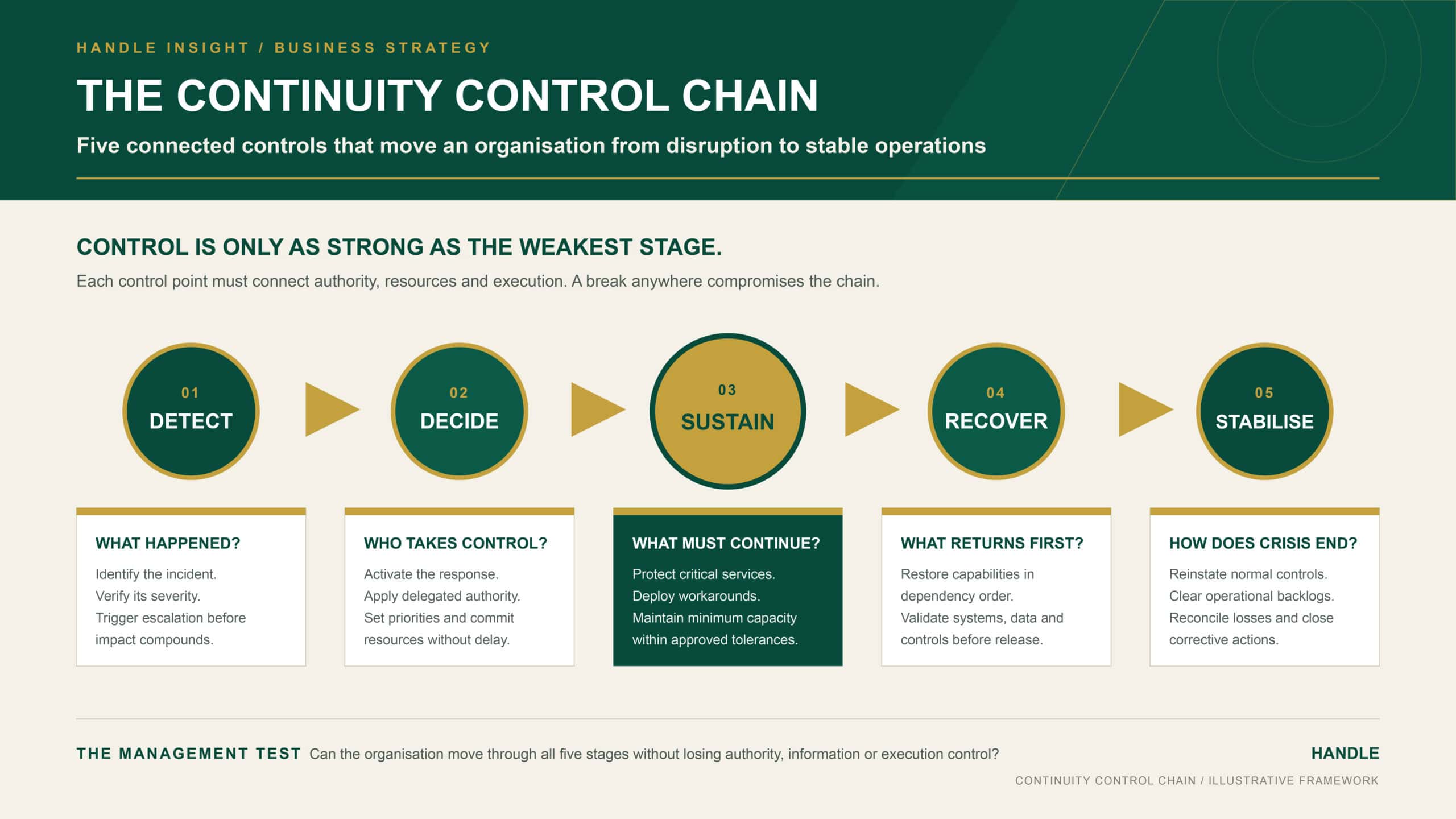
A useful way to test a business continuity strategy is to examine five connected control points: Detect, Decide, Sustain, Recover and Stabilise.
| Control Point | Management Question | Evidence of Readiness |
|---|---|---|
| Detect | How is disruption identified and classified? | Monitoring, incident thresholds and verified escalation channels |
| Decide | Who has authority to activate the response? | Named decision-makers, alternates and delegated powers |
| Sustain | How do critical services continue? | Workarounds, redundancy, minimum service levels and available resources |
| Recover | How are normal capabilities restored safely? | Sequenced recovery plans, tested systems and dependency controls |
| Stabilise | How does the organisation exit crisis mode? | Backlog plans, financial reconciliation, control reinstatement and post-incident review |
A weakness at any point breaks the chain. Rapid detection has limited value where activation authority is disputed. Effective workarounds do not create recovery if systems are restored in the wrong sequence. Technical recovery does not create stability if unresolved backlogs, customer claims or control exceptions remain unmanaged.
The continuity control chain tests whether the strategy can move the organisation from disruption to stable operations without losing command between phases.
Testing the Strategy Under Pressure
A continuity strategy remains unproven until it has been exercised. Testing should validate decision-making, dependencies and practical execution rather than confirm that employees have read the plan.
Testing methods include:
- Executive tabletop exercises.
- Unannounced call-tree and mobilisation tests.
- Technology failover and data restoration tests.
- Remote-working capacity tests.
- Supplier disruption simulations.
- Cyber incident and ransomware exercises.
- Alternative-site activation.
- Full operational simulations involving customers or counterparties where appropriate.
Each exercise should produce identified weaknesses, assigned corrective actions, accountable owners and completion deadlines. Repeating exercises without closing findings creates the appearance of readiness rather than operational resilience.
Common Business Continuity Failures
Continuity strategies commonly fail for structural reasons rather than because the triggering event was unforeseeable.
Frequent weaknesses include:
- Plans built around organisational charts rather than business services.
- Recovery targets unsupported by available technology or resources.
- Unmapped dependencies on individual employees or third parties.
- Supplier assurances accepted without verification.
- Backups maintained but never restored under test conditions.
- Crisis authority left subject to ordinary approval processes.
- Plans that assume primary communication channels remain available.
- Outdated contact information, systems inventories or facility arrangements.
- No provision for prolonged disruption or simultaneous incidents.
- Testing that excludes senior leadership.
The central failure is often the gap between the documented plan and the organisation’s actual operating model.
Business Continuity and Enterprise Value
Continuity capability influences enterprise value because operational resilience affects revenue certainty, customer retention, insurance exposure, regulatory confidence and transaction risk.
Investors and acquirers increasingly examine whether critical operations depend on concentrated suppliers, legacy systems, individual executives or untested recovery assumptions. These weaknesses can affect valuation, warranties, indemnities, deal conditions and post-acquisition integration planning.
A mature continuity strategy demonstrates that the organisation understands its dependencies, has priced its resilience requirements and can preserve key services under pressure. It converts preparedness from a compliance document into evidence of management control.
Conclusion
A business continuity strategy defines how an organisation preserves critical services when ordinary operating conditions fail. It identifies what must continue, measures how long interruption can be tolerated, assigns decision authority and establishes the alternative resources required to sustain performance. Effective continuity connects business impact analysis, recovery metrics, technology resilience, workforce planning, supplier oversight, financial capacity and crisis governance within one operating framework. The strongest strategies are prioritised, measurable and repeatedly tested against real dependencies. They do not attempt to prevent every disruption. They ensure that disruption does not remove control. Critical operations continue. Recovery is sequenced. Enterprise value remains protected.
