

Most business models that look new in one industry are already proven in another. Subscriptions moved from software into industrial maintenance. Platform economics moved from consumer technology into logistics and healthcare coordination. Risk pooling moved from insurance into performance guarantees. Cross-industry model adaptation is the discipline of importing those proven economic engines and rebuilding them to operate under a different set of regulatory, capital and liability constraints. Within Business Model Innovation, it is one of the fastest routes to advantage, because the mechanism has already been de-risked elsewhere. It is also one of the easiest to get wrong, because the conditions that made the model work in its home industry rarely travel with it. Copying the surface imports the risk. Translating the mechanism imports the advantage.
Why Cross-Industry Model Adaptation Creates Advantage
Industries mature at different speeds. Pricing innovation, data leverage, automation and platform dynamics tend to appear first where regulation is lighter, margins are richer or customers adopt faster. Sectors that move more slowly inherit those mechanisms years later, often from new entrants rather than incumbents.
Cross-industry adaptation arbitrages that timing gap. An organisation that recognises a mechanism already working elsewhere, and translates it correctly into its own sector, can capture advantage before competitors do and at lower experimental cost than inventing a model from first principles. The constraint is not imagination. It is the quality of the translation.
Imitation Versus Adaptation: What Is the Difference?
Imitation copies what a model looks like. Adaptation transfers what makes it work. The distinction determines whether the imported model creates value or simply relocates another industry’s problems.
| Dimension | Imitation | Adaptation |
|---|---|---|
| What is transferred | Features, branding, pricing labels | The underlying economic mechanism |
| Treatment of regulation | Assumed to be similar or dealt with later | Mapped explicitly before design |
| Capital assumptions | Borrowed from the source industry | Rebuilt for the target industry’s cost and cash cycle |
| Liability | Left where the source model placed it | Reallocated by contract and structure |
| Typical result | Early traction, then margin erosion or regulatory friction | Slower launch, durable economics |
Three disciplines separate adaptation from imitation. Mechanism extraction identifies the economic engine, such as recurring revenue, network effects, risk pooling or usage-based pricing, and ignores the surface features. Constraint remapping restates the regulatory, capital, liability and customer conditions of the target sector. Control preservation rejects any imported element that weakens pricing authority, data ownership or the ability to enforce contracts.
Which Models Transfer Across Industries?
Certain model archetypes transfer repeatedly when they are engineered correctly. Each carries a specific condition that must hold in the target sector.
| Model Archetype | Source Industry | Typical Target | Condition for Success |
|---|---|---|---|
| Subscription and entitlement | Software | Equipment maintenance, professional services | Auditable entitlements and minimum terms that protect margin |
| Platform or marketplace | Consumer technology | Logistics, healthcare coordination, B2B procurement | Control of the rules, data and access, not of every transaction |
| Usage-based pricing | Cloud services, utilities | Manufacturing equipment, mobility, energy | Reliable metering and caps that prevent revenue volatility |
| Risk pooling | Insurance | Warranties, performance guarantees, service levels | Priced risk, loss data and, where required, the right licence |
| Data monetisation | Technology | Industrial and professional services | Clear data ownership, consent and liability allocation |
The final column is where most adaptations fail. The archetype is easy to recognise. The condition is easy to overlook.
How to Identify a Transferable Mechanism
Not every successful model is transferable. The useful test is whether its advantage comes from a mechanism or from a circumstance. A mechanism is a repeatable economic logic, such as converting uncertain repair costs into a predictable fee, or charging for access to a network rather than for each transaction. A circumstance is a condition specific to the source industry, such as near-zero marginal cost, light regulation or an unusually tolerant customer base.
Leadership teams should ask three questions of any candidate model. What exactly does the customer pay for, and why do they prefer it? Which cost, risk or friction does the model remove for the customer, and who absorbs it instead? And which conditions in the source industry made that absorption profitable? If the answers depend mainly on circumstances that do not exist in the target sector, the model is not a candidate for adaptation, however attractive it looks.
The strongest candidates solve a problem the target sector already has, using a mechanism whose economics can be rebuilt with available data. Evidence of customer pain matters more than evidence of success elsewhere.
Regulation as the Primary Constraint
Regulation determines whether an imported model is viable at all. A mechanism that bypasses an intermediary may require the licence that intermediary held. An automated decision may be lawful in one sector and require human judgement in another. A risk-pooling product that resembles insurance may be treated as insurance.
In the UAE, regulators have created structured routes for testing new models. The Dubai Financial Services Authority and the Financial Services Regulatory Authority in ADGM each operate innovation and testing frameworks for financial technology, and onshore financial activity falls under the Central Bank of the UAE and other federal regulators. Data-driven models must also comply with the federal personal data protection law onshore or the separate data protection regimes of the DIFC and ADGM, depending on where the business operates. Each regime has its own requirements for consent, cross-border transfer and accountability.
The practical rule is to map the licensing and data position of the adapted model before design is finalised. Remediation after launch is almost always more expensive than design before it.
Liability and Structure: Where Should the Risk Sit?
Adapted models redistribute liability. A subscription shifts the risk of unexpected repair costs from customer to provider. A platform may be held responsible for failures by participants it does not employ. A performance guarantee converts operational risk into a contractual promise. Each shift must be priced and documented, or the business will carry exposure it has not recognised.
Structure supports that allocation. Many groups hold intellectual property, data assets and platform rules in a dedicated entity, and place customer-facing operations in a separately licensed operating company. In the UAE, a holding or IP entity in the DIFC or ADGM can offer common-law based company and contract regimes and established courts, while the operating company holds the activity licence where the customers are served. The right structure depends on the activity, the licence and the tax position, and should be chosen deliberately rather than inherited.
Capital and Unit Economics Must Be Rebuilt
Capital behaves differently across sectors. Software subscriptions can tolerate years of upfront customer acquisition cost because marginal cost of delivery is low. An industrial maintenance subscription carries labour, parts and travel in every unit delivered. If the economics are copied rather than rebuilt, the model grows revenue while consuming cash.
Adapted models therefore need explicit payback thresholds, margin floors and stress tests on the variables that differ most from the source industry. Growth without capital recovery is not a business model. It is a subsidy.
Worked Example: Subscription Logic in Equipment Maintenance
Consider an illustrative industrial services company that repairs equipment on a call-out basis. It decides to adapt subscription logic and offer a fixed annual service fee per machine.
For illustration, it signs 400 machines at AED 90,000 each per year, producing AED 36 million of recurring revenue. Its model assumes a cost to serve of AED 60,000 per machine, giving a margin of one third. If call-out frequency runs 20% above assumption, cost to serve rises to AED 72,000 and the margin falls to 20%. If the contract allows customers to cancel at any time, the company bears the cost of front-loaded inspections without the certainty of revenue to recover them.
The translated model therefore includes a minimum three-year term, a defined entitlement of scheduled and unscheduled visits, a usage charge above the cap, condition-based exclusions and a pricing review mechanism. The subscription label came from software. The economics had to be rebuilt for machinery.
Operating Model and Governance
An adapted model fails if the organisation around it is unchanged. Decision rights must move to the points where the new model creates value. Sales incentives designed for one-off transactions must be redesigned for retention and lifetime value. Automation should replace discretion only where it is legally and operationally permissible, with exceptions governed rather than improvised.
Governance must also harden as novelty increases. Rights, pricing, data use and exit conditions should be codified in contracts rather than inferred from the practice of another industry. Performance, risk and compliance should be monitored centrally during the early phase, and the model should carry defined termination triggers if economics or compliance deviate from plan. Reversibility is designed in, not discovered.
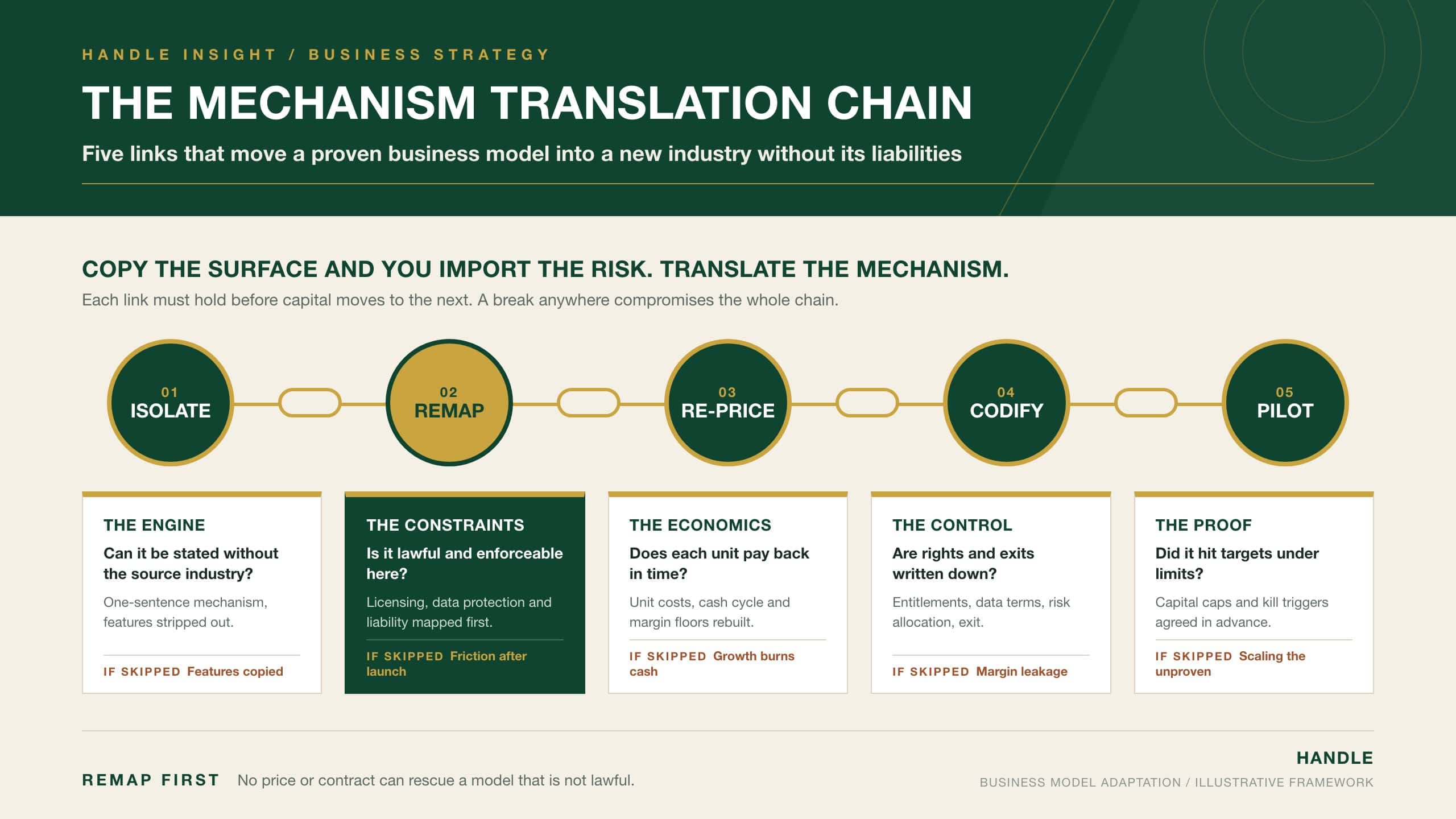
Original Analysis: The Mechanism Translation Chain
Successful adaptation follows a chain of five links. Each link must hold before the next is attempted, and a break at any point compromises the whole.
1. Isolate. Define the economic mechanism in one sentence, stripped of its source-industry features.
2. Remap. Restate the regulatory, licensing, data and liability conditions of the target sector, and identify what must change for the mechanism to be lawful and enforceable.
3. Re-price. Rebuild unit economics for the target sector’s cost structure, cash cycle and customer behaviour, with explicit payback and margin floors.
4. Codify. Write the rights, entitlements, data terms, risk allocation and exit conditions into contracts and governance.
5. Pilot. Launch under capital limits and defined kill triggers, then scale only when the evidence matches the plan.
Each link can be tested with a single question before the organisation commits capital to the next.
| Link | Test Question | Evidence Required | Failure if Skipped |
|---|---|---|---|
| Isolate | Can the mechanism be stated without naming the source industry? | One-sentence definition agreed by leadership | Features copied, engine missing |
| Remap | Is the model lawful and enforceable in the target sector? | Licensing, data and liability analysis | Regulatory friction after launch |
| Re-price | Does each unit recover its cost and capital within the threshold? | Stress-tested unit economics | Revenue growth that consumes cash |
| Codify | Are rights, entitlements and exits written down? | Contracts, policies, governance approvals | Disputes and margin leakage |
| Pilot | Has the model met its targets under capital limits? | Pilot results against pre-agreed triggers | Scaling an unproven model |
The second link carries the most weight. A mechanism that cannot be made lawful and enforceable in the target sector cannot be rescued by better pricing or stronger contracts. Remap first. Then build.
Common Cross-Industry Adaptation Failures
- Copying the features of a successful model without the control layer that made it profitable, so margins erode as volume grows.
- Discovering licensing or data protection requirements after launch, when remediation costs exceed the benefit of the model.
- Assuming the source industry’s return profile will hold in a sector with higher capital intensity or longer cash cycles.
- Leaving liability where the source model placed it, so the business carries risks it has not priced.
- Changing the customer offer without changing incentives, decision rights and reporting inside the organisation.
- Launching without kill triggers, so a failing model continues to consume capital because no one has authority to stop it.
Each failure is a translation error. The mechanism was sound. The conditions were not rebuilt.
Conclusion
Cross-industry model adaptation is not about borrowing ideas. It is about importing proven economic engines and rebuilding them for a sector with different regulation, capital intensity, liability and customer behaviour. Subscriptions, platforms, usage pricing, risk pooling and data models all travel well when their conditions are rebuilt, and badly when they are copied. In the UAE, that rebuilding includes the licensing perimeter of the relevant regulator, the applicable data protection regime and the structured testing routes available in the DIFC and ADGM. Organisations that isolate the mechanism, remap the constraints, re-price the economics, codify control and pilot under limits capture advantage at lower risk than inventing from first principles. The decisive link is the remapping of constraints, because nothing downstream can repair a model that is not lawful or enforceable. Organisations that imitate inherit fragility. Translation is the work. Control is the test.


