

Every diversified group eventually holds assets it would not buy today. They remain because they are profitable, because they were the founder’s first business, because no one has asked the question formally, or because selling them feels like admitting a mistake. The cost is rarely visible on a single line of the accounts. It shows up as diluted management attention, capital spread too thinly and a valuation discount applied by investors who cannot tell which parts of the group drive value. Asset classification is therefore not descriptive. It is a capital decision. Within Portfolio Strategy & Business Unit Optimization, core vs non-core asset identification determines where capital compounds, where governance intensifies and where an orderly exit is prepared. Boards do not manage assets equally. They concentrate control where enterprise value is built and release capital where value is trapped. Classification must be earned with evidence. Sentiment is not evidence.
What Makes an Asset Core?
An asset is core when it strengthens the group’s declared mandate under pressure. Core status is earned through measurable contribution, not through history, size or reputation. Four attributes recur.
Cash flow durability. Core assets generate recurring, enforceable cash flows with defensible margins. Contracts are binding, customers are retained, pricing power is observable and cash conversion is at or above the sector norm. Where revenue volatility or working capital drag erodes predictability, core status weakens.
Strategic leverage. Core assets strengthen the group’s position with suppliers, regulators, lenders and counterparties. They anchor brand authority, regulatory access or distribution reach. If an asset does not expand influence or strategic optionality, it is unlikely to be core.
Capital efficiency. Core assets convert invested capital into returns above the group’s cost of capital without disproportionate reinvestment merely to stand still. Efficiency is measured, not asserted.
Governance compatibility. Core assets operate within structures the group can oversee and enforce. Reporting is transparent, legal exposure is manageable and leadership is aligned. An asset that consumes excessive board time through disputes or compliance gaps cannot remain core, whatever it earns.
What Does Non-Core Actually Mean?
Non-core does not mean underperforming. It means misaligned. A non-core asset may be highly profitable, but if it does not reinforce the group’s mandate or capital thesis, it dilutes focus and depresses the multiple investors apply to the whole.
Misalignment usually takes one of four forms. Strategic drift occurs when an asset acquired under a previous strategy remains after the thesis has moved on, such as a discretionary retail business inside a group now focused on regulated infrastructure. Capital drag occurs when the asset absorbs reinvestment to remain competitive without compounding group value. Risk mismatch occurs when the asset adds exposure the group cannot ring-fence or price, such as concentrated counterparty risk or a volatile regulatory regime. Governance distraction occurs when leadership time is consumed by operational friction rather than strategic progress.
| Dimension | Core Asset | Non-Core Asset |
|---|---|---|
| Relationship to mandate | Directly advances declared strategic objectives | Neutral or unrelated to current objectives |
| Capital behaviour | Receives growth capital under disciplined underwriting | Capital capped, harvested or released |
| Return profile | Sustained returns above the group’s hurdle rate | Returns below hurdle or dependent on reinvestment |
| Risk contribution | Diversifies or strengthens portfolio resilience | Adds correlated or unpriced exposure |
| Governance intensity | Strongest management bench and board attention | Defined oversight with an end state |
How Should Classification Be Tested?
Classification should be conducted through a structured, repeatable assessment rather than a strategy offsite discussion. The test works best when it is run on every asset at the same time, using the same evidence standard, so that no business is judged by a different rule.
Mandate alignment. Each asset is mapped against the group’s three-year and ten-year objectives, which are weighted by importance. Contribution must be evidenced. An asset that contributes nothing to the primary objectives is provisionally non-core.
Economic engine compatibility. The asset’s revenue model is compared with the group’s preferred profile, whether recurring contracted income, asset-backed yield, regulated returns or scalable platform economics. An engine that diverges and cannot be integrated is structurally peripheral.
Return differential. Return on invested capital, free cash flow yield and reinvestment intensity are compared with the portfolio hurdle rate. Assets below hurdle are placed under review, and sustained underperformance triggers reclassification.
Risk concentration. The correlation between the asset’s exposures and the group’s aggregate risk is assessed. An asset that increases correlated exposure without compensating return weakens resilience.
Exit feasibility. An asset may be non-core yet retained if exit conditions are temporarily unfavourable. Buyer universe, market multiples, tax consequences and carve-out complexity are evaluated, producing an exit readiness score.
Original Analysis: The Core Classification Chain
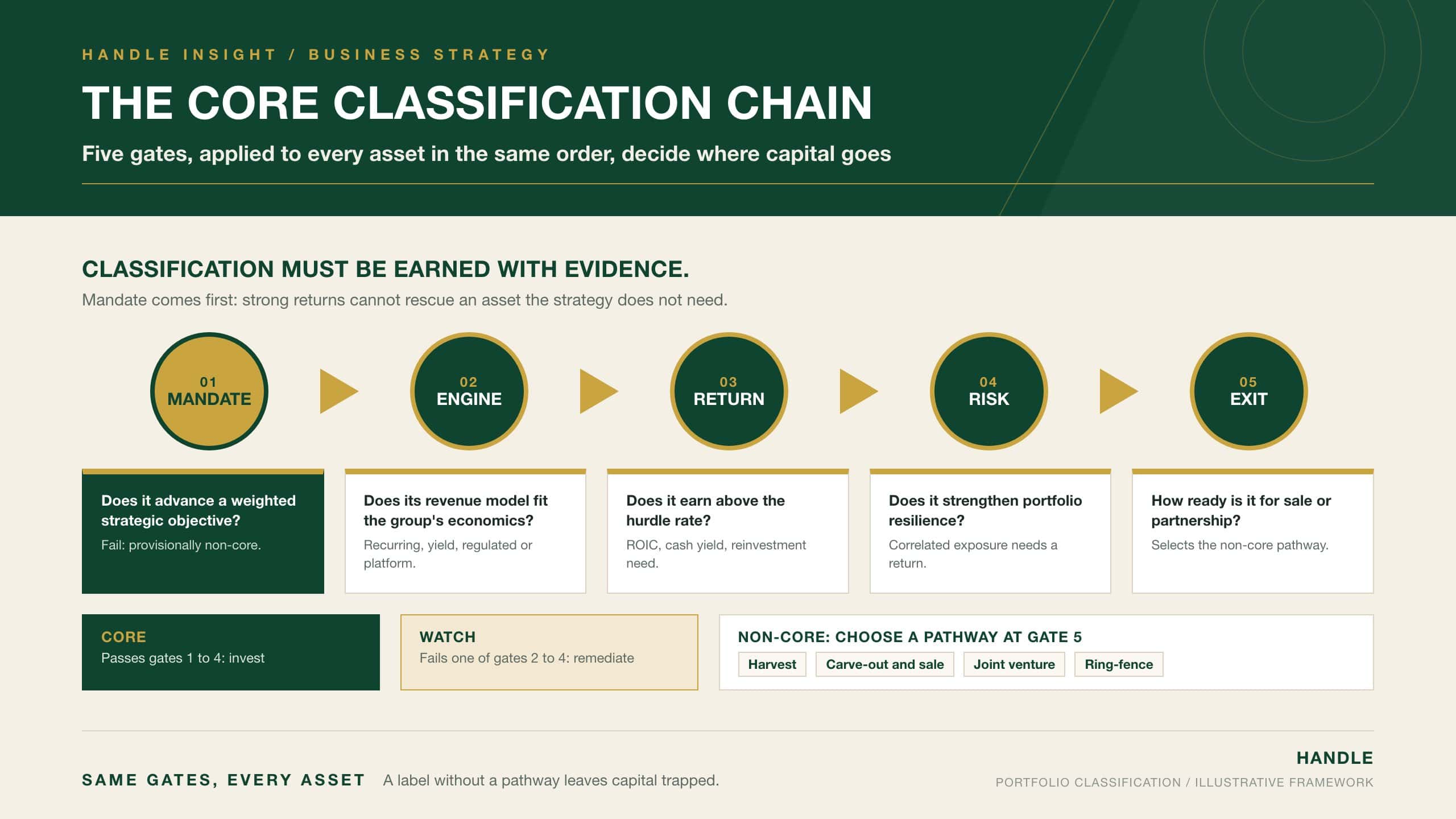
The Core Classification Chain links the five tests in a fixed order, so that each asset passes through the same gates and the result determines capital behaviour. The order matters. Mandate is tested first because an asset that does not serve the strategy cannot be rescued by strong returns. Exit feasibility is tested last because it determines how a non-core asset is handled, not whether it is non-core.
- Gate 1, Mandate: does the asset advance a weighted strategic objective? If not, it is provisionally non-core.
- Gate 2, Engine: does its revenue model fit the group’s preferred economics, or can it be integrated?
- Gate 3, Return: does it earn above the hurdle rate without disproportionate reinvestment?
- Gate 4, Risk: does it strengthen portfolio resilience rather than concentrate exposure?
- Gate 5, Exit: for assets failing earlier gates, how ready is the asset for sale, partnership or ring-fencing?
An asset passing the first four gates is core and receives concentrated investment. An asset failing Gate 1 or two or more of Gates 2 to 4 is non-core, and Gate 5 selects its pathway. An asset failing a single gate among Gates 2 to 4 is placed on a watch list with a defined remediation period. The chain removes the most damaging habit in portfolio reviews: judging each asset by whichever measure flatters it.
A Worked Example: Classifying a Family Group’s Portfolio
Consider an illustrative UAE family group whose declared mandate is regulated infrastructure and logistics, with a hurdle rate of 11 percent. It holds four businesses. All figures are illustrative.
| Asset | Mandate | Engine | Return (ROIC) | Risk | Exit Readiness | Classification |
|---|---|---|---|---|---|---|
| Port logistics operator | Pass | Pass | 14% pass | Pass | Not required | Core: invest |
| Cold-chain warehousing | Pass | Pass | 9% fail | Pass | Not required | Watch: two-year remediation |
| Fashion retail franchise | Fail | Fail | 16% pass | Fail | High | Non-core: carve-out and sale |
| Founding trading company | Fail | Fail | 7% fail | Pass | Low | Non-core: harvest and ring-fence |
The fashion franchise is the most profitable asset in the group, yet it is non-core because it fails mandate, engine and risk tests. Its high exit readiness makes a sale realistic, and the proceeds can fund the cold-chain remediation. The founding trading company carries emotional weight, but it fails the mandate and return tests and has few buyers. It is harvested for cash, capital expenditure is capped and its guarantees are separated from the core group. The classification turns a conversation about loyalty into a conversation about evidence.
What Happens After Classification?
Core assets are governed through capital concentration and structural reinforcement. Expansion capital is directed to them under disciplined underwriting, leverage is structured to preserve optionality and growth is sequenced to protect liquidity. They receive the strongest management bench and succession planning, with incentives tied to returns, cash durability and risk control. Legal structures isolate them from peripheral liabilities.
Non-core classification does not imply immediate divestment. It opens one of four pathways, each with its own governance requirements.
| Pathway | When It Fits | Governance Requirement |
|---|---|---|
| Harvest | Cash-generative but peripheral, limited buyer interest | Capital expenditure cap, dividend policy, defined review date |
| Carve-out and sale | Buyer universe exists and market conditions support value | Standalone financials, time-limited transitional services, leakage controls |
| Joint venture or minority sale | Partial strategic relevance or capability gap | Retained reserved matters where influence is still required |
| Structural ring-fencing | Exit impractical in current conditions | Isolate liabilities and guarantees, remove cross-default exposure |
UAE Structuring and Tax Considerations
In the UAE, the way a non-core asset is separated affects both value and tax cost. Under the Corporate Tax regime (Federal Decree-Law No. 47 of 2022), reliefs for transfers within a qualifying group and for business restructurings can allow assets or businesses to move without an immediate taxable gain, subject to ownership conditions and clawback if the asset or shares are disposed of within the specified period. A restructuring designed to obtain relief may therefore restrict how soon the non-core asset can be sold, so tax analysis belongs in the pathway decision. An asset’s tax status, for example whether income qualifies for the 0 percent rate available to a Qualifying Free Zone Person, can also change its after-tax return and therefore its result at the return gate.
Holding structures matter too. Many groups place core assets under a DIFC or ADGM holding company, which provides familiar governance tools and a cleaner route to transfer or pledge shares. Sales of larger businesses may require merger control notification under the Competition Law (Federal Decree-Law No. 36 of 2023) where the thresholds are met, which should be built into the exit timetable.
Why Do Investors and Lenders Reward Clear Classification?
Capital markets reward clarity. A conglomerate discount arises when investors cannot distinguish the businesses that drive growth from those that distract from it, and they price the whole group at the level of its least understood part. Transparent classification narrows that discount and can reduce the cost of capital.
Disclosure should follow the classification. Segment reporting that reflects the core and non-core distinction, and capital allocation commentary that is consistent with it, allow investors to see that the group is doing what it says. Inconsistency between stated priorities and actual capital deployment is quickly noticed.
Lenders apply the same logic to collateral. Concentrating security around core assets with durable cash flows generally improves borrowing terms, while peripheral assets can be kept outside covenant packages where possible, so that their performance does not trigger stress across the core group.
Family Enterprise Considerations
In founder-led and family groups, emotional attachment often distorts classification. A foundational business may hold symbolic value for the family. If it remains economically core, it is reinforced. If it does not, governance must place capital logic ahead of sentiment, while recognising the family’s legitimate interest in how the transition is handled. Next-generation strategies frequently differ from the founding mandate, and classification must reflect the forward thesis rather than the historical narrative. Family charters and, where used, the governing documents of a family foundation should record the mandate against which assets are assessed, so that classification is not relitigated every time leadership changes.
Common Misclassifications
- Treating revenue size as proof of core status, when low-margin, capital-intensive businesses can inflate turnover while depressing returns.
- Accepting a growth narrative without enforceable margins or durable contracts, which leaves the asset speculative rather than core.
- Allowing founder identity or public perception to override capital discipline on a legacy business.
- Classifying profitable assets as core by default, ignoring misalignment with the mandate and the valuation discount it creates.
- Labelling an asset non-core without selecting a pathway, so it drifts with neither investment nor exit.
- Designing a tax-efficient separation without checking whether it delays the intended sale.
Each error erodes enterprise value. Each is corrected by applying the same evidence standard to every asset.
Conclusion
Core vs non-core asset identification imposes clarity on capital behaviour. Core assets are those that advance the group’s mandate, fit its economic engine, earn above its hurdle rate and strengthen its resilience. Non-core assets are misaligned, not necessarily weak, and each requires a defined pathway: harvest, carve-out and sale, partnership or ring-fencing. The Core Classification Chain applies the same gates to every asset in the same order, which prevents profitable but peripheral businesses from escaping scrutiny and legacy businesses from being protected by sentiment. In the UAE, Corporate Tax reliefs, holding structures and merger control shape how a non-core asset can be separated and how quickly it can be sold. Classification without a pathway is a label. Classification with a pathway is a capital decision. Capital aligned. Risk isolated. Value compounded.


