

Most organisations have a vision, a mission and a set of values. Few can show where any of them changed a decision. That gap is the real alignment problem. Vision, mission and values alignment means that each statement has a distinct job, that the three do not overlap or contradict one another, and that each is wired into the decisions, policies, incentives and consequences through which the organisation actually operates. This work sits inside Strategic Planning & Visioning because alignment is not the output of a workshop. It is a governance system that either shapes behaviour under pressure or quietly fails. A statement that never costs anything is not a governing statement.
What Does Vision, Mission and Values Alignment Mean?
Alignment means the vision defines the destination, the mission defines the operating mandate, and the values define the behaviours that are required and prohibited while the mandate is carried out. Each element answers a different question. The vision answers where the organisation is going. The mission answers what it does, for whom and how, every day. The values answer how it behaves when incentives tighten and deadlines compress.
An aligned set of statements passes two tests. The first is distinctness: the vision contains no operating detail, the mission contains no abstract aspiration, and the values contain no generic virtues. The second is enforceability: each statement can be traced to at least one decision right, policy, measure or consequence. If either test fails, the statements may read well but they do not govern.
| Element | Question Answered | Horizon | Owner | Typical Failure Form |
|---|---|---|---|---|
| Vision | Where are we going? | Five to ten years | Board | A slogan with no end state |
| Mission | What do we do, for whom and to what standard? | Current strategic cycle | Executive team | Marketing copy with no operating content |
| Values | How do we behave under pressure? | Continuous | Board and leadership, enforced through policy | Generic virtues nobody can be dismissed for breaching |
How Should a Vision Govern Direction?
A governing vision is a boundary-setting device. Its purpose is to eliminate false options, not to inspire. It should declare a clear end state, signal competitive intent, define the scope of ambition and survive a change of leadership. A vision that could belong to any company in the sector fails the first requirement.
The practical test is speed. Every major decision should be testable against the vision in under a minute. Does this acquisition, market entry or investment move the organisation toward the declared end state? If it does not, it is non-core, deferred or rejected. This is the first and most powerful filter in the alignment system, because it removes options before management time and capital are spent on them.
How Should a Mission Control Execution?
The mission is an operating instruction, not a promise. It specifies the core domain of activity, the clients or stakeholders served, the mechanism by which value is created and the standard of delivery. Written properly, it lets each business unit and function derive its own mandate without interpretation.
A useful check is whether a senior team could map the operating model directly to the mission. If the mission says the organisation serves mid-market manufacturers through integrated advisory and implementation, then the service lines, hiring plan and delivery standards should all be recognisable in that sentence. If the mission would fit equally well on a competitor’s website, it is not controlling anything.
Why Values Must Be Enforceable
Values are behavioural covenants. They are not personality traits or aspirations. Each value should contain a behaviour statement and an exclusion statement: what people do, and what they do not do even when it would help short-term results. If a value cannot support a hiring, promotion or termination decision, it is sentiment rather than governance.
Values should also map to the organisation’s risk profile. A regulated, capital-exposed institution needs values that enforce integrity of process, evidence-based judgement, accountability, confidentiality and disciplined escalation. In that setting values operate like covenants in a loan agreement. They exist to protect outcomes when pressure would otherwise erode them.
A short list is stronger than a long one. Four or five covenants that leaders can recall and apply are more effective than a dozen that nobody can use in a decision. Each should be illustrated with real examples of conduct the organisation has rewarded and conduct it has refused to accept, so that staff understand where the boundary lies.
How Is Alignment Engineered?
Alignment is built in a fixed sequence, so that each statement has a distinct function and circular wording is avoided.
1. Define the Strategic End State
Describe concretely what the organisation becomes: market position, core capabilities, scale markers and reputation. This becomes the backbone of the vision.
2. Define the Execution Mandate
Specify what the organisation will do repeatedly to reach the end state. This becomes the mission, tied to service lines, operating model and delivery standards.
3. Define the Behavioural Covenants
Set how the organisation operates while executing the mandate. Translate each covenant into expected and disallowed behaviours. These become the values.
4. Cross-Check for Overlap and Contradiction
Overlap creates redundancy and confusion. Contradiction creates cultural fracture. A value of speed alongside a mission built on meticulous assurance, for example, must be reconciled before either is published.
Translating Alignment into Governance
Statements become real only when governance reflects them. The board owns the vision and the strategic thesis, and should approve any material change to either. The executive team owns the mission as an execution mandate and is held accountable for delivery against it. Values are enforced through leadership standards and policy rather than through posters and internal campaigns.
Policies are where values become enforceable. Escalation rules, conflict of interest procedures, confidentiality standards, approval thresholds and risk acceptance criteria should each be traceable to a stated value. Role charters should reference the mission, and performance contracts should reward aligned behaviour and penalise behaviour that breaches covenants, even where short-term results look positive.
Annual planning closes the loop. Each initiative in the plan should show how it advances the vision and how its delivery reflects the mission, and the values should determine how trade-offs are resolved when objectives collide.
A Worked Example: Alignment as a Capital Filter
Consider an illustrative regional services group preparing its annual plan. Business units submit twelve initiatives requesting a combined AED 48 million against an available budget of AED 30 million. Rather than cutting every request proportionally, the executive team applies the alignment filters in order.
| Filter | Question | Initiatives Remaining | Capital Requested (AED m) |
|---|---|---|---|
| Starting position | All submissions | 12 | 48.0 |
| Vision filter | Does it move us toward the declared end state? | 8 | 34.0 |
| Mission filter | Is it delivered through our stated mandate and standard? | 7 | 31.5 |
| Values filter | Can it be delivered without breaching a covenant? | 6 | 28.5 |
The group funds six initiatives at AED 28.5 million and retains AED 1.5 million as contingency. More importantly, every rejected proposal has a stated reason that refers to a governing statement rather than to the preferences of whoever chaired the meeting. That is what alignment delivers in practice: faster decisions, fewer appeals and a capital plan the organisation can explain.
Measuring and Enforcing Alignment
Alignment decays without measurement. Vision is tracked through strategic milestones and leading indicators. Mission is tracked through delivery performance and client outcomes. Values are tracked through behavioural evidence: audit findings, escalations, exceptions granted and leadership evaluations.
Misalignment has recognisable symptoms. Priorities shift repeatedly without a change in strategy. Similar decisions produce inconsistent outcomes. Policy exceptions are granted without consequence. Promotions reward politics over accountability. These are governance failures, not communication failures, and they are corrected through decision rights and consequences rather than through new messaging.
Review cadence should match the function of each statement. The vision is reviewed annually for relevance but rarely rewritten. The mission is reviewed annually for execution integrity. The values are reviewed continuously through the decisions leaders actually make.
| Symptom | What It Usually Signals | Corrective Control |
|---|---|---|
| Strategic priorities change every quarter | The vision is too vague to filter options | Rewrite the end state with scope and scale markers |
| Units interpret the mission differently | The mission lacks operating content | Specify domain, clients, mechanism and standard |
| Policy exceptions are routine | Values are not codified in approval rules | Link each exception to a named value and owner |
| High performers breach values without consequence | Incentives reward results regardless of conduct | Add behavioural criteria to appraisal and bonus decisions |
Keeping Alignment Through Growth and Leadership Change
Alignment is most at risk when the organisation changes shape. Rapid growth brings in managers who never took part in writing the statements. Acquisitions import cultures with their own unwritten values. A new chief executive may arrive with a different strategic instinct. Each event tests whether the statements are embedded in governance or only in the memory of the people who drafted them.
Three practices protect alignment through change. Induction for senior hires should cover the decision rights and policies that enforce the statements, not only their wording. Integration plans for acquisitions should include a values reconciliation, identifying which behaviours in the acquired business conflict with the covenants and how quickly they must change. Leadership transitions should be treated as an opportunity to confirm the vision rather than to replace it, with any genuine change of direction decided by the board as a strategic choice.
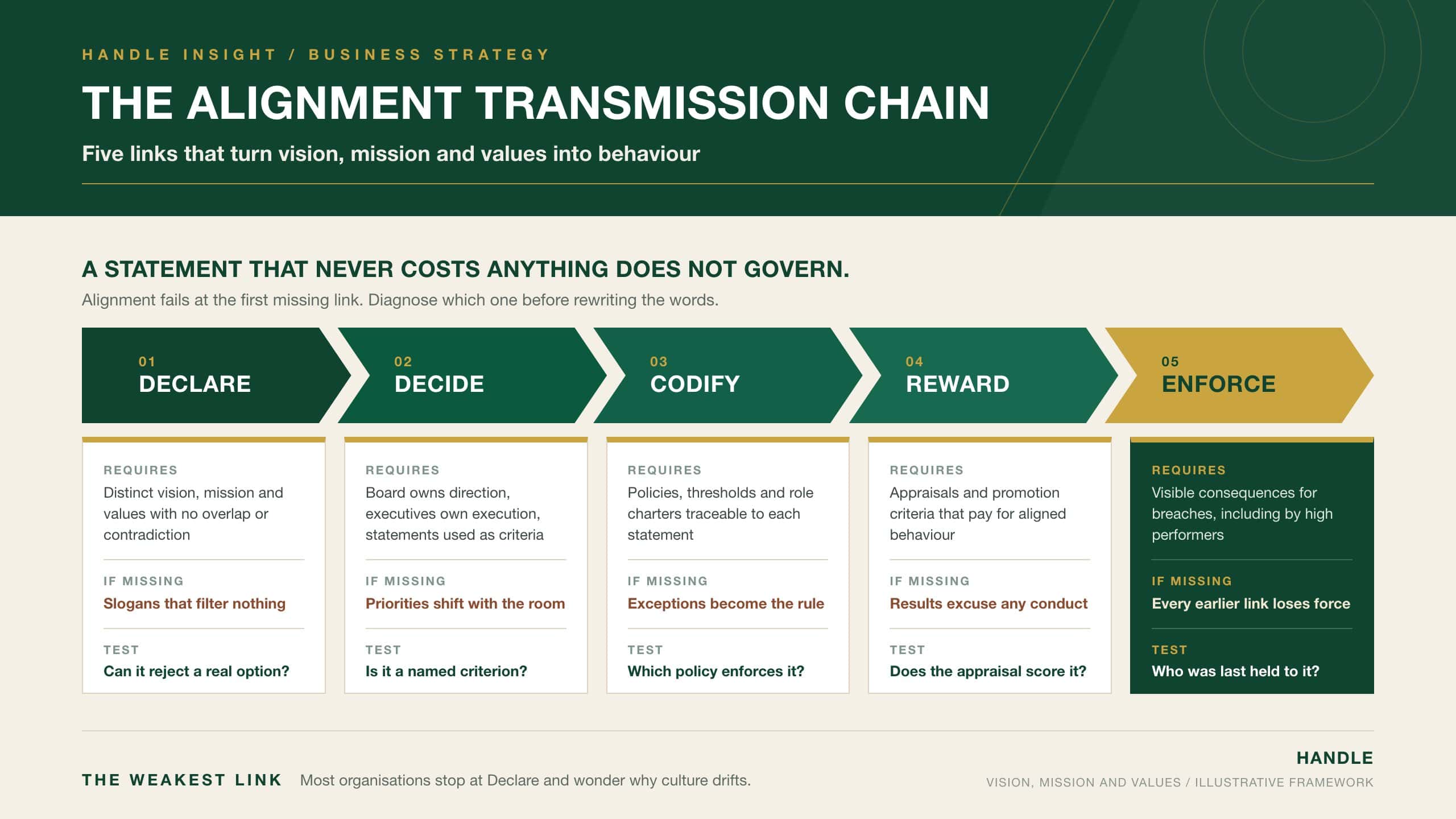
Original Analysis: The Alignment Transmission Chain
The Alignment Transmission Chain describes how a statement becomes behaviour. It has five links, and alignment fails at the first link that is missing.
Declare. The vision, mission and values are written with distinct functions and pass the overlap and contradiction check.
Decide. Decision rights are allocated so that the board governs direction and the executive team governs execution, each using the statements as explicit criteria.
Codify. Policies, approval thresholds and role charters translate the statements into rules that apply whoever is in the room.
Reward. Incentives, appraisals and promotion criteria pay for aligned behaviour and withhold reward for misaligned results.
Enforce. Breaches carry visible consequences, including for high performers. This is the link most organisations omit, and without it every earlier link loses force.
The chain also works as a diagnostic. When behaviour diverges from the stated values, leaders can ask which link failed. A missing policy is a codification failure. A rewarded breach is an enforcement failure. Each requires a different remedy.
Common Alignment Failures
- Writing a vision that sounds like a slogan and therefore cannot eliminate any strategic option.
- Writing a mission as marketing copy, so business units cannot derive their mandates from it.
- Adopting generic values such as excellence or integrity without behaviour and exclusion statements that make them enforceable.
- Treating the published statements as the end of the work rather than the start of the governance design.
- Rewarding results achieved in breach of stated values, which teaches the organisation that the values are optional.
- Rewriting the vision whenever leadership changes, which destroys the continuity it is meant to provide.
Each failure is visible in decisions long before it appears in culture surveys.
Conclusion
Vision, mission and values alignment is institutional design rather than communication. The vision sets the destination and filters out false options. The mission sets the operating mandate from which every unit derives its work. The values set enforceable behavioural covenants that hold when pressure rises. Alignment requires that the three are distinct, free of contradiction and connected to decision rights, policies, incentives and consequences. The Alignment Transmission Chain shows that a statement becomes behaviour only when it is declared, used in decisions, codified, rewarded and enforced, and that the chain breaks at its weakest link. Measured properly, alignment produces faster decisions, cleaner capital allocation and consistent conduct across leadership changes. Statements describe intent. Governance converts intent into behaviour. Consequences prove it.


