

A KPI is a claim about performance. The data source behind it decides whether that claim can be relied on when capital, bonuses or careers depend on it. Most measurement frameworks fail not because the wrong indicators were chosen, but because nobody decided which system holds the authoritative number, how late that number is allowed to arrive, or who may change it. Within KPI & Strategic Performance Tracking, the selection and governance of data sources for KPI measurement is therefore a control decision for the board and the executive, not a configuration task for the IT function. When two reports show different figures for the same metric, the organisation stops managing performance and starts arguing about arithmetic. A KPI is only as credible as the source that can be defended under challenge.
Why Do Data Sources Decide Whether a KPI Can Be Trusted?
KPIs influence three things that matter most to an institution: where capital is deployed, how leaders are held to account and when management intervenes. Each of those decisions assumes that the number on the dashboard is complete, current and calculated the same way it was last quarter. If any of those assumptions fails, the decision built on it fails with it.
Data source discipline removes interpretation from measurement. When every KPI resolves to one designated system of record, disputes are settled by reference to that system rather than by negotiation between departments. That is the practical meaning of a single version of truth: not a single database, but a single answer to the question of which source prevails.
Decision-grade reliability is a different standard from reporting convenience. A source chosen because it produces attractive charts, or because a team has always used it, may be unsuitable for a metric that drives executive remuneration or covenant monitoring. Completeness, timeliness, auditability and consistency across periods come first. Presentation comes last.
Which Systems Should Feed Enterprise KPIs?
Enterprise KPI frameworks draw on a limited set of source categories. Each has a natural authority over certain metrics and should not be stretched beyond it.
Financial systems of record. The general ledger, consolidation platform, treasury system and billing engine are the authoritative sources for revenue, margin, cash, working capital, leverage and covenant metrics. In the UAE these systems also underpin VAT and Corporate Tax filings under Federal Decree-Law No. 47 of 2022, so a financial KPI that cannot be reconciled to the ledger used for tax reporting is a warning sign in itself.
Operational execution systems. ERP, supply chain, project management, manufacturing and service delivery platforms measure throughput, cycle time, utilisation and delivery performance. Their value lies in capturing data at the point of execution, before it is summarised or adjusted.
Customer and commercial platforms. CRM, contract management and pricing systems support pipeline, retention, customer profitability and pricing discipline KPIs. Only records that reflect executed contracts and realised transactions should be used for metrics that carry consequences. Pipeline estimates are useful for forecasting. They are not evidence of performance.
Risk, compliance and governance systems. Risk registers, compliance platforms, internal audit tools and regulatory reporting systems supply exposure, breach and control metrics. These sources should remain independent of commercial reporting lines so that the people selling are not the people reporting on whether they sold within limits.
| Source Category | Typical KPIs | Authority Basis | Main Weakness to Control |
|---|---|---|---|
| Financial systems of record | Revenue, gross margin, cash conversion, leverage | Audited ledger and period close | Manual journals and late adjustments |
| Operational execution systems | Cycle time, utilisation, on-time delivery | Capture at point of execution | Inconsistent definitions across sites |
| Customer and commercial platforms | Retention, customer profitability, price realisation | Executed contracts and invoiced transactions | Unverified pipeline and optimistic stage data |
| Risk and compliance systems | Limit breaches, open findings, incident ageing | Independent control functions | Under-reporting by the measured function |
| Spreadsheets and offline files | Any, in practice | None | No version control, lineage or access control |
What Criteria Should a KPI Data Source Meet?
Not every system that holds a number qualifies as the source of a KPI. Four criteria apply before a source is admitted, and a fifth applies to how it is governed afterwards.
Authoritativeness
The source must be the system of record for the underlying activity. If a dispute arises, the designated source prevails by governance mandate, not by consensus. Where two systems hold overlapping data, one is named as controlling and the other is either subordinated to it or retired.
Timeliness
The data must be available within the decision window the KPI is designed to support. A perfectly accurate weekly figure is useless for a decision that must be made daily. Late accuracy is still failure, and latency should be measured and disclosed rather than assumed.
Consistency Across Periods
Trend analysis requires that definitions, logic and structures remain comparable over time. A source that changes calculation logic without controlled versioning breaks the series and invites misleading conclusions about improvement or decline.
Auditability
Every input, transformation, adjustment and override must be traceable. KPIs that influence capital allocation or leadership assessment require a full audit trail, so that an internal auditor or board committee can reconstruct how the reported figure was produced.
Independence
Those measured by a KPI should not control its source. Separation of duties between the function that performs and the function that records is what allows the board to rely on the number without re-performing the work.
Centralised Control or Distributed Capture?
Groups operating across several business units, free zones or jurisdictions must decide where data authority sits. Two models are common.
In a centralised model, KPI data is consolidated into a governed data layer or warehouse, and definitions and transformations are enforced centrally. Comparability is high and control is strong, but local teams may experience the model as slow to adapt.
In a model of distributed capture with central governance, operating units capture data in their own systems, but definitions, validation rules and transformation logic are imposed from the centre. Local autonomy exists at the point of capture, not at the point of interpretation. For a UAE group with entities onshore and in DIFC or ADGM, this is often the more practical design, because local systems reflect different licensing, payroll and regulatory requirements while group metrics must still mean the same thing everywhere.
How Should Latency Be Matched to the Decision?
Not every KPI needs real-time data, and pursuing real-time feeds for every metric is expensive and frequently counterproductive. The principle is to match latency to decision impact.
| Decision Type | Example KPIs | Acceptable Latency | Control Requirement |
|---|---|---|---|
| Immediate intervention | Cash position, system outages, compliance breaches | Real time or intraday | Automated feeds with exception alerts |
| Operational steering | Throughput, backlog, service levels | Daily | Locked daily cut-off and reconciled totals |
| Management performance | Margin, working capital, customer profitability | Weekly or monthly | Period close with no retroactive change |
| Strategic and board review | Return on capital, market share, strategic milestones | Monthly or quarterly | Approved definitions and versioned methodology |
Whatever the latency, it should be stated. Every dashboard should show when its data was last refreshed. Decision-makers should never have to assume that a number is current. Hidden delay is a control failure, not a technical detail.
Who Owns a KPI Data Source?
Ownership of a data source is an institutional responsibility, not a technical one. Two roles are needed.
The data owner is a senior executive accountable for the integrity, availability and definition of the source. The owner has authority to enforce standards, approve changes to logic and resolve disputes between users. For financial KPIs this is usually the CFO or group financial controller. For operational KPIs it is the executive responsible for the process.
Data stewards maintain quality day to day. They manage exceptions, execute approved corrections and monitor completeness. They do not redefine metrics. They enforce the definitions the owner has approved.
A Worked Example: One Margin, Three Answers
Consider an illustrative regional distribution group with quarterly revenue of AED 120 million. The commercial team reports a gross margin of 24% from its CRM, based on quoted prices. The finance team reports 21.5% from the general ledger, after rebates, credit notes and freight recharges. A business unit spreadsheet shows 23%, because it excludes a disputed customer rebate.
The spread between 21.5% and 24% is 2.5 percentage points, or AED 3 million of gross profit in a single quarter. If the incentive plan pays on the CRM figure, the group rewards margin it never earned. If the board approves expansion on the spreadsheet figure, it allocates capital to a return that does not exist.
The fix is not a fourth report. It is a governance decision: gross margin resolves to the general ledger after period close, the CRM figure is relabelled as quoted margin and used for pricing analysis only, and the spreadsheet is retired. The rebate dispute is logged as a controlled adjustment, visible to the audit committee, until it is settled.
How Is Metric Gaming Prevented?
Data that drives rewards attracts pressure. A governance framework should anticipate that pressure rather than react to it.
- Every manual adjustment requires a written justification, an approver other than the requester and a permanent log entry that reviewers can see.
- Calculation logic is version-controlled, and any change to a KPI definition is approved by the data owner and disclosed alongside the next report.
- Periodic data audits test accuracy, completeness and adherence to definitions, and failures trigger remediation with a named owner and deadline.
- Restatements of prior periods are shown explicitly rather than absorbed silently into the current figure.
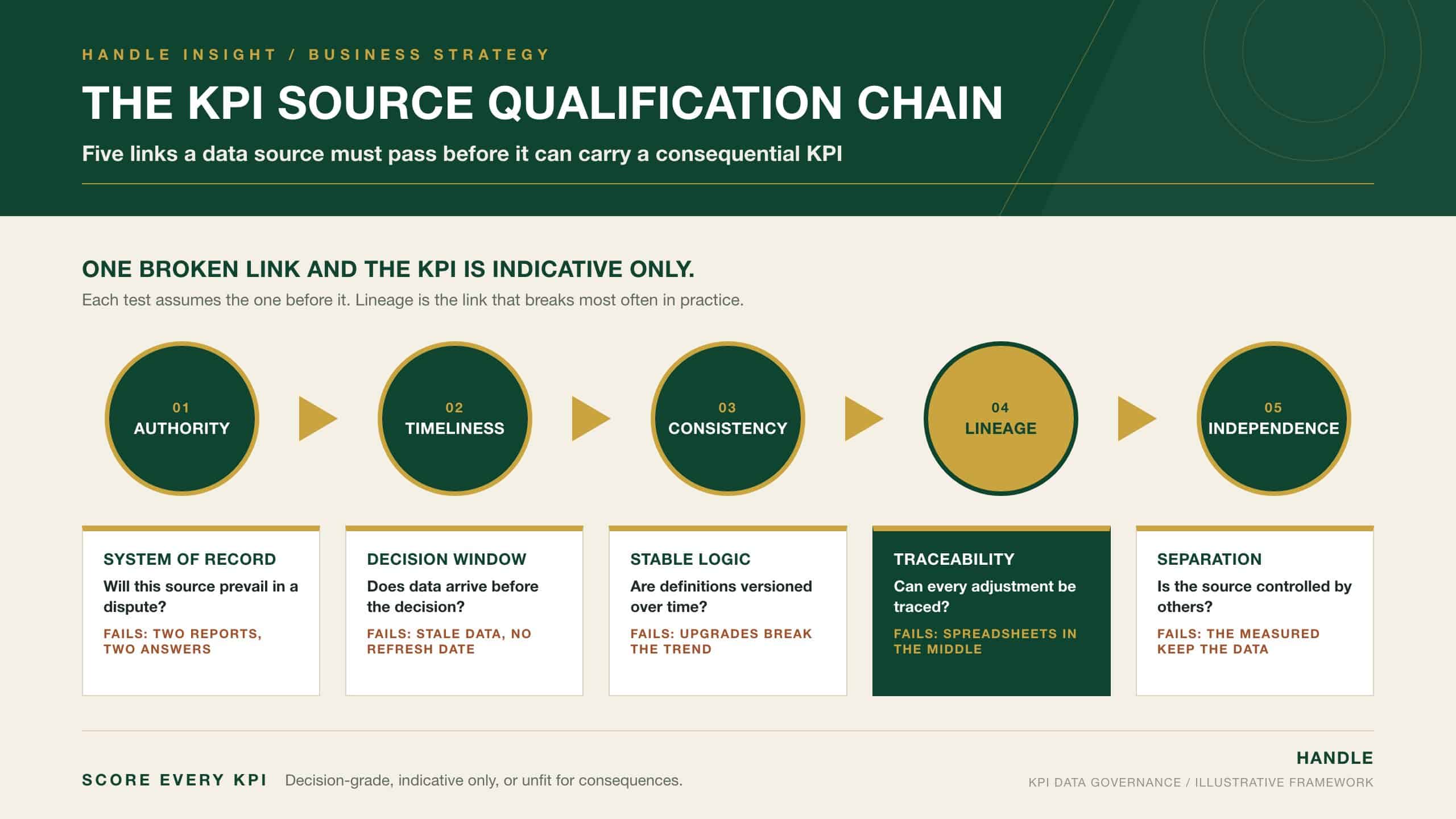
Original Analysis: The KPI Source Qualification Chain
A practical way to decide whether a data source is fit to underwrite a KPI is to pass it through five sequential tests. Each link answers one question, and a source that fails any link cannot carry a consequential metric until the weakness is remediated.
- Authority. Is this the designated system of record for the activity, and will it prevail in a dispute?
- Timeliness. Does the data arrive within the decision window, and is its latency disclosed?
- Consistency. Are definitions and logic stable across periods, with versioned changes?
- Lineage. Can every input, transformation and adjustment be traced and reviewed?
- Independence. Is the source controlled by someone other than the people measured by it?
The chain is sequential because each test assumes the one before it. Lineage is meaningless for a source that is not authoritative, and independence cannot protect data that arrives too late to matter. Lineage is the link that most often breaks in practice, because spreadsheets and undocumented transformations sit between the source system and the dashboard. Scoring each KPI against the five links gives the board a clear view of which metrics are decision-grade, which are indicative only and which should not be used for consequences at all.
Common Data Source Failures
- Spreadsheet dependency persists because spreadsheets are flexible, but flexibility without version control or access control makes them unfit for any KPI that carries consequences.
- Multiple systems report the same KPI with different results, and the organisation spends its review meetings reconciling numbers instead of acting on them.
- System upgrades or migrations change calculation logic without governance approval, breaking trend lines and making apparent improvement impossible to verify.
- Dashboards omit refresh dates, so leaders act on stale data in the belief that it is current.
- The function measured by a KPI also maintains its source, which allows favourable timing, classification or adjustment to go unchallenged.
- Ownership is assigned to a technical team with no authority to resolve definitional disputes, so disagreements escalate without resolution.
Each of these failures is structural. None is solved by better visualisation.
Conclusion
Data sources for KPI measurement determine whether a performance framework commands decisions or provokes debate. The right approach is consistent across sectors: designate one authoritative system of record for each metric, match latency to the decision the KPI supports, keep definitions stable and versioned, preserve full lineage from capture to dashboard, and separate the people measured from the people who control the data. Ownership must sit with senior executives who have authority to resolve disputes, supported by stewards who enforce definitions rather than rewrite them. Manual adjustments must be visible, approved and logged. Spreadsheets have no place under consequential metrics. When every KPI passes the five links of authority, timeliness, consistency, lineage and independence, the board stops questioning the numbers and starts acting on them. Measurement then becomes control. The data is settled. The decision follows.


