

Measurement without authority creates reporting theatre. Authority without measurement creates unchecked discretion. Most organisations have more KPIs than they can use and fewer owners than they need, which is why performance is discussed every month and corrected rarely. Within KPI & Strategic Performance Tracking, KPI governance and accountability models bind each measure to a person with the power to act on it, define the thresholds that oblige them to act, and set the route by which a persistent problem moves to someone more senior. The model chosen must match how decisions are actually made in the organisation, not how the organisation chart suggests they are made. A KPI is governed only when a breach changes what someone does next. Ownership is a power, not a label.
What KPI Governance Is Designed to Control
KPI governance is not administrative oversight of a dashboard. It is the set of rules that decides whether a performance signal produces action or explanation. Those rules answer four questions for every measure: who owns it, who controls the data, what level of deviation requires a response, and what happens if the response does not work.
Two outcomes follow when the rules are clear. Authority aligns with responsibility, because the person accountable for a KPI holds the levers that move it. Decision velocity increases, because deviation moves directly to a predefined response rather than to a meeting about who should respond. When the rules are unclear, the reverse happens. Responsibility is assigned without power, debate replaces action, and the same red indicators reappear month after month.
The Four Components of a KPI Governance Model
Effective models are built from a small number of components. Each is simple. Their absence is what causes most governance failures.
Single ownership. Each KPI has one accountable owner, placed at the level where corrective action can be taken. Where several functions influence a result, ownership sits with the role that controls the primary lever. Shared ownership is avoided because it allows each party to wait for the other.
Separate data authority. The owner of a KPI should not also control the data that measures it. Data authority is assigned to an independent function, usually finance or a performance office, so disputes about the numbers are settled by mandate rather than negotiation.
Thresholds and triggers. Each KPI operates within defined bands. Green requires no intervention. Amber requires investigation and a documented cause. Red requires corrective action or escalation. Discretion is limited by design.
Time-bound escalation. If a KPI stays in breach beyond a defined window, authority moves upward automatically. Escalation is a rule, not a judgement call that the owner can defer.
Which Accountability Model Fits Which KPI?
Organisations use three main accountability structures. The choice depends on how many functions influence the result and where the decision rights sit. Most enterprises use all three, applied to different KPIs.
| Model | How Accountability Works | Best Suited To | Main Risk |
|---|---|---|---|
| Single owner | One executive owns the KPI end to end and holds intervention authority | Financial outcomes, capital discipline, risk limits | Owner lacks levers outside their function |
| Primary owner with contributors | One role owns the outcome; contributors are measured on defined drivers | Cross-functional results such as customer retention or delivery time | Contributors dispute driver targets |
| Committee-owned | A committee owns the KPI under a chair with decision authority | Enterprise-wide measures such as transformation progress or systemic risk | Accountability diffuses without strong chair authority |
The committee model is the most fragile. It works only when the chair can decide, the protocol for disagreement is written down and decisions are minuted with owners and dates. Without those features, a committee-owned KPI is effectively unowned.
Board, Executive and Operational Layers
KPI governance operates across three layers, each with a distinct mandate.
The board governs outcome KPIs that define enterprise success or failure: return on capital, liquidity, leverage and delivery of strategic priorities. The board does not manage the drivers behind those outcomes. It sets tolerances, holds executives to account and enforces consequences.
Executives own the KPIs that translate board intent into execution. They allocate resources across units, intervene where thresholds are breached and redesign the operating model when performance problems are structural rather than temporary.
Operational leaders own driver KPIs: the volumes, cycle times, costs and quality measures that produce the outcomes above them. Their mandate is stability and correction. Persistent failure at this layer escalates by design, and explanation without correction is not accepted as a response.
In UAE organisations these layers need particular care. In many family-owned groups, real authority rests with family principals whose role is not reflected in the formal delegation of authority. Under the Commercial Companies Law (Federal Decree-Law No. 32 of 2021) and the DIFC and ADGM company regimes, directors carry legal responsibility for the company’s management regardless of informal arrangements. Firms regulated by the DFSA or FSRA are also expected to allocate responsibilities clearly among senior management. A KPI governance model that ignores where authority actually sits, or that conflicts with where the law places it, will not hold.
Why RACI Is Not Enough
Many organisations define accountability through RACI charts. These are useful for clarifying who does what, but they describe participation, not power. A person can be marked accountable on a RACI chart without the authority to reallocate budget, change priorities or override another function.
KPI governance requires authority mapping in addition to role mapping. For each KPI, the decision rights are documented: which actions the owner can take independently, which require approval and from whom, and at what point the issue must escalate. Ambiguity is removed before the first breach, not negotiated during it.
How Should Cross-Functional KPIs Be Owned?
Cross-functional KPIs are where most accountability models break. Customer retention depends on sales, service, product and billing. Order-to-cash time depends on sales, operations, logistics and finance. Each function can show that its own part was performed and that the failure sat elsewhere.
The answer is to separate the outcome from the drivers. One role owns the outcome and holds intervention authority over it. Each contributing function owns a defined driver KPI, with its own threshold, that feeds the outcome. When the outcome is red, the owner can see which driver caused it and require that function to act.
Conflicts between contributors are resolved by arbitration rules agreed in advance. The outcome owner decides within a defined scope, for example on priorities or service standards. Decisions outside that scope, such as moving budget or headcount between functions, escalate to a named executive. Writing these rules down before the first conflict removes most of the friction that otherwise surrounds cross-functional performance. It also tells contributors that the outcome owner’s authority is real.
Worked Example: Thresholds and Escalation on a Working Capital KPI
Consider an illustrative distribution business with annual revenue of AED 120 million and a target of 60 days sales outstanding. Each day of DSO represents roughly AED 0.33 million of cash tied up in receivables. The governance model sets the following rules.
| Status | Threshold | Required Response | Who Acts |
|---|---|---|---|
| Green | Up to 65 days | None beyond routine monitoring | Credit control manager |
| Amber | 66 to 74 days | Root cause and recovery plan within five business days | Head of credit, as KPI owner |
| Red | 75 days or more | Corrective action approved; customer credit holds considered | Chief financial officer |
| Persistent red | Red for two consecutive months | Escalation with options and recommendation | Executive committee, with board visibility |
At 75 days, the business has about AED 4.9 million more cash in receivables than at target. The thresholds ensure that this is visible as a decision for the chief financial officer, not as a line in a monthly pack. The persistent-red rule ensures that a structural problem, such as a sales incentive that rewards volume regardless of payment terms, reaches the level that can change it.
Making Review Forums Decide
Governance models fail when KPIs are reviewed without consequence. Review forums should follow a fixed structure: status, variance, cause, action, owner and deadline. Narrative is limited and every action is recorded. Decisions taken against breaches are logged and tracked, which builds institutional memory and prevents the same failure recurring under a new explanation.
Consequence management links KPI outcomes to capital allocation, leadership evaluation and, where appropriate, incentives. Performance without consequence erodes the authority of the whole system.
Preventing Gaming and Silent Breaches
Every measurement system creates behavioural pressure. Governance anticipates it. Those who design KPIs should not unilaterally set the incentives attached to them, so that targets are not shaped to be easy. KPIs should be validated periodically to confirm they still drive the intended outcome, and metrics that have been gamed or have lost relevance should be redesigned. A breach that is known and not reported should be treated as a governance failure in its own right.
A practical safeguard is an annual KPI review led by the function that holds data authority, with a report to the audit or risk committee. The review tests whether each KPI still reflects the strategy, whether thresholds remain meaningful, whether owners still hold the relevant levers after any reorganisation, and whether any measure has been met consistently in ways that did not improve the underlying result. Measures that fail the test are retired or redesigned. A KPI set that is never pruned slowly fills with measures nobody acts on.
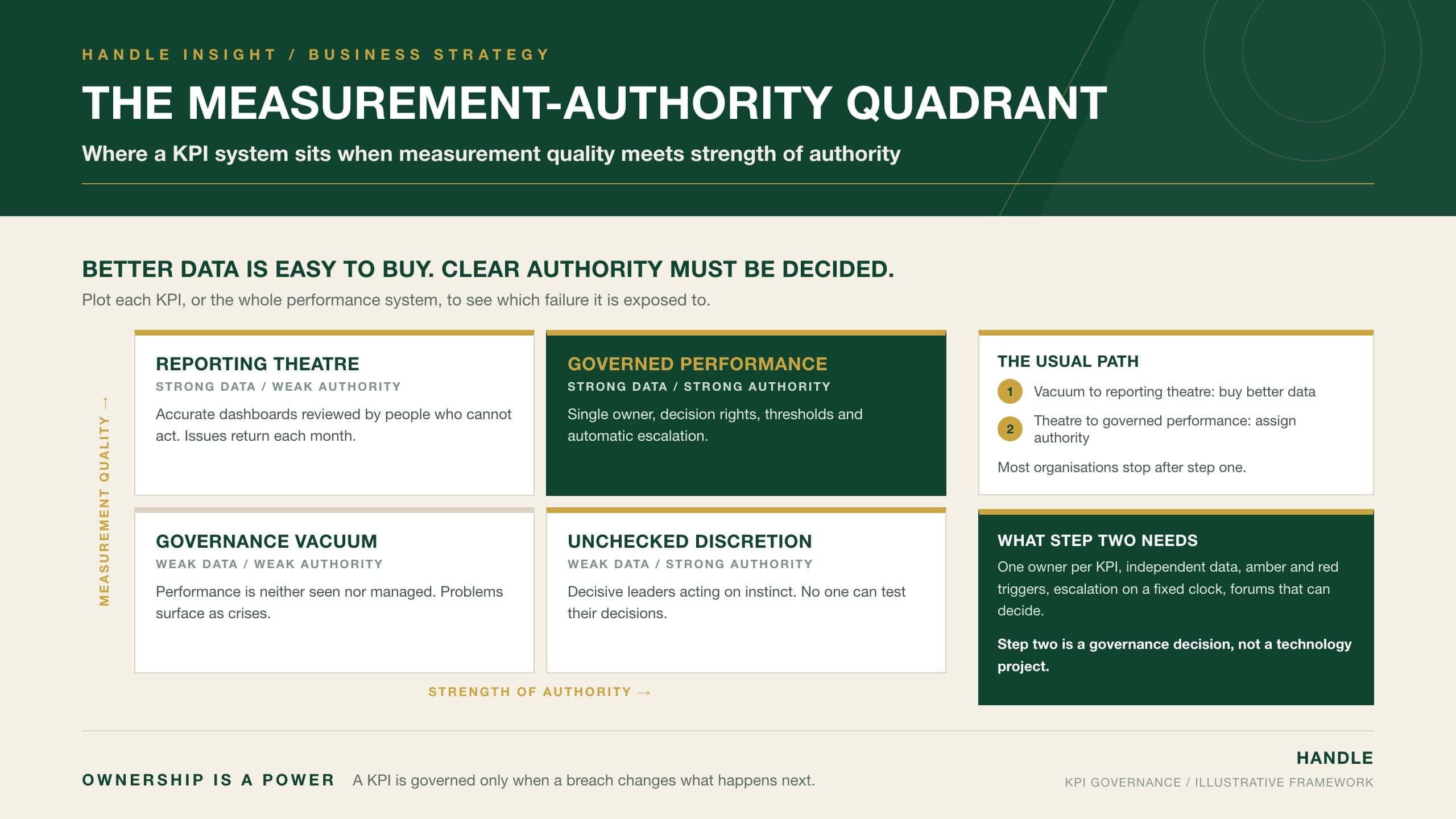
Original Analysis: The Measurement-Authority Quadrant
KPI governance can be assessed on two dimensions: the quality of measurement and the strength of authority attached to it. Plotting a KPI, or a whole performance system, on these two axes shows which kind of failure it is exposed to.
- Governance vacuum (weak measurement, weak authority). Performance is neither seen nor managed. Problems surface through crisis.
- Unchecked discretion (weak measurement, strong authority). Leaders act decisively, but on instinct rather than evidence, and no one can test their decisions.
- Reporting theatre (strong measurement, weak authority). Dashboards are accurate and reviewed, but no one present can act on them. The same issues return each month.
- Governed performance (strong measurement, strong authority). Each KPI has reliable data, a single owner with decision rights, defined thresholds and automatic escalation.
Most organisations that invest in performance tracking move from the vacuum into reporting theatre, because better data is easier to buy than clearer authority. The final move, from reporting to governed performance, is a governance decision, not a technology project.
Common KPI Governance Failures
- Assigning a KPI to a team or committee without a chair who can decide, so accountability diffuses and action is delayed.
- Making escalation discretionary, which allows owners to keep a breached KPI at their level until it becomes a crisis.
- Holding review forums attended by people without decision rights, which produces discussion rather than correction.
- Letting KPI owners control their own data, which turns performance reviews into disputes about the numbers.
- Relying on RACI charts without authority mapping, so the accountable person cannot move the resources required.
- Ignoring informal authority in family or founder-led groups, so the formal model governs everything except the decisions that matter.
Each failure separates measurement from power. Governance exists to join them.
Conclusion
KPI governance and accountability models determine whether measurement produces control or commentary. The components are few: a single owner for each KPI at the level where action is possible, data authority held independently, thresholds that oblige a response, and escalation that moves authority upward on a fixed timetable. The accountability model, whether single owner, primary owner with contributors or committee, must match how decisions are really made, including in family-led UAE groups where formal and informal authority can diverge. Review forums must include people who can decide, and outcomes must carry consequences. Organisations that improve data without clarifying authority reach reporting theatre and stop there. Those that bind measurement to decision rights reach governed performance. Ownership becomes action. Escalation becomes automatic. Performance remains under control.


