Defensive strategy is often mistaken for caution. In practice it is a deliberate allocation of capital, management attention and contractual protection to the positions that generate most of an enterprise’s value, at the moment those positions come under threat. What is defensive strategy in business, then? It is the discipline of deciding what must be protected, what can be conceded and what the organisation can afford to spend defending each. Within Business Strategy, defensive measures safeguard market share, preserve capital, strengthen resilience and keep the organisation stable when competitors, cycles or regulators change the terms of competition. A business that defends everything defends nothing well. Defence is a choice about where to hold the line.
What Is Defensive Strategy in Business?
Defensive strategy is a business approach designed to protect market position, preserve profitability, manage risk and defend enterprise value against competitive, economic, operational or regulatory threats. Its purpose is not growth for its own sake. Its purpose is to make sure that the sources of current value survive long enough, and remain strong enough, to fund future growth.
Every organisation faces continuous pressure. New entrants price aggressively. Technology lowers barriers to entry. Customers consolidate their purchasing. Regulation alters cost structures. Economic cycles tighten liquidity. Defensive strategy gives leadership a structured way to respond, rather than reacting to each threat in isolation.
A credible defensive strategy answers four questions. Which positions generate the value the organisation cannot afford to lose? Which threats are serious enough to justify spending to protect them? Which instruments, from pricing to contracts to cost structure, are best suited to each threat? And what will the defence cost compared with the value it protects?
Why Defence Is Not Retreat
Retreat gives ground without a plan. Defence gives ground deliberately, if at all, and concentrates resources where the organisation’s advantage is strongest. The distinction matters because the same visible action, such as exiting a product line or cutting costs, can be either a sign of decline or a sign of discipline depending on whether it is part of a coherent defensive design.
A business that withdraws from a low-margin segment to fund the defence of its core customer base is defending. A business that cuts investment across every division because profits fell is retreating. The first preserves enterprise value. The second often erodes it.
When Should a Business Prioritise Defence?
Defensive priorities rise when the cost of losing a position exceeds the return available from new expansion. Common triggers include the entry of a well-funded competitor, slowing market growth, margin compression from input costs, technological substitution, regulatory change, concentration of revenue in a few customers and periods of tight credit or geopolitical uncertainty.
None of these triggers automatically requires a defensive posture. The question is how exposed the organisation’s core value is to the threat. A diversified business with strong customer contracts may absorb a new entrant with little response. A business dependent on one large customer may need to act at the first sign of that customer testing alternatives.
The Five Instruments of Defence
Effective defensive strategies combine several instruments. Each protects a different source of value and carries a different cost.
| Instrument | What It Protects | Typical Measures | Main Cost or Risk |
|---|---|---|---|
| Market defence | Customer relationships and share in core segments | Retention programmes, service upgrades, longer contracts, targeted pricing | Margin given away to customers who would have stayed |
| Financial defence | Liquidity and balance sheet resilience | Cash reserves, debt reduction, extended facilities, working capital discipline | Lower returns on idle capital |
| Operational defence | Cost position and continuity of supply | Process efficiency, dual sourcing, inventory buffers, automation | Investment that only pays back if the threat persists |
| Asset defence | Intellectual property, brand, data and key partnerships | Registration and enforcement of IP, confidentiality, exclusivity where lawful | Legal cost and the risk of overreaching |
| Structural defence | Long-term relevance of the business model | Restructuring, disposals, consolidation, selective exits | Execution risk and short-term disruption |
The instruments are not interchangeable. Financial strength does not stop customers leaving. Customer retention does not fix a cost position that a new entrant can undercut permanently. A defensive strategy must match the instrument to the threat.
Defensive Strategy Versus Offensive Strategy
Offensive strategies seek new share, new markets or new capabilities. Defensive strategies seek to keep what already generates value. The two are complements, not opposites, and most well-run organisations operate both at once in different parts of the portfolio.
| Dimension | Defensive Strategy | Offensive Strategy |
|---|---|---|
| Primary objective | Preserve existing value and position | Create new value and position |
| Capital profile | Targeted spending with near-term payback | Investment with longer and less certain payback |
| Risk posture | Reduce exposure to identified threats | Accept exposure to capture opportunity |
| Success measure | Retention, margin stability, liquidity | Growth, share gain, new revenue |
| Typical failure | Defending too broadly and starving innovation | Expanding while the core is exposed |
The most common error is sequencing. Organisations expand offensively while their core is under attack, or defend so heavily that they have nothing left to invest when conditions improve. Strong defence funds offence. Weak defence consumes it.
Defensive Strategy and UAE Competition Law
Defensive measures must remain within the law. In the UAE, Federal Decree-Law No. 36 of 2023 on the Regulation of Competition prohibits restrictive agreements and the abuse of a dominant position. A business with a strong market position cannot defend it by any means it chooses. Pricing designed to drive a competitor out of the market, exclusivity arrangements that foreclose rivals, or refusals to supply without objective justification can attract scrutiny when the defending business holds a dominant position.
The practical lesson is that the stronger a company’s position, the more carefully its defensive tactics should be reviewed. Competing on quality, service, efficiency and innovation is always open. Using market power to exclude competitors is not. Asset defence follows a similar logic: registering trademarks with the Ministry of Economy, protecting confidential information and enforcing contractual rights are legitimate, while using those rights to suppress lawful competition invites challenge.
Worked Example: Targeted Defence Against a New Entrant
Consider an illustrative distributor with annual revenue of AED 200 million, a gross margin of 30% and operating profit of AED 20 million. A new entrant offers prices 10% lower in one segment that represents 40% of revenue, or AED 80 million.
Three responses are available. Matching the entrant’s price across the whole customer book would reduce revenue by AED 20 million at no lower cost, eliminating operating profit entirely. Holding price everywhere might lose a quarter of the contested segment, or AED 20 million of revenue, costing AED 6 million of gross margin and weakening the position for the next round of competition. A targeted defence, matching price only for the contested segment’s most valuable accounts and adding a retention programme, might cost around AED 5 million to 6 million in margin and service investment while preserving the customer base.
On these illustrative numbers, the targeted response and the passive response cost similar amounts in the first year, but only the targeted response protects the position that generates future profit. Blanket price matching is the worst option by a wide margin. The value of defence lies in its precision.
How to Build a Defensive Strategy
A defensive strategy should be built in a defined sequence, so that spending follows analysis rather than anxiety.
Identify the value pools. Break revenue and profit down by customer, product, channel and geography. In most organisations a minority of positions generates the majority of profit. Those positions are the defensive priority.
Map the threats. For each value pool, identify the realistic threats over the next one to three years: competitor entry, substitution, customer consolidation, input cost shocks, regulatory change or loss of a key partner. Rate each by likelihood and by the share of profit at risk.
Assess the advantage. Test honestly whether the organisation’s advantage in each position is durable. Contracts, switching costs, cost position, brand, licences and proprietary data all count. Habit and history do not.
Choose the instruments. Match each serious threat with the instrument that addresses it directly, and estimate the cost of the defence against the profit it protects.
Set triggers and owners. Agree the indicators that will escalate or relax the defensive posture, such as churn rates in key accounts, competitor pricing moves or liquidity headroom, and assign a named executive to each.
This sequence turns defence into a portfolio decision. It also produces a written rationale that the board, lenders and auditors can test.
Original Analysis: The Defence Posture Quadrant
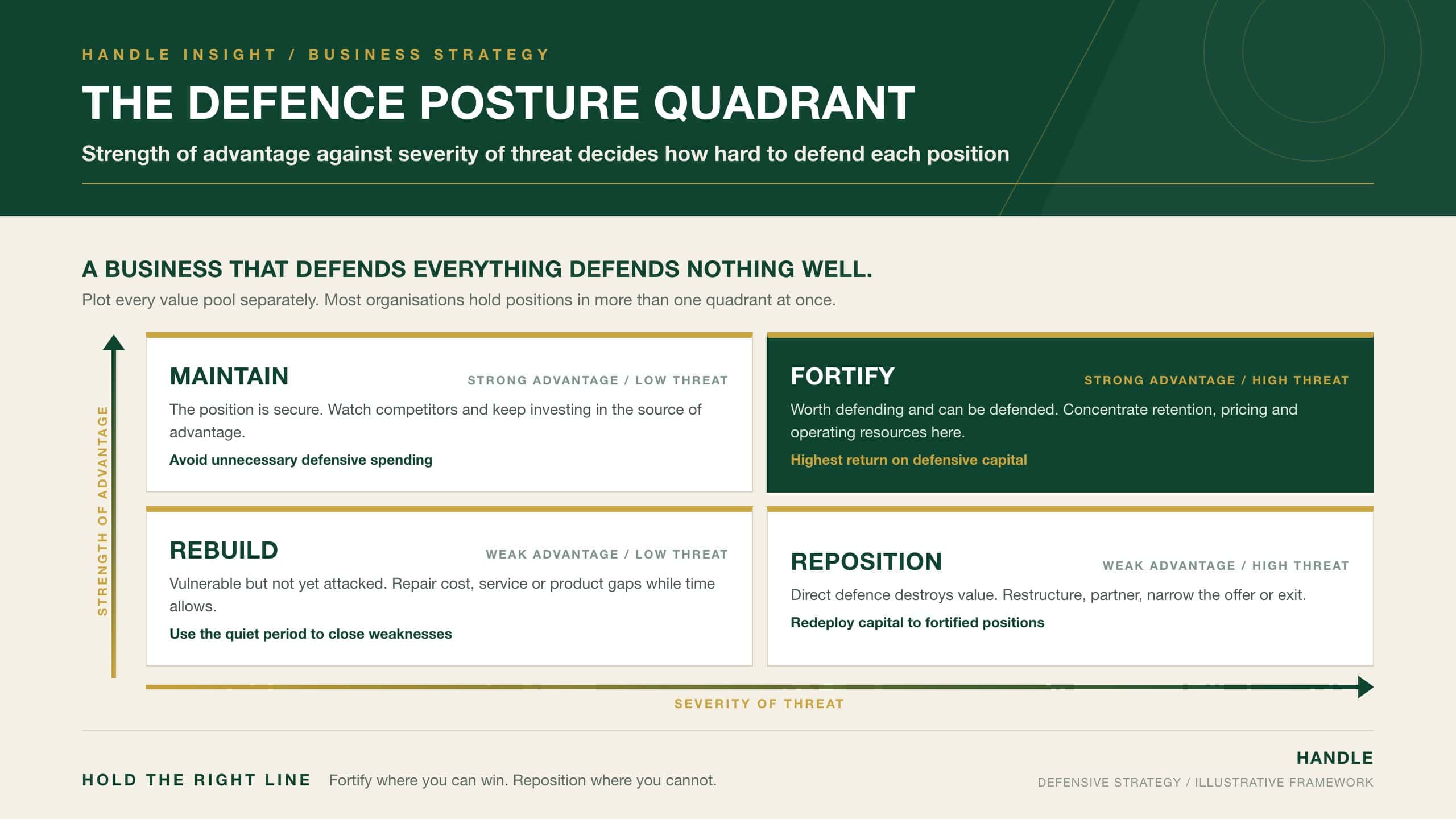
A practical way to decide how hard to defend a position is to plot it on two axes: the strength of the organisation’s advantage in that position, and the severity of the threat it faces. The result is four postures, each calling for a different response.
Maintain (strong advantage, low threat). The position is secure. Monitor competitors, keep investing in the source of advantage and avoid unnecessary spending.
Fortify (strong advantage, high threat). This is where defensive capital earns its highest return. Concentrate retention, pricing and operational resources here, because the position is worth defending and can be defended successfully.
Rebuild (weak advantage, low threat). The position is vulnerable but not yet attacked. Use the time to repair cost, service or product weaknesses before a competitor exploits them.
Reposition (weak advantage, high threat). Defending this position directly is likely to destroy value. Restructure, partner, narrow the offer or exit, and redeploy the capital to fortified positions.
The quadrant forces a portfolio view. Most organisations hold positions in more than one quadrant at once, and the error is applying a single posture to all of them. Fortify where you can win. Reposition where you cannot.
The Role of Leadership and Governance
Defensive strategy fails when it is improvised. The board and executive team should agree which positions are core, what threats are being monitored, what triggers a change in posture and who has authority to commit defensive spending. Regular review of retention, margin, liquidity and competitor activity turns defence from a reaction into a managed process.
Communication matters as well. Employees, customers and lenders read defensive actions as signals. A clear explanation of why the organisation is concentrating resources protects confidence. Silence invites the assumption of retreat.
How Do You Know Defence Is Working?
Defensive success is measured differently from growth. The relevant indicators are retention of the most profitable customers, stability of gross margin in contested segments, liquidity headroom against covenants and planned commitments, and the cost of defence as a share of the profit it protects. A defence that holds share but destroys margin has failed. A defence that preserves margin while losing only low-value customers may have succeeded, even if revenue falls.
These measures should be reviewed against the triggers agreed at the outset. When a threat recedes, defensive spending should be reduced and capital redirected to growth. When a threat intensifies beyond what the position can withstand, the posture should change from fortifying to repositioning. Defence is not permanent. It is reviewed, adjusted and, when the threat passes, released.
Common Defensive Strategy Mistakes
- Defending every position equally, which spreads resources too thinly to protect the positions that matter most.
- Matching competitor prices across the entire customer base when only a segment is contested, giving away margin unnecessarily.
- Cutting innovation and capability investment so deeply that the organisation has no route back to growth when conditions improve.
- Treating a weak position as worth defending because of its history rather than its future economics.
- Using exclusivity or pricing tactics that may breach competition law when the business holds a dominant position.
- Delaying decisions until a threat is fully visible, by which time the cheapest defensive options have expired.
- Failing to explain defensive actions to staff, customers and lenders, who then interpret them as decline.
Each mistake replaces judgement with reflex. Defence works when it is selective, lawful and timely.
Conclusion
Defensive strategy in business is the disciplined protection of the positions that generate enterprise value. It combines market, financial, operational, asset and structural instruments, matched to the threats each position faces and to the strength of the advantage being defended. It is not retreat, and it is not the opposite of growth. Strong defence preserves the cash flow and credibility that fund future expansion. Weak or indiscriminate defence consumes them. In the UAE, as elsewhere, defensive tactics must also respect competition law, particularly where a business holds a strong market position. Success is measured by retained profit, not retained revenue. Leadership that maps its positions, fortifies those it can win, rebuilds those still unattacked and repositions those it cannot hold keeps control when conditions turn. Defence is a decision about value. Precision makes it work.