

In a fraud case, the evidence that proves liability is often held by the person who committed the fraud. Give that person notice of a claim and the laptop is wiped, the messaging account is closed and the paper file disappears. Search and seizure orders, commonly called Anton Piller orders, exist for that moment. They allow a claimant, under strict court supervision and without warning to the respondent, to enter specified premises and preserve evidence before it can be destroyed. They are not investigative shortcuts and they are not a substitute for disclosure. Within Fraud and Asset Tracing, search orders are court-controlled execution tools deployed only when fraud has escalated to a real risk of active concealment, and only where the applicant can meet the highest thresholds the civil courts apply. They secure proof at its point of greatest vulnerability. The order is only as strong as the evidence that justified it.
What Is a Search and Seizure Order?
A search and seizure order is an interim court order requiring a respondent to permit the applicant’s representatives to enter named premises, search for specified categories of evidence, and copy, image or remove that evidence into safe custody. The order takes its common name from the 1975 English Court of Appeal decision in Anton Piller KG v Manufacturing Processes Ltd, and in England and Wales the power is now placed on a statutory footing in the Civil Procedure Act 1997.
The order does not authorise forced entry. It operates by compelling the respondent to consent to the search, backed by the threat of contempt of court if the respondent refuses. That distinction matters. A respondent who refuses entry is not physically overridden; the respondent instead faces serious sanctions, and the court may draw adverse conclusions. The purpose is preservation, not punishment. Evidence is secured so that the merits can later be decided on a complete record.
Why Courts Treat Search Orders as Exceptional
A search order is among the most intrusive remedies available in civil proceedings. It is granted without notice, it is executed at the respondent’s business or home, and the respondent learns of the case at the moment the search begins. Courts therefore apply demanding thresholds and expect complete candour from the applicant.
The classic formulation requires three elements. First, an extremely strong prima facie case, which is a higher standard than the serious issue to be tried required for most interim relief. Second, actual or potential damage to the applicant that is very serious. Third, clear evidence that the respondent holds relevant documents or material, and a real possibility that the respondent will destroy or conceal it if notice is given. On top of these, the order must be proportionate: no broader in scope, premises or duration than is needed to preserve the evidence at risk.
The risk of destruction is usually established through conduct rather than assertion: previous deletion of records, false or inconsistent explanations, concealment of assets, attempts to move data offshore, or control over systems that can be wiped in minutes. A general fear that a fraudster might destroy evidence is not enough. The applicant must show why this respondent, on these facts, is likely to do so.
| Feature | Search Order | Freezing Order | Standard Disclosure |
|---|---|---|---|
| Purpose | Preserve evidence at risk of destruction | Prevent dissipation of assets | Obtain relevant documents in the ordinary course |
| Notice to respondent | None before execution | Usually none at first hearing | Full notice |
| Merits threshold | Extremely strong prima facie case | Good arguable case | Pleaded case |
| Risk threshold | Real possibility of destruction of evidence | Real risk of dissipation of assets | None required |
| Intrusiveness | Very high: entry and search of premises | High: restraint on dealing with assets | Low |
What Should the Order Cover?
A search order is drafted with operational precision because ambiguity undermines execution and invites a later application to discharge it.
Premises and custodians. The order names the addresses to be searched, which may include offices, storage facilities and, in appropriate cases, a residence where business is conducted. It identifies the individuals whose devices and accounts are in scope.
Categories of evidence. Each category of document, device or data must be linked to the pleaded fraud. Fishing is not permitted. An order covering “all business records” will be criticised; one covering invoices, correspondence and payment records relating to identified transactions and counterparties will not.
Method of preservation. Digital material is normally imaged by forensic specialists rather than removed, so that the respondent can continue to operate while a complete copy is held securely. Originals may be removed where the risk justifies it. Chain of custody is documented from the moment of seizure.
Ancillary obligations. Orders commonly require the respondent to disclose the whereabouts of relevant material, provide passwords to devices and accounts within scope, and refrain from informing third parties of the order for a limited period.
Which Safeguards Protect the Respondent?
The intrusive character of the order is balanced by safeguards that the court will expect to see in the draft and in the execution.
- An independent supervising solicitor, experienced in search orders and not connected to the applicant’s legal team, serves the order, explains it in plain terms, oversees the search and reports to the court afterwards.
- The respondent may seek legal advice before the search begins, for a short period set by the order, provided nothing is destroyed or removed in the meantime.
- Privileged material and material that may tend to incriminate the respondent are identified and protected, with disputes resolved by the court.
- The search is limited to the hours, premises and categories stated in the order, and the number of people attending is controlled.
- The respondent may apply to vary or discharge the order at short notice.
These safeguards are not formalities. A search conducted outside the order’s terms can lead to discharge, an award of damages under the applicant’s cross-undertaking and serious damage to the credibility of the applicant’s wider case.
The Applicant’s Obligations and Exposure
Because the application is made without notice, the applicant owes a duty of full and frank disclosure. Everything material, including facts that weaken the application, must be put before the judge. A failure of candour is one of the most frequent grounds on which search orders are discharged.
The applicant also gives a cross-undertaking in damages, promising to compensate the respondent if the order is later found to have been wrongly granted or improperly executed. The court may require that undertaking to be supported by security. The cost of the supervising solicitor and forensic team falls on the applicant at the outset. Before applying, the applicant should therefore quantify its exposure as carefully as the evidence it hopes to obtain.
A Worked Example: Weighing the Application
Consider an illustrative case. A former finance director is suspected of diverting AED 18 million through a supplier he secretly controls. The company holds bank statements showing payments to the supplier, an employee statement that the director instructed staff to delete emails, and forensic evidence that a company laptop was wiped on the day he resigned. The company believes that the supplier’s records and the director’s personal devices hold the remaining proof.
The merits test is likely to be met: documentary evidence of payments, a link between the director and the supplier, and conduct consistent with concealment. The risk test is supported by evidence of past deletion rather than speculation. The applicant must still consider proportionality. A search limited to the supplier’s office and the director’s devices, with forensic imaging and a supervising solicitor, is more defensible than a search of every premises connected to him. Illustratively, if supervision, forensic imaging and legal costs run to AED 400,000, and the cross-undertaking could expose the company to a further claim if the search proves unjustified, the board should approve that budget knowing that the evidence is the only realistic route to recovering AED 18 million.
How Search Orders Work in the UAE
The position in the UAE depends on which court system is engaged. The Dubai International Financial Centre Courts and the Abu Dhabi Global Market Courts apply procedural rules modelled closely on English civil procedure, and both have power to grant interim remedies of this kind, including orders for the preservation of evidence and search orders, on principles drawn from English practice. Applicants before those courts should expect the same high thresholds, the same duty of full and frank disclosure and the same emphasis on supervision and undertakings.
The onshore UAE courts operate under a civil law system and do not grant Anton Piller orders as such. The Civil Procedure Law (Federal Decree-Law No. 42 of 2022) allows applicants to seek precautionary and urgent measures, including precautionary attachment of assets and court-ordered steps to establish or preserve evidence, often through the appointment of a court expert. Where conduct amounts to a crime, a criminal complaint can lead the Public Prosecution to exercise its own powers of search and seizure, but the complainant does not control that process or its timing.
Jurisdiction also matters. The reach of a DIFC or ADGM order over premises and persons outside those centres raises questions of jurisdiction and onshore execution that must be analysed before the application, not during the search. Where evidence sits in several emirates or countries, parallel applications or coordinated relief may be needed to prevent data being moved across a border while one court acts.
Original Analysis: The Search Order Gateway
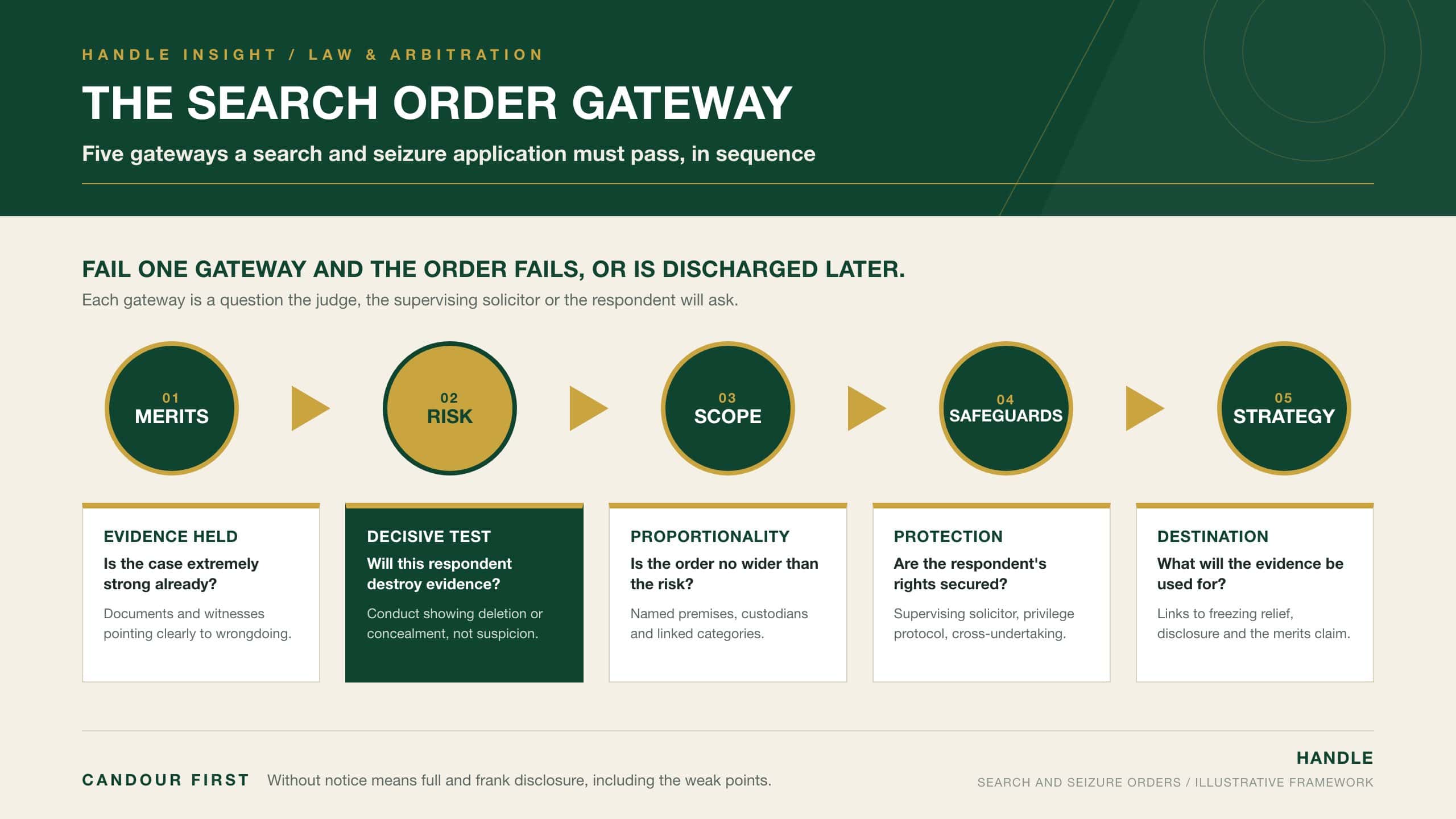
A search order application should pass five gateways in sequence. Each gateway is a question the judge, the supervising solicitor or the respondent will ask. Failure at any one is enough to defeat the application or to have the order discharged later.
| Gateway | Question | What Must Be Shown |
|---|---|---|
| 1. Merits | Is the case extremely strong on the evidence already held? | Documents and witness evidence pointing clearly to wrongdoing |
| 2. Risk | Will the respondent destroy evidence if given notice? | Conduct showing concealment or deletion, not general suspicion |
| 3. Scope | Is the order no wider than the evidence at risk? | Named premises, custodians and categories linked to the claim |
| 4. Safeguards | Are the respondent’s rights protected during execution? | Supervising solicitor, privilege protocol, cross-undertaking |
| 5. Strategy | What will the evidence be used for? | A plan linking the search to freezing, disclosure and the merits claim |
The risk gateway is usually decisive. Most applications that fail do so because the applicant can show that fraud occurred but cannot show that this respondent is likely to destroy evidence. The strategy gateway is the one most often neglected. Evidence obtained without a plan for how it supports freezing relief, third-party disclosure and the pleaded case is expensive evidence with no destination.
Common Failures in Search Order Applications
- Applying on suspicion rather than evidence, so the extremely strong prima facie case threshold is not met.
- Asserting a risk of destruction without identifying specific conduct that makes the risk real.
- Drafting categories of evidence so broadly that the order looks like a fishing expedition.
- Omitting adverse facts from the without-notice application, which exposes the order to discharge for lack of candour.
- Allowing the search team to go beyond the premises, hours or categories in the order.
- Seizing digital material without forensic imaging protocols, which compromises integrity and admissibility.
- Treating the order as an end in itself rather than as the first step in a coordinated recovery strategy.
Each failure turns a powerful remedy into a liability. Discipline in preparation is what makes the order survive scrutiny.
Conclusion
Search and seizure orders exist to preserve evidence at the moment it is most likely to disappear. They are granted without notice, executed at the respondent’s premises and backed by the threat of contempt, which is why courts demand an extremely strong case, proof of a real risk of destruction, a proportionate scope and robust safeguards. The applicant carries the burden of full and frank disclosure and the exposure of a cross-undertaking in damages. In the UAE, the DIFC and ADGM Courts can grant relief of this kind on English-derived principles, while the onshore courts rely on precautionary measures, court experts and, where a crime is alleged, the powers of the Public Prosecution. The right forum depends on where the evidence and the respondent sit. Used with discipline, a search order anchors freezing relief, disclosure and the merits case. Used carelessly, it damages the applicant. Evidence secured lawfully is evidence that holds.


