

An acquisition combines two businesses. It also combines two corporate family trees, and the second combination is rarely planned with the care given to the first. Within a year of closing, the enlarged group typically holds subsidiaries performing the same function, dormant companies left over from earlier deals, holding layers created for financing that no longer exists and licensed entities in jurisdictions where neither business still trades. Each entity carries filings, audits, tax returns, bank mandates, directors and regulatory obligations, and each is a place where risk can hide. A structured Post-Merger Integration framework establishes the control required to rationalise that legal architecture. Legal entity consolidation after M&A is the workstream that decides, entity by entity, what is kept, combined, emptied or closed, and then executes those decisions without breaking contracts, licences, tax positions or employment. Fewer entities are not the goal in themselves. A structure that matches how the business actually operates is.
Why Legal Entity Consolidation Matters After an Acquisition
Every legal entity has a fixed cost of existence: statutory filings, audited accounts, tax registrations and returns, licence renewals, board meetings, bank accounts and the people who maintain them. In a single company those costs are modest. Across a combined group with dozens of entities in several jurisdictions, they become a material and largely invisible drain on management time and cash.
The larger cost is loss of control. When the legal structure no longer matches the operating structure, contracts are signed by the wrong entity, intercompany balances accumulate without settlement, employees are paid by companies they do not work for and liabilities sit in entities that nobody monitors. Lenders, auditors and regulators see that complexity as risk. Future buyers price it in. Legal entity consolidation restores the link between the legal map and the business it is supposed to represent.
Start With a Complete Entity Map
Consolidation begins with an inventory of every entity inherited through the transaction and every entity the acquirer already held: subsidiaries, holding companies, branches, joint venture vehicles, special purpose vehicles and dormant companies. The map records for each entity its jurisdiction and legal form, ownership chain, directors and signatories, function, licences and regulatory permissions, tax registrations and status, material contracts, employees, real estate, intellectual property, bank accounts, debt and guarantees, intercompany balances and any litigation.
The exercise is rarely straightforward. Acquired groups often have incomplete corporate records, and some entities are discovered only when a bank statement or tax notice arrives. The map must be verified against registries and source documents, not assembled from memory or organisation charts. Without it, leadership cannot decide which entities to keep and which to remove, and every later step carries the risk of an unknown liability surfacing after an entity has been closed.
Designing the Target Legal Structure
The target structure is a design decision, not the residue of whatever entities happen to survive. It should reflect four considerations.
Operating model. Legal entities should broadly mirror how the business is managed: by region, by business line or by regulated activity. Where a single operating unit is spread across several entities, consolidation should bring it together.
Regulatory requirements. Some entities must exist because a licence, a regulator or a local ownership rule requires them. These are fixed points around which the rest of the structure is designed.
Capital and cash flow. The structure should allow dividends, intercompany funding and financing to move efficiently. Excessive holding layers delay cash movement and complicate reporting.
Future transactions. A clean structure makes the next acquisition, disposal or financing faster. Businesses that may be sold should sit in entities that can be sold cleanly.
Which Consolidation Method Fits Each Entity?
Once the target structure is agreed, each surplus entity is removed or combined by one of four main methods. The right method depends on what the entity holds and what the law of its jurisdiction allows.
| Method | How It Works | Best Suited To | Main Constraints |
|---|---|---|---|
| Statutory merger | Two entities combine by law; the survivor inherits assets, liabilities and contracts | Active entities in the same jurisdiction with similar activities | Creditor protection procedures, regulatory approvals, availability of the procedure |
| Transfer then dissolve | Assets, contracts and staff move to another entity, which is then closed | Entities in different jurisdictions or legal forms | Counterparty consents, employee transfers, tax on transfer |
| Voluntary liquidation | The entity’s affairs are wound up and it is struck off | Dormant or emptied entities | All liabilities settled, tax clearances, creditor notice periods |
| Continuation or redomiciliation | The entity moves its registration to another jurisdiction without dissolving | Holding entities in jurisdictions no longer used | Both jurisdictions must permit it; licences do not move automatically |
Statutory mergers are often the cleanest route because contracts and liabilities pass by operation of law, but not every jurisdiction or legal form offers the procedure, and creditors may have rights to object. Where a merger is unavailable, the transfer-then-dissolve route achieves a similar result at the cost of more consents and documentation.
Contracts, Licences and People
Consolidation is where legal theory meets commercial reality. Contracts held by an entity being removed must be transferred to the surviving entity. In a statutory merger they may pass automatically, subject to the applicable law and the contract’s terms. In any other route, assignment or novation usually requires the counterparty’s consent, and change-of-control or anti-assignment clauses must be reviewed early. A key customer or lender that withholds consent can change the sequence of the whole programme.
Licences and regulatory permissions generally do not transfer. The surviving entity must obtain its own, or the licensed entity must be the survivor. Regulated businesses may also need prior approval for the merger or change of ownership. Employees must move to their new employer with contracts, visas and accrued entitlements properly handled, and with service continuity recognised where it should be.
Tax and Accounting Consequences
Every consolidation step can have tax consequences: gains on asset transfers, loss of tax attributes, transfer taxes, withholding on distributions and changes in tax residence. Reliefs for intra-group reorganisations exist in many jurisdictions, but they come with conditions and, often, clawback if ownership changes within a specified period. Tax analysis must precede the choice of method, because the cheapest legal route can be the most expensive tax route. Intercompany balances should be reconciled and settled, capitalised or formally waived before entities are closed, so that no orphaned receivable or payable survives the process.
A Worked Example: Rationalising a Combined Group
Consider an illustrative acquirer that completes a purchase and finds the combined group holds 38 legal entities across six jurisdictions. Mapping shows 14 active operating companies, 6 holding or financing companies, 5 licensed entities, 9 dormant companies and 4 entities with overlapping functions.
| Category | Entities | Disposition | Entities Remaining |
|---|---|---|---|
| Licensed entities | 5 | Retain | 5 |
| Active operating companies | 14 | Retain 10; merge 4 into peers in the same jurisdictions | 10 |
| Overlapping-function entities | 4 | Transfer activities, then dissolve | 0 |
| Holding and financing companies | 6 | Retain 2; redomicile 1; liquidate 3 | 3 |
| Dormant companies | 9 | Liquidate | 0 |
| Total | 38 | 18 |
If each entity costs, illustratively, AED 80,000 a year in audit, filing, licensing and administration, removing 20 entities saves about AED 1.6 million annually once the programme is complete, against one-off legal, tax and liquidation costs that may exceed that figure in the first year. The financial case is real, but it is not the main one. The main gain is that the group’s 18 remaining entities each have a clear purpose, a known set of obligations and an owner responsible for them.
Legal Entity Consolidation in the UAE
In the UAE, the available routes depend on where each entity is established. Onshore companies are governed by the Commercial Companies Law (Federal Decree-Law No. 32 of 2021), which provides for mergers of companies, including merger by absorption into an existing company, subject to the law’s procedures for approvals, publication and the protection of creditors, as well as the rules of the relevant emirate’s licensing authority. Free zones apply their own regulations, which vary in whether they permit mergers, transfers or continuation. The DIFC and ADGM have their own regimes under DIFC Companies Law No. 5 of 2018 and the ADGM Companies Regulations 2020, including procedures for mergers and for continuation of companies into or out of those jurisdictions.
Closing an onshore or free zone entity typically requires liquidation and deregistration with the licensing authority, cancellation of visas and labour registrations, closure of bank accounts and deregistration for VAT and Corporate Tax. Under the UAE Corporate Tax regime (Federal Decree-Law No. 47 of 2022), qualifying group relief and business restructuring relief can allow transfers within a group or of a business without an immediate taxable gain, subject to conditions and clawback rules. Particular care is needed with a Qualifying Free Zone Person, because moving its activities into a mainland entity, or merging it, may forfeit the 0% rate on qualifying income. Purely internal consolidation among entities already under common control does not normally create a new change of control for merger control purposes under the Competition Law (Federal Decree-Law No. 36 of 2023), although the acquisition itself may have required review.
Original Analysis: The Entity Disposition Triage
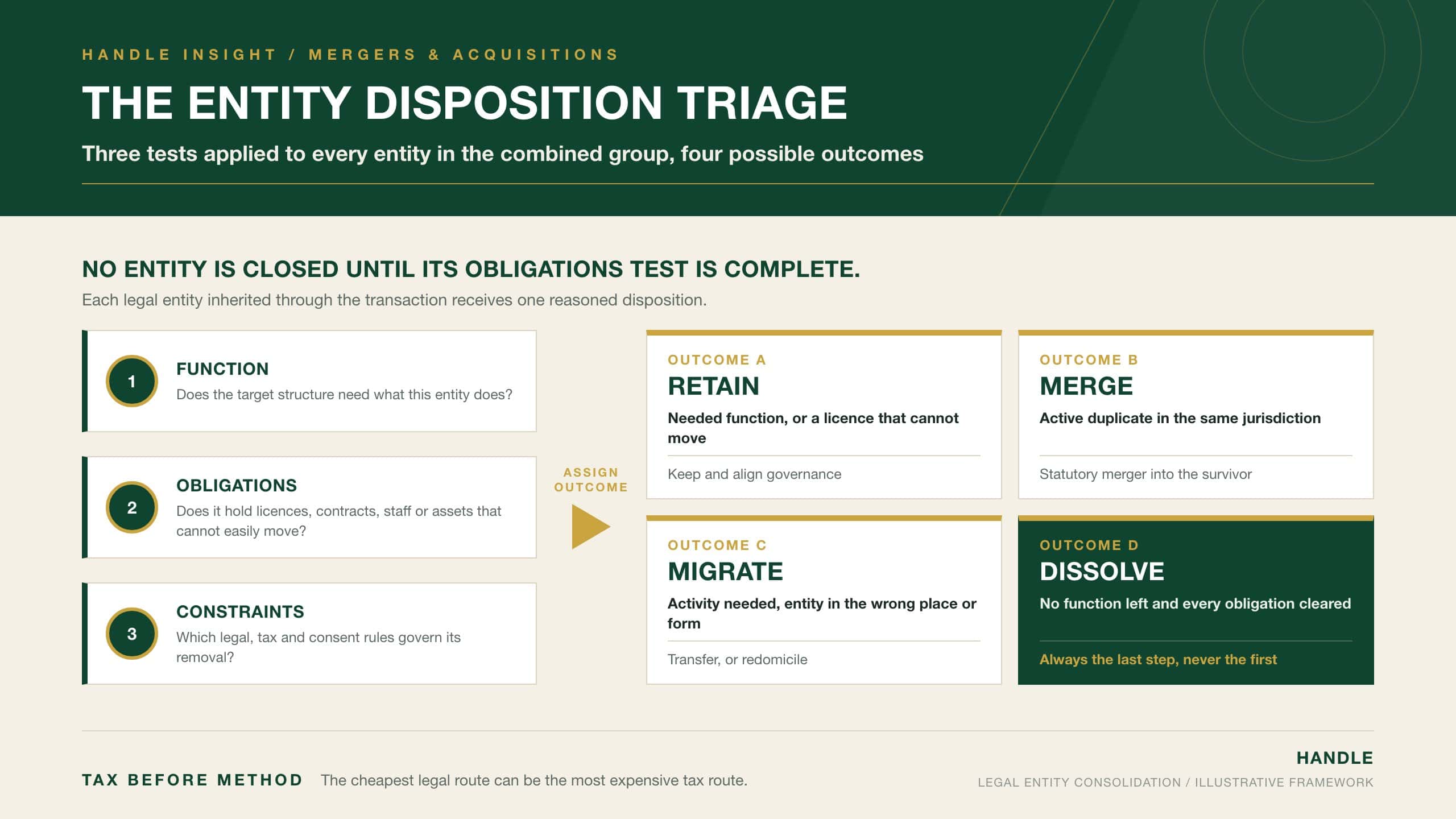
Every entity in the combined group should pass through the same triage. Three tests are applied in order: does the entity perform a function the target structure needs; does it hold obligations, licences or assets that cannot easily move; and what legal, tax and contractual constraints govern its removal. The answers point to one of four dispositions.
| Disposition | When It Applies | Typical Route |
|---|---|---|
| Retain | The entity performs a needed function or holds a licence that cannot move | Keep and align governance with the group |
| Merge | An active entity duplicates another in the same jurisdiction | Statutory merger into the surviving entity |
| Migrate | The activity is needed but the entity is in the wrong place or form | Transfer assets, contracts and staff, or redomicile |
| Dissolve | The entity has no remaining function and its obligations can be cleared | Voluntary liquidation and deregistration |
The triage imposes a discipline that most programmes lack: no entity is dissolved until its obligations test is complete, and no entity is retained merely because closing it is inconvenient. Dissolution is always the last step, never the first.
Common Failures in Legal Entity Consolidation
- Starting from an incomplete entity map, so that unknown liabilities surface after an entity has been closed.
- Choosing the legal method before the tax analysis, and triggering gains or forfeiting reliefs that a different route would have preserved.
- Assuming contracts and licences move automatically, and discovering consent or approval requirements mid-programme.
- Closing entities with unsettled intercompany balances, leaving accounting and tax mismatches behind.
- Moving employees without addressing visas, end-of-service entitlements and continuity of service.
- Merging a Qualifying Free Zone Person into a mainland entity without assessing the loss of its tax status.
- Treating consolidation as an administrative clean-up rather than a governed programme with board oversight.
Each failure turns simplification into new exposure. Sequence and evidence prevent it.
Conclusion
Legal entity consolidation after M&A turns the corporate family tree inherited from a transaction into a structure that reflects how the combined business actually operates. It begins with a verified map of every entity, continues with a deliberate target structure shaped by operations, regulation, capital flows and future transactions, and is executed through statutory mergers, transfers followed by dissolution, voluntary liquidation or continuation. Contracts, licences, employees, tax reliefs and intercompany balances must be addressed before any entity is closed. In the UAE, onshore, free zone, DIFC and ADGM entities each follow their own procedures, and Corporate Tax reliefs, Qualifying Free Zone Person status and deregistration obligations shape the sequence. The Entity Disposition Triage gives every entity a reasoned outcome: retain, merge, migrate or dissolve. Fewer entities follow from good design. Control follows from knowing why each one exists.


