

In many strategic alliances, the most valuable asset on the table is not capital. It is the technology, data, brand or know-how that one or both partners bring, and the new intellectual property the alliance creates. Within the framework of Strategic Partnerships & Joint Ventures, IP ownership provisions decide who controls that value during the alliance and, just as importantly, after it ends. Partners usually agree quickly that each keeps what it brought. The difficult questions concern what is built together, who may improve it, where each partner may sell it, who sues an infringer and what each side can still use when the relationship is unwound. Those questions are cheap to answer at signing and expensive to litigate later. In an alliance, IP ownership is not a schedule to the agreement. It is the agreement.
Why IP Ownership Decides the Value of a Strategic Alliance
Alliances typically combine complementary capabilities. One partner contributes a software platform, patented process or brand. The other contributes capital, market access, regulatory licences or operational scale. The alliance converts the first partner’s IP into revenue using the second partner’s reach.
That structure creates an inherent tension. The technology contributor wants to protect its core assets, retain freedom to use them elsewhere and capture the benefit of any improvements. The commercial partner wants security that the technology it is building a business around will remain available, and a fair share of anything it helps create. If the agreement does not resolve this tension clearly, it will resurface whenever the alliance succeeds beyond expectations or fails to meet them.
Background IP and Foreground IP
Alliance agreements usually distinguish between two categories.
Background IP is intellectual property owned or controlled by a partner before the alliance begins, or developed independently outside it. The near-universal position is that each partner retains ownership of its background IP and grants the alliance, or the other partner, a licence to use it for the purposes of the alliance. The licence must define scope of use, territory, duration, exclusivity, sub-licensing rights and fees or royalties.
Foreground IP is intellectual property created in the course of the alliance. Its ownership is a matter of negotiation, and there are three main models.
| Model | How It Works | Advantages | Risks |
|---|---|---|---|
| Joint ownership | Both partners co-own foreground IP | Perceived fairness; both share in value | Default rules on exploitation, licensing and enforcement differ by jurisdiction and can create deadlock |
| Designated owner | One partner owns foreground IP; the other receives a licence | Clear title; simpler registration, enforcement and sale | The licensee depends on the scope and durability of its licence |
| Joint venture vehicle owns | A jointly owned company holds foreground IP | Value follows the shares; clean exit through share transfer | The vehicle needs licences to background IP and a plan for IP on dissolution |
Joint ownership is often chosen because it feels balanced, but it is frequently the least practical model. In some jurisdictions, a co-owner of a patent may exploit it without the other’s consent but cannot license it without consent; in others, the position differs. Partners who choose joint ownership should not rely on statutory defaults. They should state expressly who may use, license, maintain, enforce and assign the jointly owned rights, and on what financial terms.
Improvements, Derivatives and Grant-Backs
Technology does not stand still. During an alliance, partners will improve each other’s background IP, and the boundary between an improvement to background IP and a new piece of foreground IP is often unclear. The agreement should define improvements precisely and allocate them.
A common approach assigns ownership of improvements to background IP to the owner of that background IP, with a licence back to the improving partner for use within the alliance. This protects the integrity of the core technology. The improving partner’s contribution is recognised through the licence, through a royalty reduction or through a share in revenues. An alternative allows the improving partner to own its improvements but grants the background IP owner a licence, which can be appropriate where the improvement has value outside the core platform.
Commercialisation: Fields, Territories and Competition
Ownership answers who holds title. Commercialisation rights answer who may make money from it, where and in which sectors. Alliances often allocate rights by field of use, such as industrial applications to one partner and healthcare to the other, or by territory, such as the GCC to one partner and the rest of the world to the other.
These allocations must be drafted with care. Field definitions should be specific enough to avoid overlap and broad enough to cover future applications. Territorial exclusivity should be tested against competition law. In the UAE, the Competition Law (Federal Decree-Law No. 36 of 2023) regulates restrictive agreements and economic concentrations, and an alliance between competitors that allocates markets or establishes a jointly controlled vehicle may require analysis under its merger control and restrictive agreement provisions. Equivalent questions arise in every other market where the alliance operates.
Protecting Confidential Technology
Much of the value contributed to an alliance is not registered IP at all. It is know-how, source code, data and processes protected only as confidential information. Confidentiality obligations in the alliance agreement should define confidential information broadly, limit its use to the purposes of the alliance, require security measures appropriate to its sensitivity and survive termination for a defined period or, for trade secrets, indefinitely.
Contractual protection should be reinforced operationally. Access to source code and sensitive data should be limited to named teams, logged and reviewed. Where data includes personal data, the alliance must comply with the applicable data protection regime, which in the UAE may be the federal Personal Data Protection Law, the DIFC Data Protection Law No. 5 of 2020 or the ADGM Data Protection Regulations 2021, depending on where processing takes place.
Registration and Enforcement
Registered rights must be registered in the right name. In the UAE, trademarks, patents and industrial designs are registered with the Ministry of Economy, and assignments and licences of trademarks should be recorded so that they can be relied on against third parties. Where foreground IP is to be owned by a designated partner or a joint venture vehicle, filings should be made in that owner’s name from the outset, and inventors’ and employees’ rights should be secured through clear assignment provisions in their employment or service contracts.
Enforcement provisions should state which partner has the first right to act against an infringer, the deadline after which the other partner may act instead, how costs and recoveries are shared, and who controls settlement. Without these provisions, an infringement can become a dispute between the partners rather than a claim against the infringer.
Where Should Alliance IP Be Held?
Where foreground IP is to be owned by a joint venture vehicle, the choice of vehicle matters. Many alliances with a UAE dimension use a DIFC or ADGM company as the IP-holding entity, because the DIFC Companies Law No. 5 of 2018 and the ADGM Companies Regulations 2020 allow tailored share classes, reserved matters and transfer provisions, and disputes can be referred to English-language common law courts or to arbitration. Holding title in such a vehicle does not remove the need to register rights where protection is required, including with the UAE Ministry of Economy for protection in the UAE. Royalty and licence flows should also be modelled for UAE Corporate Tax under Federal Decree-Law No. 47 of 2022, and priced at arm’s length where the parties are related, so that the commercial split agreed between the partners is not distorted by unplanned tax cost.
A Worked Example: The Platform and the Distributor
Consider an illustrative alliance. Partner A, a technology company, contributes a logistics software platform. Partner B, a regional conglomerate, contributes AED 40 million of development funding and distribution across the GCC. The alliance develops a customs-clearance module on top of the platform over three years.
The agreement provides that A keeps the platform and licenses it to B for the GCC on an exclusive basis for ten years, at a royalty of 6% of net sales. The customs module is foreground IP owned by A, with an exclusive GCC licence to B and a reduced royalty of 3% on module sales, reflecting B’s funding. Improvements to the platform belong to A. On termination for any reason other than B’s breach, B retains a non-exclusive, royalty-bearing licence for five years to continue serving existing customers. If A is acquired by a competitor of B, B may buy a perpetual GCC licence to the module at a price set by independent valuation.
In year four, A receives an acquisition offer. Because ownership, licence terms, continuity rights and the change-of-control mechanism are already defined, both partners can value their positions immediately. The alliance does not collapse into a dispute about who owns the module. It becomes a negotiation about price.
Original Analysis: The IP Allocation Ladder
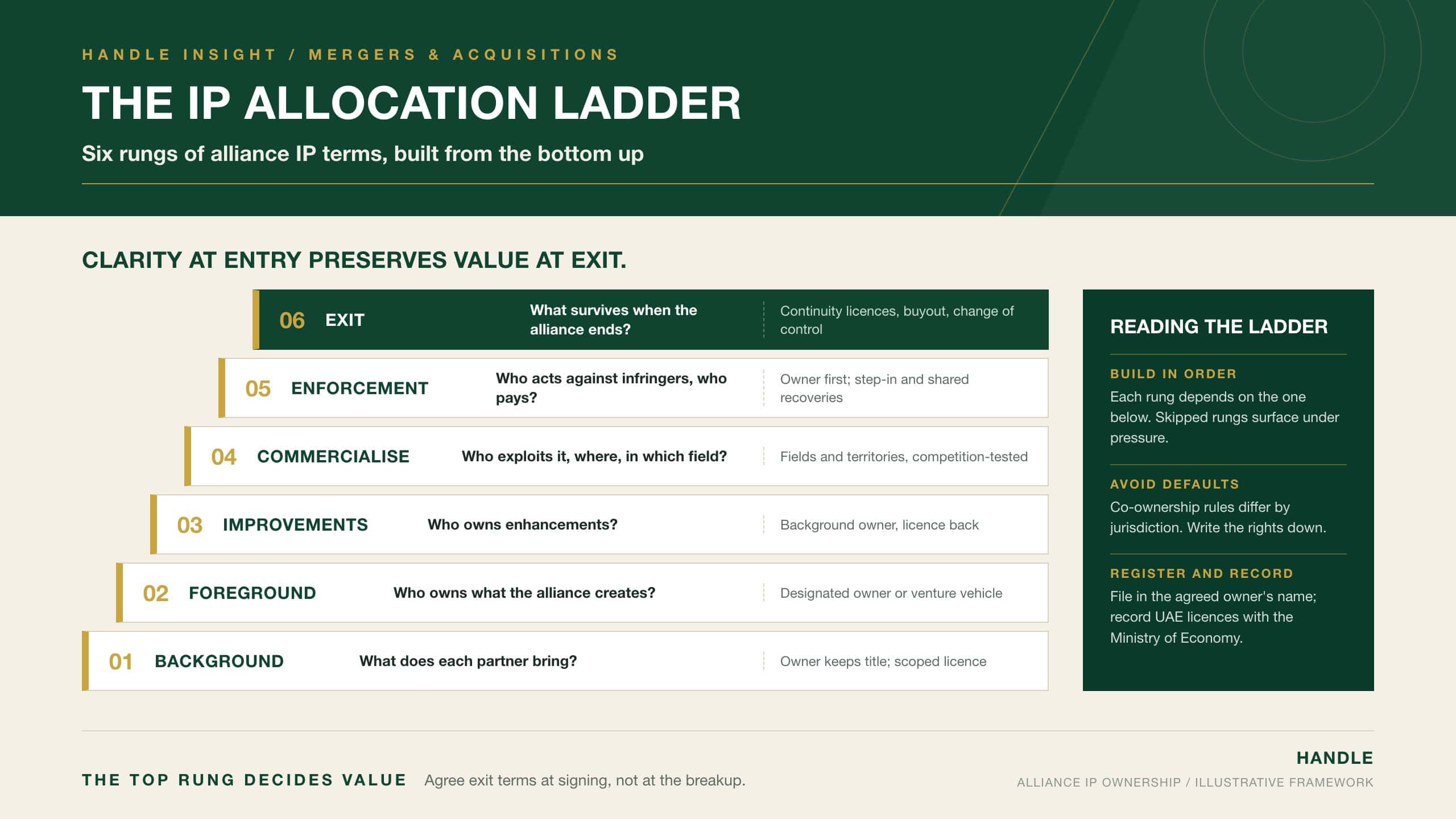
IP provisions in an alliance should be built in a fixed order, because each decision depends on the one below it. The IP Allocation Ladder sets out six rungs. An agreement that skips a rung usually discovers the gap at the moment the alliance is under the most pressure.
| Rung | Question | Default Position to Test |
|---|---|---|
| 1. Background | What does each partner bring, and on what licence? | Owner retains title; scoped licence to the alliance |
| 2. Foreground | Who owns what the alliance creates? | Designated owner or venture vehicle, with licences |
| 3. Improvements | Who owns enhancements to background IP? | Background owner, with licence back to the improver |
| 4. Commercialisation | Who may exploit it, where and in which fields? | Defined fields and territories, tested against competition law |
| 5. Enforcement | Who acts against infringers, and who pays? | Owner acts first; step-in right and shared recoveries |
| 6. Exit | What survives when the alliance ends? | Continuity licences, buyout rights and change-of-control triggers |
The top rung is where value is realised or lost. Exit terms convert every lower rung into a financial position that each partner can rely on, sell or finance against. Agreements that stop at the fourth rung leave the alliance’s most valuable outcome, its end, to be negotiated without leverage.
Common Failures in Alliance IP Structuring
- Agreeing joint ownership of foreground IP without specifying who may license, enforce or assign it, which turns success into deadlock.
- Failing to distinguish improvements to background IP from new foreground IP, so that ownership of the most valuable developments is disputed.
- Granting licences without defining field, territory, exclusivity and sub-licensing rights, which invites overlapping commercial activity.
- Registering foreground IP in the name of whichever partner’s team filed first, rather than the agreed owner.
- Omitting assignment provisions in employee and contractor agreements, leaving title to code and inventions with individuals.
- Ignoring competition law when allocating markets between partners who are actual or potential competitors.
- Leaving exit terms to be agreed later, when the partners’ interests have diverged and neither has an incentive to compromise.
Each failure is a decision deferred. In an alliance, deferred IP decisions are made eventually, usually by a tribunal.
Conclusion
IP ownership in strategic alliances determines who controls the value the partnership creates. Background IP should remain with its owner under a carefully scoped licence. Foreground IP needs a clear owner, whether a designated partner or a joint venture vehicle, with licences that give the other side the certainty it needs. Improvements, commercialisation fields and territories, confidentiality and enforcement each require express allocation rather than reliance on statutory defaults that differ between jurisdictions. In the UAE, registrations and recorded licences with the Ministry of Economy, data protection compliance and competition law analysis complete the picture. Above all, the agreement must say what happens when the alliance ends. Partners who climb every rung of the IP Allocation Ladder at signing can negotiate an exit on price. Partners who do not will negotiate it on ownership. Clarity at entry preserves value at exit.


