

Joint ventures share opportunity, and they share risk with the same precision or the same carelessness. When two institutions combine capital, operations and licences in a single vehicle, every exposure the venture carries must land somewhere: on one partner, on both in proportion, on the venture itself or on a third party such as an insurer. Within Strategic Partnerships & Joint Ventures, JV risk allocation and mitigation is the discipline of deciding where each exposure lands before the venture begins trading, and of building mechanisms that keep it there under stress. The central test is simple. Risk should sit with the partner best placed to control it, and every exposure that cannot be controlled should have a defined route to containment or exit. Unallocated risk does not disappear. It becomes a dispute.
Why Is Risk Allocation the Core of JV Design?
A joint venture is a negotiated division of control between parties whose interests overlap but are not identical. Each partner is exposed to outcomes shaped partly by its own decisions and partly by decisions it does not control. That asymmetry is what makes JV risk distinctive.
In a wholly owned subsidiary, a parent that funds the business also directs it. In a joint venture, one partner may fund operations that another partner runs, rely on a licence that another partner holds, or carry reputational exposure for conduct it cannot see. Risk allocation therefore has two tasks: to match exposure with control wherever possible, and to protect each partner where the match cannot be made.
The four exposures that most often break joint ventures are financial (who funds losses and expansion), operational (who runs the business and answers for performance), legal and regulatory (who holds licences and bears compliance failures) and governance (how decisions are made and what happens when the partners disagree). Market and reputational risks sit across all four.
Who Should Bear Each Category of JV Risk?
| Risk Category | Who Usually Controls It | Who Should Bear It | Primary Instrument |
|---|---|---|---|
| Capital and funding | Both partners through the board | Both, pro rata to ownership | Capital call mechanics, default and dilution provisions |
| Operational execution | The operating partner | The operating partner for failures within its control | Management agreement, KPIs, removal rights |
| Licensing and compliance | The partner holding or managing licences | That partner, for its own breaches | Compliance covenants, indemnities |
| Contributed assets and IP | The contributing partner | The contributing partner, for title and defects | Warranties on contribution, IP licences |
| Governance deadlock | Neither partner alone | Both, through a pre-agreed resolution route | Reserved matters, escalation, buy-sell rights |
| Market and commercial | No one | The venture, with defined review points | Business plan reviews, funding caps, exit triggers |
The matrix exposes the most common drafting error: allocating risk by ownership percentage alone. Ownership determines how profits and general losses are shared. It does not answer who should pay when the operating partner’s own failure causes a regulatory fine, or when a contributed asset turns out to be defective. Those exposures should follow fault and control, not equity.
Financial Risk: Funding, Default and Dilution
Most JV agreements fix initial contributions and then provide for further capital calls, usually pro rata to ownership. The weak point is not the obligation to fund. It is the consequence of failing to fund.
A credible structure defines a funding cap or a business plan threshold above which calls require unanimous approval, a clear notice and payment period, and a remedy for default. Remedies typically include dilution of the defaulting partner, conversion of the non-defaulting partner’s extra funding into a shareholder loan with priority repayment, suspension of the defaulter’s voting and board rights, or a call option over the defaulter’s shares at a discount. Each remedy must work under the law of the place where the JV company is incorporated. Dilution, for example, requires a share issue that may need shareholder resolutions and registry steps, and the defaulting partner may be in a position to obstruct those steps unless the agreement and constitutional documents anticipate it.
A Worked Example: The Missed Capital Call
The following example is illustrative. Two partners form a JV company with AED 100 million of share capital, held 60 percent by Partner A and 40 percent by Partner B. The business plan requires a further AED 50 million in year two. A pays its AED 30 million share. B, facing its own liquidity pressure, cannot pay its AED 20 million.
Under a pure dilution clause at par, A funds the AED 20 million shortfall by subscribing for new shares. A then holds AED 110 million of AED 150 million, or 73.3 percent, and B falls to 26.7 percent. If the reserved matters list protects any shareholder holding 25 percent or more, B retains its veto despite failing to fund. If the threshold is 30 percent, B loses it.
Under a penal dilution clause that issues the shortfall shares at half of par, A receives shares with a par value of AED 40 million for its AED 20 million. A then holds AED 130 million of AED 170 million, or 76.5 percent, and B holds 23.5 percent. The difference between the two outcomes is not in the funding obligation. It is in the dilution mechanics and the governance thresholds, both of which were fixed at signing. Penal mechanisms should be checked against the governing law, because some courts will scrutinise remedies that operate as penalties rather than genuine pre-estimates of loss.
Operational and Regulatory Risk: Matching Exposure to Control
Operational risk usually belongs to the partner that runs the business. That partner should carry defined responsibility for performance, backed by key performance indicators, reporting obligations and the other partner’s right to replace management or terminate a services agreement after sustained underperformance.
Regulatory risk follows the licence. Where one partner holds the licence or brings regulatory relationships, it should give covenants on maintaining that licence and indemnify the venture and the other partner against losses caused by its own breaches. Indemnities are only as good as the indemnifier’s balance sheet. Parent guarantees, escrow or set-off rights against future distributions convert a promise into recoverable value.
Liability caps and exclusions need care. Partners commonly cap indemnities and exclude indirect loss, but caps that purport to cover fraud or wilful misconduct are unlikely to be upheld in most legal systems, including the UAE. The agreement should state the carve-outs expressly.
Insurance completes the transfer layer. Property, liability, professional indemnity and directors’ and officers’ cover move defined categories of loss outside the partnership altogether. The agreement should specify who procures each policy, the minimum limits, whether both partners are named as insured and how claims proceeds are applied, so that cover is not lost through a gap between the partners’ own programmes.
Governance Risk: Reserved Matters and Deadlock
Reserved matters protect each partner from unilateral decisions that would change its risk profile: new debt above a threshold, major acquisitions, changes to the business plan, related-party transactions and the issue of new shares. They also create the conditions for deadlock, particularly in 50:50 ventures.
A workable deadlock regime has three stages. Escalation moves the issue from the board to senior executives of each partner within a fixed period. Mediation or expert determination addresses technical disagreements. Only then do terminal mechanisms such as buy-sell, Russian roulette or shoot-out clauses apply. Terminal mechanisms are powerful but should be reserved for persistent deadlock on fundamental matters, because they can force a sale at the worst possible moment for the weaker-funded partner.
The UAE Dimension
The choice of JV vehicle shapes every mechanism above. An onshore limited liability company is governed by the Commercial Companies Law (Federal Decree-Law No. 32 of 2021), with share transfers and capital changes recorded through the relevant licensing authority. Following the reforms that opened most onshore activities to full foreign ownership, partnering with a UAE national is no longer a legal requirement for many activities, although some activities of strategic impact remain subject to specific conditions. A JV company in the DIFC (DIFC Companies Law No. 5 of 2018) or the ADGM (ADGM Companies Regulations 2020) offers articles and share mechanics closer to common law practice, which many partners prefer for dilution, transfer and deadlock provisions.
The formation of a joint venture may also constitute an economic concentration under the UAE Competition Law (Federal Decree-Law No. 36 of 2023) where the applicable thresholds are met, and may then require clearance before completion. Sector regulators, including the Central Bank, the DFSA and the FSRA for financial activities, may need to approve the partners as controllers. The venture itself is subject to UAE Corporate Tax (Federal Decree-Law No. 47 of 2022) at 9 percent on taxable income above AED 375,000 unless an exemption or the Qualifying Free Zone Person regime applies. Disputes between partners are commonly referred to arbitration, onshore under the Federal Arbitration Law No. 6 of 2018 or seated in the DIFC or the ADGM, so that awards benefit from enforcement under the New York Convention.
Original Analysis: The Risk Containment Cascade
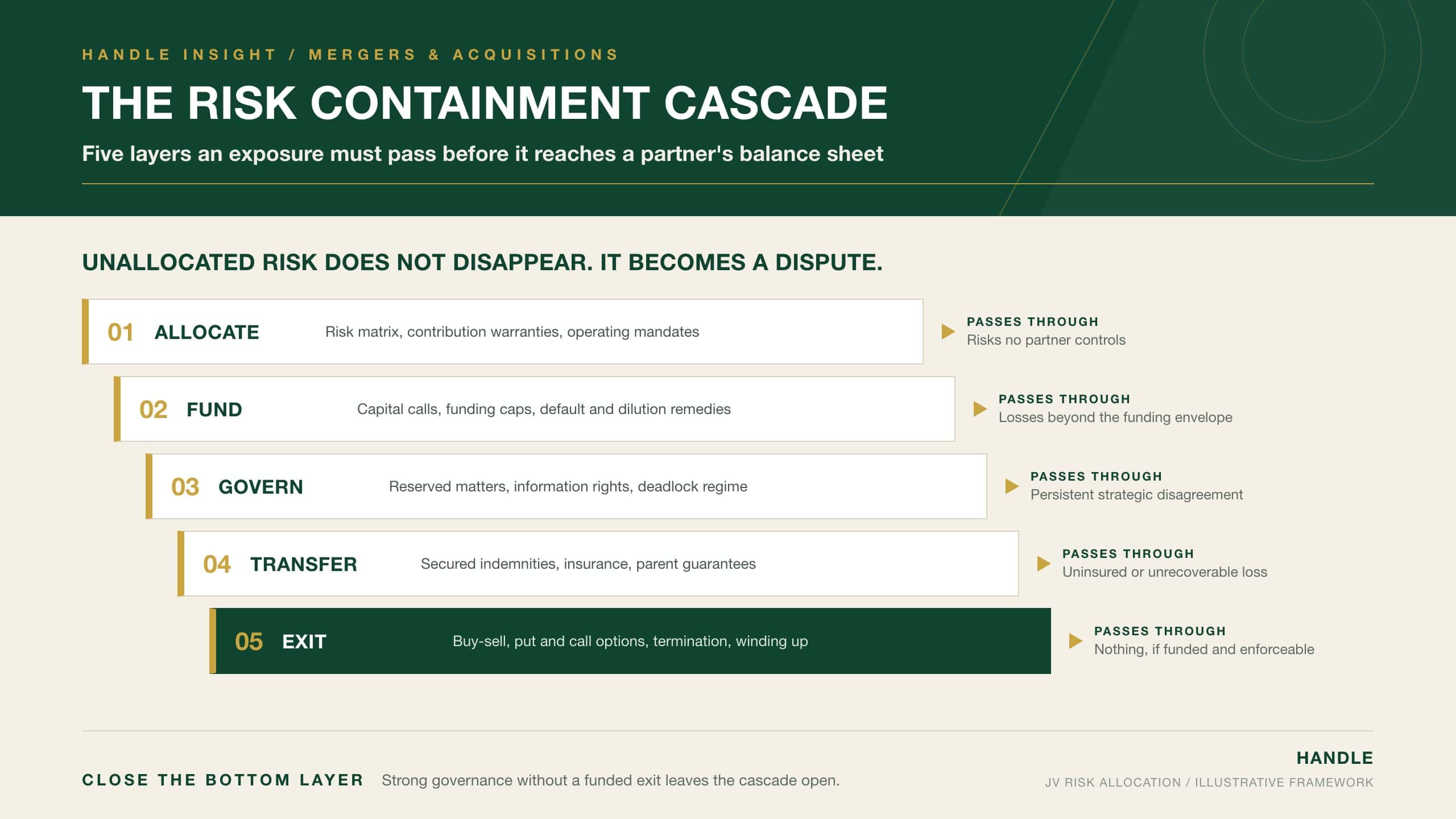
No single clause controls JV risk. Protection works in layers, each catching what the layer above allows through. We describe this as the Risk Containment Cascade: five layers that an exposure must pass through before it reaches a partner’s balance sheet.
| Layer | Function | Key Instruments | What Passes Through |
|---|---|---|---|
| 1. Allocate | Assign each risk to the party that controls it | Risk matrix, contribution warranties, operating mandates | Risks no partner controls |
| 2. Fund | Ensure losses and growth are financed on agreed terms | Capital calls, funding caps, default remedies | Losses beyond the agreed funding envelope |
| 3. Govern | Prevent unilateral changes to the risk profile | Reserved matters, information rights, deadlock regime | Persistent strategic disagreement |
| 4. Transfer | Move residual loss to third parties or the party at fault | Indemnities with security, insurance, guarantees | Uninsured, uncapped or unrecoverable loss |
| 5. Exit | Limit exposure when the venture no longer works | Buy-sell, put and call options, termination and winding up | Nothing, if the exit is funded and enforceable |
The cascade changes the review question. Instead of asking whether the agreement contains an indemnity or a deadlock clause, partners should ask what passes through each layer and whether the next layer catches it. A venture with strong governance but no funded exit has a gap at the bottom of the cascade. That gap is where disputes accumulate.
Common JV Risk Allocation Failures
- Risk is allocated by ownership percentage alone, so a partner pays for losses caused by the other partner’s operational or regulatory failure.
- Capital call provisions specify the obligation to fund but not the remedy for default, leaving the funding partner to litigate rather than dilute.
- Indemnities are given by thinly capitalised partner entities without parent guarantees or security, so they cannot be recovered.
- Governance thresholds are set without modelling dilution, so a partner that stops funding keeps its veto.
- Deadlock clauses move directly to a buy-sell mechanism without escalation, forcing a terminal outcome over a resolvable disagreement.
- Merger control and sector approvals for the venture’s formation are overlooked, delaying completion or exposing the partners to penalties.
Each failure is a decision deferred at signing. Each becomes a dispute when the venture is under strain.
Conclusion
JV risk allocation and mitigation determines whether a joint venture remains a controlled platform for growth or becomes a vehicle for dispute. Financial, operational, regulatory and governance exposures must each be assigned deliberately, with risk following control rather than ownership wherever possible. Funding obligations need enforceable default remedies. Indemnities need security behind them. Reserved matters need thresholds that have been tested against dilution, and deadlock regimes need escalation before they reach a terminal buy-sell. In the UAE, the choice between onshore, DIFC and ADGM vehicles, merger control and sector approvals, and the forum for disputes all shape how each mechanism will perform under stress. The Risk Containment Cascade offers a practical review discipline: identify what passes through each layer and confirm that the next layer catches it. Allocate precisely. Fund the exit. Contain the rest.


